



Judge to determine Desai’s competency
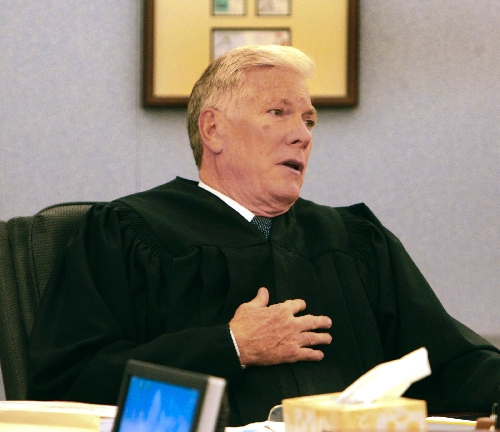


District Judge Donald Mosley on Wednesday ordered the criminal case against Dr. Dipak Desai transferred temporarily to another judge who has authority to determine his competency to stand trial.
After a brief hearing, Mosley said he would ask District Judge Jackie Glass to arrange independent mental and physical evaluations of the physician charged in the 2007 hepatitis C outbreak.
Prosecutors and defense lawyers supported the temporary move, which is procedure in such cases.
Desai is set to stand trial March 14 on several felony charges, including racketeering, insurance fraud and neglect of patients. The cases against Desai's co-defendants, former nurse anesthetists Keith Mathahs and Ronald Lakeman, will proceed separately in Mosley's court.
The charges revolve around the health cases of seven people authorities say were infected with the potentially deadly hepatitis C virus at Desai's Endoscopy Center of Southern Nevada.
If Glass decides that Desai is competent to assist his lawyers, she will transfer his case back to Mosley. A July 29 hearing before Glass was set to determine how to move forward with the evaluation.
Desai's lead criminal attorney, Richard Wright, said in court papers last week that a July 2008 stroke left Desai with a "cognitive impairment" that diminished his ability to assist his lawyers.
Prosecutors, however, have challenged that claim.
Chief Deputy District Attorney Mike Staudaher filed court papers last month accusing Desai, a 60-year-old gastroenterologist, of hiding "behind a curtain of mental and physical impairment so he can avoid facing consequences of his actions."
Staudaher charged that Desai used an earlier stroke he suffered in the fall of 2007 as an excuse to duck the media at a Feb. 27, 2008, news conference on the hepatitis outbreak.
Desai left a partner, Dr. Eladio Carrera, to face reporters alone, saying his cardiologist wouldn't allow him to read the statement, Staudaher wrote.
At Wednesday's hearing, Staudaher told Mosley he worries Desai will "feign some sort medical event closer to trial, and we'll be in the same situation."
Staudaher said the medical evaluations would help determine the legitimacy of any future health issues involving Desai.
The prosecutor asked Mosley to order Desai to show up at all future court hearings so that his physical appearance can be monitored as the case proceeds. Mosley declined, but he suggested that Desai make an appearance in Glass' courtroom next week.
Long before Staudaher questioned Desai's truthfulness about his health, attorney Dan Carvalho accused Desai of being disingenuous about claims his medical condition would allow him to answer questions at a deposition for only an hour.
The Feb. 12, 2008, deposition was part of a malpractice lawsuit Carvalho filed against Desai's Endoscopy Center of Southern Nevada that was unrelated to the hepatitis outbreak.
In March 2008, Carvalho sought to force Desai to complete the deposition after the physician's lawyers cut it short, but the case was settled for
$2 million before a hearing could be held.
Desai acknowledged in the deposition that while the stroke had left him too stressed to answer questions for more than an hour, he was back doing high-pressure surgery at the clinic.
"It is difficult to comprehend that he can perform multiple endoscopic surgical procedures upon patients under anesthesia with the risk of death, perforation and other complications, but cannot answer questions for longer than a self-imposed 60-minute time limit," Carvalho said in court papers.
Contact Jeff German at jgerman@review journal.com or 702-380-8135 or read more courts coverage at lvlegalnews.com.


