



Going above and beyond the call
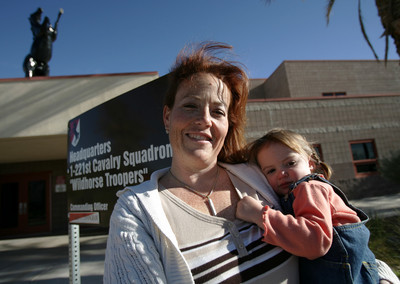
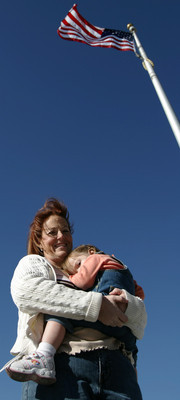


Melissa Schalles did not serve her country in a combat zone. She served it back home, by leading a local contingent of Nevada Army National Guard families who had loved ones in Iraq.
She drew on the experience of her husband, who twice came under attack, to comfort others who had a family member similarly injured or emotionally traumatized.
Melissa, 31, volunteered to head the so-called family readiness group for her husband's unit, the 1st Squadron 221st Cavalry. Staff Sgt. David Schalles came under IED attack twice within 10 days in Iraq in January 2007.
The full unit, about 450 members, deployed to Fort Irwin, Calif., from August 2004 to April 2006, to provide base security when the fort's security force went overseas.
In May 2006, about 100 members of the 221st, including David Schalles, went on to Iraq.
There they filled out a Wisconsin unit tasked with guarding military convoys. The Nevada soldiers returned to Las Vegas in July 2007 to fanfare, including welcome-home messages on electronic Strip hotel signs that Melissa and others had lovingly planned.
Part of Melissa's unpaid job as head of family readiness entailed making phone calls to family members who wanted to discuss the official military news they were receiving about their deployed relative.
When a member of the 221st was injured in Iraq -- fortunately, none was killed -- the military would directly contact immediate family, some of whom would then request to talk to Melissa, too.
But Melissa also would phone every other family in the group to update them about the event.
Swiftly, she learned, any family receiving an update phone call, even from a civilian such as herself, would automatically assume the worst: that their loved one was near death, or dead.
"There's shock, scare. Once you hear the gasp of air on the other end, you say, 'No, it's not your soldier,' " Melissa recalls. "Some of them were mothers crying, and I'm crying along with them."
She describes that part of the job as "being their ear."
Wives, husbands or parents didn't just want to discuss injuries, but also incidents when their loved one had participated in a gunfight or witnessed violence.
She sometimes had to explain to anxious people that, "No, just because he was involved in a gunfight doesn't mean he gets to come home" for a visit.
When needs sprang up on the home front, Melissa also mustered the families.
"Three babies were born during deployment. Two spouses had (unexpected) surgery," she recites.
She also lined up help when families needed to replace a water heater or move. In such cases, the Schalles' horse trailer came in handy. Melissa, who loves horses, is a veterinary technician and teaches animal science at the College of Southern Nevada.
She readily stepped into the role of family-readiness leader for several reasons. One, which she laughingly describes as "sick," is that she wanted to be among the first to know bad news about the unit.
Another reason, she considered herself rich in terms of having local family. She and David are graduates of Cimarron-Memorial High School, and both have parents here.
"I knew I had my family ... and I can 'pawn them out' (to be) a support system" for soldier spouses who didn't have relatives in Las Vegas.
To that end, Melissa's dad, Kim Chesley, played Santa at one holiday function that Melissa helped organize for families.
Halloween, Thanksgiving and Easter parties also took place, "to bring our families together. We're all experiencing the same things, whether it's IED attacks or loneliness," Melissa explains.
With other spouses, she also raised funds to buy personal supplies for the troops in Iraq by holding pancake breakfasts and selling snacks at monthly drills that other local guard units had.
In addition to running the family readiness group, Melissa also served as sole parent, for one year, to the couple's new infant daughter. Gabriella, who had special medical needs at birth, arrived via adoption, just 10 days before David had to ship out for training prior to heading to Iraq.
When the adoption suddenly came through, the couple considered having David opt out of Iraq on the grounds of family hardship. But David, who had entered the Army out of high school before switching to the National Guard, considered it an honor and a career advancement to serve in combat. He now works full-time as a Las Vegas recruiter for the Guard.
"It was tough, but I knew I needed to support him in his decision to go," Melissa explains. "I know I married a soldier. He is a soldier and will always be a soldier."
For her service, the Nevada National Guard awarded Melissa its state Medal of Merit. The honor normally goes to soldiers or airmen, Capt. April Conway of the Nevada National Guard said.
Capt. Gene Dieters, who worked daily with Melissa during the term the 221st Cavalry was overseas, described her as "organized, persistent" and able to communicate easily with families who were less familiar with the military.
The work she did was essential, according to Dieters.
"In a transient type community ... like Vegas, you can kind of feel disconnected from people going through the same struggles," Dieters said.
"She helped bring them together to where they can share that commonality."
Friday: Meet the man who exposed a hotel chain's practice of bypassing building permits and safety inspections.
Editor's Note: Seeking heroes in our own time, the Review-Journal annually asks the public to nominate people who in the past year took serious risks to life, career, financial well-being or other personal interests for the greater good of humanity. This is the fourth of six "Nevada Profiles in Courage" about some who performed such deeds in 2007. Look for others each day through Saturday.


