Hearing examines ways to ease drought in West




A small fraction of the funds for fighting the war in Iraq could be used instead to combat an enemy of a different nature: the forces of drought, wildfires and global warming that are taking a toll on the Great Basin's water supplies and ecosystems.
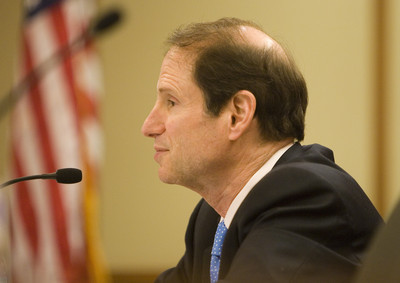
That was the message Thursday from Sen. Harry Reid, D-Nev., near the end of a field hearing in Las Vegas by the Subcommittee on Public Lands and Forests.
"We're spending $2.3 billion of borrowed money every week in Iraq," Reid told subcommittee chairman Sen. Ron Wyden, D-Ore. "If we give one day of our money that is spent in Iraq, we could solve the problems, or at least in the foreseeable future know what we need to do."
He said the agencies tracking problems with invasive plant species that contribute to the wildfire problem and government scientists who are trying to get their arms around global warming need more personnel and financial resources.
Wyden was the only other senator at the hearing at Boyd Law School on the University of Nevada, Las Vegas campus. Besides Reid, the hearing featured two panels of experts on water supplies, wildfires, rangeland and global warming.
Wyden called on Reid, the Senate majority leader, to "lead the charge."
"It really comes down to choices. It comes down to our values. It comes down to what we care about: $300 million a day for the war in Iraq versus, as you have said, addressing critical needs right here in the West," Wyden said.
Reid wrapped up his remarks by taking aim at coal-fired power plants and the petroleum industry to curb greenhouse gas emissions. Earlier he had noted their roles in global warming and extended periods of drought that have affected the snow pack on western slope of the Rocky Mountains, the source of Colorado River water in Lake Mead.
One panel member, Pat Mulroy, general manager of the Southern Nevada Water Authority, painted a grim picture of the situation on the Colorado River.
"Perhaps nowhere are the consequences of climate change more manifest than in the Colorado River Basin where a sustained drought has altered our historical understanding of the river and challenged many underlying assumptions about its long-term management.
"It's forcing communities such as ours to adjust infrastructure plans, improve water efficiency and develop additional unused water supplies to maintain the reliability of our delivery systems," she said. "And all this has happened in just a matter of years."
Mulroy said the effects of the drought "have been daunting." Levels of both lakes Mead and Powell are about 49 percent of capacity, a combined loss of 25 million acre-feet of water.
One acre-foot is almost enough to supply two households per year in the Las Vegas Valley, where 2 million people depend on Lake Mead for water.
She said the water authority acquired seven ranch properties in Spring Valley that have more than 33,000 acre-feet of surface water rights and more than 6,000 acre-feet of groundwater rights.
"Through various efforts we can develop this essential water supply in a way that meets the needs of Southern Nevada but does not compromise the basin of origin's natural resources or way of life," Mulroy said.
U.S. Geological Survey ecologist Jayne Belnap emphasized the need for more data on global warming.
"We simply don't know what the concentration of greenhouse gas will be in the future," she said.
"What can science do? We really need to improve climate models, and we need to protect resources at risk."
Mike Pellant, Bureau of Land Management coordinator for the Great Basin Restoration Initiative, said invasion of non-native weeds and grasses coupled with global warming have increased the threat of wildfires. About 2.7 million acres in the Great Basin burned during this year's fire season.
Land managers, he said, are concerned about a predicted increase in woody vegetation as a result of climate change and a loss of sagebrush that will have a significant effect on wildlife, especially sage grouse that depend on shrubs for food and shelter.