



Gibbons steers leaders toward cuts
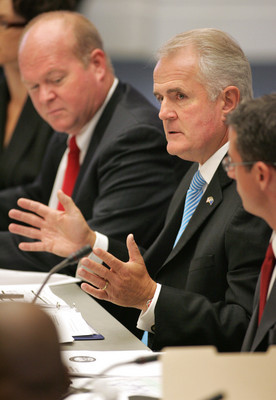


CARSON CITY -- Gov. Jim Gibbons called on legislators and local politicians Wednesday to put politics aside and work together to find ways to cut state government spending by at least $285 million.
Gibbons, who opposes tax increases, emphasized he has not decided where to reduce any of the state's $6.8 billion, two-year budget and won't be making actual reductions before January.
"It is entirely possible agencies may be called on to make further reductions," Gibbons said during a 90-minute discussion with many of the state's top political leaders. "After we receive new revenue projections, the percentage that will be reduced may be higher than 5 percent."
Just three weeks ago, the governor asked selected state agencies to prepare lists of how they would cut their spending by 5 percent, or a combined $184 million. And he ordered a hiring freeze for all but critical state jobs affecting public safety.
The proposal was met with resistance by officials in the university system and Clark County government who said the cuts would be devastating to education and the child welfare system.
Since then the projected shortfall has increased by $100 million, and could get worse, Gibbons said.
State Budget Director Andrew Clinger blamed the decline in tax revenue on a nearly 50 percent drop in home sales and fewer people purchasing furniture, cars and household products.
Even if he cuts state spending by $285 million, Gibbons noted that the current two-year budget still would be more than $700 million, or 13.32 percent higher than the budget for the period that ended June 30.
Assembly Speaker Barbara Buckley, D-Las Vegas, and Henderson Mayor Jim Gibson suggested the governor create a working group of political leaders who would examine available revenue and make suggestions on where cuts should be made.
Buckley added state legislative analysts project a revenue shortfall that's about $50 million less than that forecast by Gibbons' analysts.
She said most cuts could be avoided if Gibbons postponed construction of some building projects, such as the expansion of the Lakes Crossing facility for mentally ill criminal offenders, approved during the legislative session. The budget includes $194 million in building projects.
She also said the state's $267 million rainy-day fund should be part of the solution. Gibbons does not have to call a special session to seek the Legislature's approval to use these funds, according to Buckley.
Buckley said Gov. Kenny Guinn employed this tactic to handle a revenue decline in 2002.
"The rainy-day fund was created for rainy days," she said.
Senate Minority Leader Dina Titus, D-Las Vegas, said Gibbons should not cut state agency spending until he first uses rainy-day funds and delays construction projects.
"The feeling is you use some of the rainy-day fund, you look at the one-shots and then if you have to cut ongoing programs, that's where you should stop, not where you start," Titus said.
But Gibbons would not commit to supporting the creation of a working group that includes legislators and local politicians.
"I want to see how that works," Gibbons said following the meeting. "It may be a wonderful idea. But there is a separation of powers."
A packet of material given to political leaders included legal citations explaining that governors have the power to make budget reductions during emergencies.
Gibbons noted that every governor over the past 30 years has been forced to cut state spending during economic downturns. He pointed out that he was the first to call political leaders together and request their ideas on how to make revenue reductions.
But he added the suggestions from Democratic legislative leaders about using rainy-day funds and delaying construction projects had merit.
"The rainy-day fund is not off the books," he said. "But I don't want to dip in and take the whole thing."
Though they pledged to work with the governor, Las Vegas Mayor Oscar Goodman, Reno Mayor Bob Cashell and Assembly Ways and Means Chairman Morse Arberry, D-Las Vegas, said taxes must be raised to avoid the economic crises that have plagued state government every seven or eight years.
"We have to provide all the wonderful things that great cities and states provide," Goodman said. "I don't know we can accomplish that objective without increasing revenue."
Arberry said, "For once, come up with a solution so we don't have to cut again."
But Gibbons ruled out increasing taxes as a way to solve the state's current financial problems.
"We need to solve our fiscal problems by reducing state spending, not increasing taxes," he said. "A lot of people in Nevada are finding it hard to make ends meet. For many working families, the last thing they can absorb is higher taxes."
Sen. Bob Beers, R-Las Vegas, said it was clear from the discussion that Gibbons will cut spending, rather than calling a special legislative session to consider tax increases.
"The financing of government is a reflection of the economy," Beers said. "And as long as economies have swings, which as long as we have an economy, which is forever and has been forever, you're going to have these swings in funding, which is part of the challenge in governing."
The most novel idea of raising additional revenue was suggested by Chancellor Jim Rogers, a multi-millionaire who owns TV stations throughout the West.
Rogers said he has many friends who earn more than $10 million a year and he is confident they would support tax increases to help state government.
"A lot of us made a lot of money," Rogers said. "We would be more than willing to contribute funds to the state."
After the meeting, Rogers said momentum is building for a corporate income tax.
"The pressure is out there," he said. "I think there is a groundswell out there."
Gibbons last month requested Rogers prepare a list showing how he would cut Higher Education System of Nevada spending by 5 percent, or $64 million. Rogers balked at the request, saying he would not preside over the destruction of the university system.
The new state budget increases university spending by $168 million, but Rogers said all but $3.9 million of those funds have been committed, mostly for wages for staff members.
"It really hurts us," Rogers said of the proposed cuts.
But Clinger pointed out the university system will have 6.55 percent fewer students this year compared with last year and then have another 4.81 percent drop in enrollment next year.
Clark County Commission Chairman Rory Reid may have been the only person who left the discussion with a smile on his face.
Reid expressed disgust that the Gibbons administration asked Clark County to prepare a list on how to cut $3.6 million from child welfare and juvenile justice programs.
He said the county would have to lay off 45 of 85 caseworkers and end its recruitment of foster parents.
Since public education was spared from cuts, Reid said a similar exemption should be given to child welfare programs.
"No decision has been made in that area," Gibbons responded. "My goal is to minimize any impact on services to children."
"I take that as a yes," Reid replied.
Contact Capital Bureau Chief Ed Vogel at evogel@reviewjournal.com or (775) 687-3901. Contact Capital Bureau reporter Sean Whaley at swhaley@reviewjournal.com or (775) 687-3900.
Nevada budget woes 1983: Gov. Richard Bryan orders state agencies to reduce their spending by $64 million, starts monthly collections of gaming revenues. 1992: Gov. Bob Miller orders state agencies to reduce their spending by $173 million. 2001: Gov. Kenny Guinn orders hiring freeze, spending cuts of $59 million. 2002: Guinn orders state agencies to cut spending by $38 million, uses $135 million in rainy day funds to cover other budget shortfalls. 2007: Gov. Jim Gibbons, citing $285 million shortfall, freezes hiring, orders state agencies to prepare for 5 percent budget cuts. SOURCE: Governor's office, Review-Journal archives


