Kucinich touts his plans for change in visit to LV
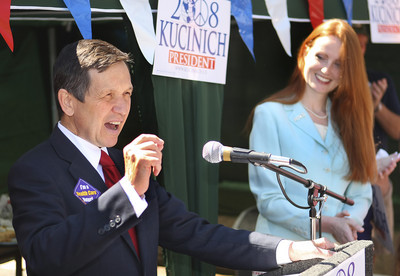


On Monday, while Hillary Clinton was unveiling her second-time-around health care plan to much fanfare in Iowa, Dennis Kucinich was in Las Vegas, not at all impressed.
"Same old same old," said Kucinich, a congressman from Ohio making his second long-shot run at the presidency, as he waved dismissively during an interview after a campaign appearance at his new local headquarters. "Look, with all due respect to Senator Clinton, she's talking about continuing the present system."
The plan from the U.S. senator from New York, he said, was not substantially different from those of her top rivals: combining public and private resources and helping people buy health insurance from for-profit business concerns.
"Who wins with that? The insurance companies," Kucinich said. "I don't know if it has any connection to the fact that she (Clinton) is the No. 2 recipient in the entire Congress of money from health insurance companies. But I imagine if they didn't like it, they wouldn't give her money."
Kucinich is the only candidate promoting what he calls a "not-for-profit," or wholly government run, health care system -- what is unkindly referred to as "socialized medicine." He has introduced a bill in the House of Representatives to enact such a system.
Under his plan, he told a crowd of about 50 people sweating in the noonday sun, there would be no health insurance because nobody would need it. The government would take care of anyone who needed medical treatment, including visual and dental care.
"No more premiums, no more co-pays, no more deductibles," he promised, to cheers. "Health care is a right in America. It is our basic right."
In the interview, Kucinich said health care is one of many issues on which the Democratic candidates and Democratic Congress have been too timid. Others include funding the Iraq war, which Kucinich voted against, and impeaching President Bush and Vice President Cheney.
There is public support for these ideas, said Kucinich, who proposes creating a Cabinet-level Department of Peace that would teach children nonviolence from an early age.
"I'm the candidate of the mainstream," he said. "My policies are mainstream."
Kucinich said he is also the strongest and most consistent candidate opposed to storing nuclear waste at Nevada's Yucca Mountain. He claimed to "probably have more knowledge of this issue than not only anyone running for president, but anyone in the United States Congress, including your representatives here."
In 1995, as an Ohio state senator, his was the loudest voice in stopping a nuclear waste dump from being built in that state. "I said, 'I'm not for a Chernobyl on wheels. We have to stop producing nuclear waste, and don't make any particular state pay the price,'" he recalled.
Because of that experience, Kucinich said, he stood up for Nevada before he was a candidate and it was politically convenient to do so; his record in Congress bears out that claim.
Nevada, Kucinich said, is giving him a good reception -- the well-appointed office on Rancho Drive is an in-kind donation from a landlord who supports the campaign -- and could be the state that propels him to the Democratic nomination despite what he acknowledges are long odds.
If he does better than expected in an early state such as Nevada, Kucinich said, he could pick up the momentum he needs. "I don't have to win a state, but I do have to show an ability to get votes."