



BEHIND THESCREEN
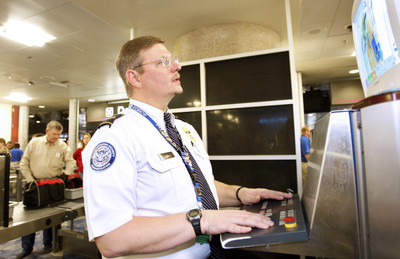
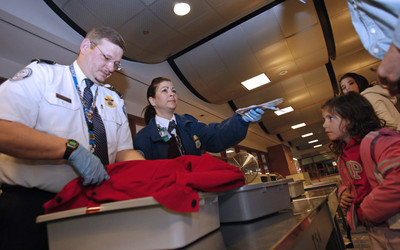
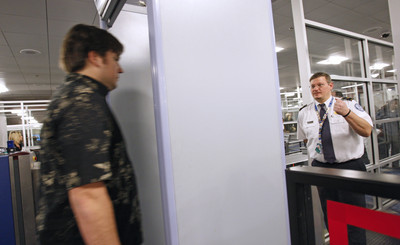
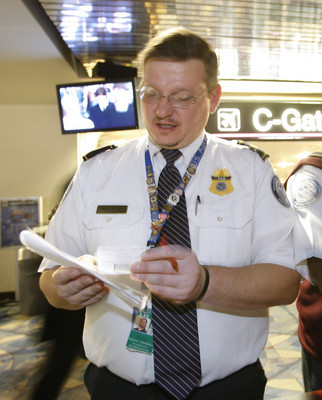


Mike Zimmerman slips off his shoes, stows his pack in a plastic bin and makes his way -- a bit more slowly than he and, probably, those behind him would prefer -- through the security checkpoint at McCarran International Airport's D gates.
Depending upon how you feel about going through airport checkpoints, that's either ironic, funny or karmic, because Zimmerman is, himself, a checkpoint security officer at McCarran.
But when he finally does clear the checkpoint, it will be Zimmerman and his fellow transportation security officers who will X-ray your bags, run the metal-detecting device you'll walk through and prevent you from taking prohibited or illegal things -- from water bottles to guns -- onto your flight.
Zimmerman and his colleagues work for the Transportation Security Administration, which was created in the wake of 9/11 to oversee security at the nation's airports. And because the agency's mandate combines the seemingly contradictory imperatives of providing passengers with both security and customer service, its officers must bring to their gig the best qualities of both a neighborhood beat cop and a Wal-Mart greeter.
Zimmerman, 41, began his TSA service after retiring from a 20-year career in the Air Force. Searching for a new job, he found a call for TSA transportation security officers on a government jobs Web site.
"It just sounded interesting," he says. "I thought I'd give it a chance. And, over three years later, I'm still here."
TSA spokesman Nico Melendez notes that TSA officers are a select group, and only one out of about 15 candidates makes the cut. Once accepted, officers receive 40 hours of classroom training and 60 hours of on-the-job training and must pass tests before they can man a checkpoint station by themselves. After that, officers receive three hours of training a week, as well as explosive threat detection training as much one hour more weekly, and take written and practical exams for recertification each year.
The TSA's transportation security officers are, Melendez says, "the most tested workforce in the federal government."
When Zimmerman begins his workday at about 4:45 a.m. Monday, cowboy-hatted National Finals Rodeo fans, suited businesspeople and casually dressed travelers already are lined up at the checkpoint.
Teresa Jones, TSA security manager at McCarran, expected anywhere from 26,000 to 32,000 travelers to pass through the D gates alone on that day. Sunday, another of the airport's busiest days, already had seen more than 75,000 people pass through the checkpoint.
After their daily morning briefing, the officers take their places at the checkpoint's various stations. Throughout their shift, each officer rotates among them, spending about 30 minutes at each station at a time.
That's because the work requires nearly constant activity and concentration. "We don't want them to get tired at any one position," explains Jones. "This helps break up the day."
Most passengers make it through the checkpoint suffering no further inconvenience than a document check, a walk through the magnetometer and an X-ray of their carry-on bag. However, some -- who had questionable or no IDs, who set off the metal detector or whose bag contained something immediately unidentifiable -- were referred to other officers for a bag search or hand wanding.
Other passengers, "selectees," also would be chosen, either randomly or by preassignment via a code on their boarding passes, for a more thorough search. Melendez notes that, while media reports have named one-way tickets or tickets paid for in cash as reasons for a more thorough screening, "we've never confirmed what the criteria are."
By the way: Blame your airline if you're sent for a more thorough screening. While a checkpoint officer can make that call, Melendez says it's airlines that usually do that through the passenger prescreening system, a computer-based tool that's been in use since the mid-'90s.
Throughout the morning, the checkpoint is a beehive of constant, controlled activity. Zimmerman begins his shift at the bag check area, where he rubs swatches of fabric inside and outside carry-on bags, and places the swatches into an explosive trace detector, a machine that tells whether the bag contains traces of explosives.
In some cases, the explanation could be as simple as residue from a nitrogylcerin pill a heart patient has taken or a glycerin-based hand lotion. Complicating that particular screening Monday, Melendez notes, were rodeo fans' cowboy boots: Fertilizer, or manure, on them can be reason for a more thorough check.
Zimmerman moves on to the magnetometer, which detects metal a passenger is carrying, a station where he checks IDs and boarding passes -- the TSA assumed that responsibility at McCarran only recently -- and at the X-ray machine, where he examines images of carry-on bags passing by on a conveyor belt.
Zimmerman admits that his favorite stations are the magnetometer, because he enjoys interacting with travelers, and the X-ray machine, because, he jokes, "it's the only position where you get to sit down."
The X-ray station also serves as a sort of daily quiz for officers. When an officer signs on to the machine, he or she likely will, at some point, be presented with a phantom image that doesn't correspond to a bag on the belt. The officer then is scored on whether he or she identifies the bogus positive.
From the other side of the checkpoint -- what Jones jokingly referred to that morning as "the other side of the world" -- it all seems well-coordinated. In fact, the weakest link in the chain seems to be the travelers.
Checkpoint officers still find all sorts of things, some obvious, some less so, that aren't allowed through airport checkpoints.
Among the obvious: Drugs. Melendez says that, while officers don't look for drugs, they do call local law enforcement officers if drugs are found.
And knives. Conventioneers sometimes will pack into their carry-ons Swiss Army knives given away as promotional items.
And even guns. After gun shows, "we get a lot of parts -- barrels, cylinders, handles," Zimmerman says. "Those can't go either.
"We see a lot of bullets. People pick up a bag out of the closet and the last time they used it was when they went to the range. And they may have a dozen rounds lying around, but they don't look and pack it."
And, less obvious but hardly new: Water bottles and liquids in containers of more than 3 ounces, which have been prohibited since September 2006. The most common excuse for everything from water to guns, according to Zimmerman: "Oops. Sorry. I forgot."
Then there are the items in carry-on bags that aren't illegal but could be embarrassing. "You see a little bit of everything," Zimmerman says with a laugh. "Maybe they meant to put it in the bag, maybe they forgot it's in there.
"You open the bag to reach in and grab a bottle of water and it may come out with other things -- 'Oh, I'm so embarrassed I put that in there. I forgot it. I just bought it as a gift' or whatever."
But, Zimmerman says, "it's no big deal. It's like anything else. You build up a tolerance to it. You don't think about it."
What helps in any situation is a good attitude, some friendliness and a bit of humor, even when passengers don't bother to reciprocate.
"I'm very tolerant," Zimmerman says. "I've got kids at home going through the teenage years now so that helps."
He laughs. "Having teenagers prepares you for this job, I think."
What does become wearing over the course of a shift, Zimmerman says, is a parade of passengers who don't bother to learn what they can and can't bring through a checkpoint.
"And this time of the year, it's even more frustrating because you've got people who fly only at Christmastime," he adds.
Still, most passengers are helpful. Some are even thankful.
"I get thanked every day -- 'Thank you for your job. I appreciate what you're doing,' " Zimmerman says. "I do get thanks. And the public, all they hear is the negative stuff: 'Well, the TSA's going to be taking away something new now.'
"This job wears on you day in and day out, and you've got to keep a positive attitude. If you don't keep a positive attitude, you're going to go downhill fast."
And at those times when keeping a positive attitude is tough, Zimmerman need only look at the back of his ID badge. There, he keeps a card-sized photo of the Twin Towers aflame.
"If I'm having a particularly bad day and passengers are really getting to me, all I have to do is look at that picture," he says. "It reminds me of why I'm here."
Contact reporter John Przybys at jprzybys@reviewjournal.com or (702) 383-0280.
CHECKPOINT TIPS
Information for travelers -- as well as current lists of prohibited items -- can be found at the Transportation Security Administration Web site (www.tsa.gov).
Currently, liquids in carry-on bags must conform to the "3-1-1" rule:
Three-ounce bottles (by volume), placed in one quart-sized, clear, plastic, zip-top bag with one bag per passenger placed in screening bin. The one-quart bag per person limits the total liquid volume each traveler can bring, while the three-ounce containers represent a security measure.
Bottles should be placed into one bag and must be X-rayed separately. If in doubt, the TSA recommends placing the liquids in checked luggage.
According to the TSA, medications, baby formula and baby food, breast milk and juice are allowed in "reasonable quantities" more than three ounces and don't have to be in a zip-top bag. However, the items must be declared at the checkpoint.
In addition, because outdated or expired IDs can create delays at the checkpoint, check your driver's license or ID to ensure that it's still valid.
To allow enough time to get through the checkpoint, it's recommended that travelers arrive at the airport at least two hours before their domestic flight's departure and three hours before an international flight's departure. During the holiday, an even longer lead time isn't a bad idea.
The TSA also recommends wrapping gifts at your destination. Otherwise, the package may need to be unwrapped at the security checkpoint, anyway.
And don't overstuff either carry-on or checked bags, to prevent items from falling out at a checkpoint.


