Death Valley livens up for its mild winter


After its typical summer unfit for man or beast, Death Valley National Park is again showing its kinder side. From now through mid-April, this sprawling geological wonderland will offer day after day of perfect hiking weather and night after night perfect for sleeping under star-spangled skies.
My family and I have visited the 3.3 million-acre park dozens of times. The majority of these trips involved camping, but we also have enjoyed spending a couple of nights at Furnace Creek Ranch in the main hub of the park. My daughter and I, along with some old friends, used the ranch as our base for a few autumn days. Besides returning to good clean rooms after hiking and biking, we also played a few sets of tennis, swam in the warm, spring-fed swimming pool and ate great meals.
On our first full day in the park we left Furnace Creek at early morn, heading north along the main highway. Our first stop was at the Mesquite Flat sand dunes, just outside the Stovepipe Wells Village area. People unfamiliar with the desert imagine all of it to consist of dunes, but they're actually uncommon. These are some of the most accessible in the region, therefore the most photographed, and in my opinion, they deserve to be. There are three different kinds here -- linear, star-shaped and graceful crescent-shaped. Best of all, nobody much cares if you climb on a dune and leave a trail. Wind and gravity heal dunes rapidly, and a new morning may find a dune, well trodden only the previous afternoon, now as innocent of human footprints as when the '49ers first saw it. We played in the soft sand, climbed a couple of the smaller peaks and then headed back on the road, our destination the western area of the Panamint Range.
From the park's main road we went left onto the paved Emigrant Canyon Road. Our destination was the Wildrose Peak trailhead, which is 6,870 feet, for we were anxious to hike this trail before first snow -- which can come by late November and cover the trail all winter. Most people drive out here just to see the 10 charcoal kilns of Wildrose Canyon, built in 1877 and known as the best-preserved kilns in the West.
We found the hike strenuous but well worth it for the extraordinary views of the Funeral and Black Mountains to the east and the Eastern Sierras to the west. Then we retraced our route down Wildrose Canyon and Emigrant Canyon Road. We easily found the gravel road to the right that would take us just a couple of miles to Aguereberry Camp and Eureka Mine.
The camp was the longtime home of Pete Aguereberry, originally from France, who ventured to the United States in 1890 at the age of 16. He met Shorty Harris, who described himself as "a single-blanket jackass prospector" and became legendary for his extraordinary skill at finding rich claims and extraordinary indifference to working them. Harris sold them for quick cash and the chance to go find another. Together, in 1905, they discovered gold here, along the Providence Ridge. At one time, about 300 people lived in the immediate area, but all moved on except Aguereberry, who worked the Eureka Mine for 40 years. It is estimated he extracted $175,000 worth of gold before he died in 1945.
His original two-room cabin, built in 1907, still stands, though it shows the effects of many blistering Death Valley summers. We found the home still housed an old refrigerator and toilet, and we pondered why some of the walls were painted pink. We concluded that this far from town, you use the paint you can get. There are two other cabins on the property and an outhouse.
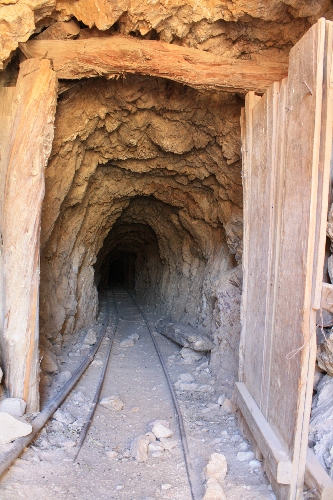
From the camp, we walked around to the east side of the ridge and took a short hike up to the Eureka Mine. For most of the winter, the mine entrance is closed off with a metal grill, as it is a home to the endangered Townsend's big-eared bat. But even so, you can get an excellent look inside and see the tracks that were used for the mine carts.
From here, we headed over to the north side of the ridge, where we found the Cashier Mill. Built in 1909, this gasoline-powered mill pulverized the ore, then mercury and cyanide extracted the gold.
If the weather cooperates and you have a high-clearance vehicle -- one with four-wheel-drive is even better -- you can continue east on Aguereberry Road from the camp, about four miles, to Aguereberry Point. This is where Pete would take visitors to see what he called "The Great View." This viewpoint looks down through badland terrain at the eastern edge of the Panamint Range and into the large expanse of Death Valley proper and mountains to the east.
The Eureka is just one among thousands of mines in the park. Although historic, many of these mines are dangerous to be around, because of collapsing structures, toxic waste and unstable ground. We have visited the Keane Wonder Mine, in the eastern area of the park, several times, but it's now closed to visitors. Starting earlier this month, the park service embarked on projects that will make some of the mines, including the Eureka, safer for humans, yet also able to provide habitat for wildlife and preserve cultural resources. This work will secure 238 mine features at eight locations.
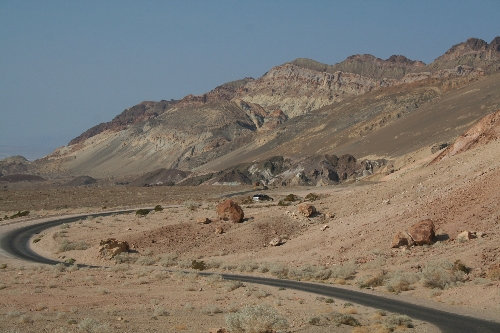
The park has about 300 miles of paved roads, another 300 miles of improved gravel, and hundreds more of unmaintained four-wheel-drive roads. We have always enjoyed taking our mountain bikes along the park's gravel roads, but on this trip, my daughter and I did something different -- a fast downhill cruise along the paved Emigrant Canyon Road. We found it quite a pleasant experience, for we only saw a couple of cars as we traveled about a dozen miles from the junction of Aguereberry Road until we reached the main road just outside of Stovepipe Wells, where a friend picked us up in our motor vehicle.
The 61st Annual Death Valley '49ers Encampment takes place Nov. 10-14. This is a celebration of the pioneer spirit and the Death Valley area. The festivities are concentrated around Stovepipe Wells and the Furnace Creek area. The Death Valley '49ers are a nonprofit organization dedicated to raising public awareness of the park and its resources.
There are dozens of family-friendly events, including gold panning, a wheelbarrow race, and contests in throwing horseshoes, fiddling and telling tall tales. An impressive lineup of live entertainment includes country-western singers, yoddlers and fiddlers. The Invitational Western Art Show, which takes place over the final four days, has been an important part of the '49er celebration since 1951.
There is also a pioneer costume contest, which in the past has brought those dressed as mountain men, Harvey Girls, cowboys, settlers and snake-oil salesmen. The encampment also features cowboy poetry, educational talks, tours and guided hikes, and four-wheel-drive trips to historical and scenic sites. To fully participate in the encampment -- as well as the contests and tournaments -- you'll need to become a member of the Death Valley '49ers. All funds raised at the encampment go to an educational fund and scholarships for students in the area.
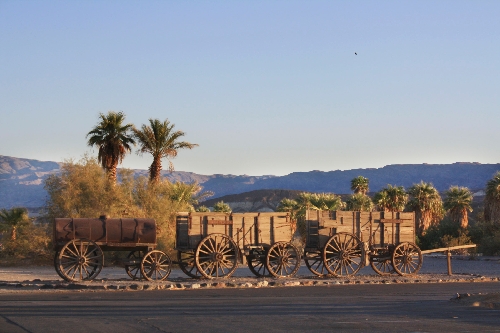
Borax was successfully mined in Death Valley from 1883 until well into the 20th century. For the first several years, teams of 20 mules hauled the refined borax out of the valley. They later lent their image to the brand name of 20 Mule Team Borax, which in turn sponsored the "Death Valley Days" program that became an icon of early television. Even with 20 mules and expert drivers, it took 10 long days to travel the rugged 165-mile route out of the valley, and over the Panamint Mountains, to the nearest rail depot at Mojave. You can see two of the wagons they pulled, one in front of Furnace Creek Ranch and another down the road at Harmony Borax Works. Custom-built, these wagons were huge, weighed 7,800 pounds empty and had back wheels seven feet tall and front ones five feet.
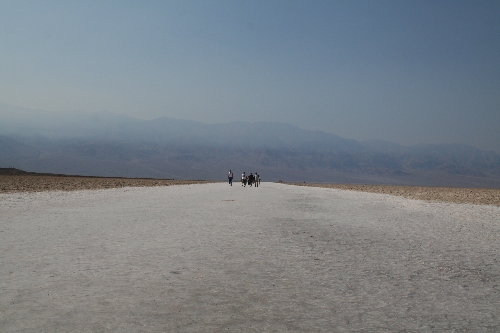
No Death Valley trip is complete without a drive down Badwater Road to visit some of the park's classic destinations. Every visitor should go to Badwater itself, if only to say you have stood at the lowest point in North America, and craned your neck to see the sign, 282 feet above you on the towering cliffs, marking sea level. From the parking area, you can just walk out on the salt flat and travel out as far as you care to go. Looking west across the basin, you'll see the Panamint Mountains, which include the highest point in the park, 11,049-foot Telescope Peak.
November brings average maximum temperatures of 76 degrees and lows averaging 48 degrees. This agreeable weather naturally brings high visitation. If you wait until the period between Thanksgiving and Christmas, you will enjoy the least crowded time of year and weather almost as good.
There are lots of changes going on in the park. The American Recovery and Reinvestment Act and the Federal Lands Recreation Enhancement Act, signed into law in 2009, will both benefit Death Valley. The Recovery Act provides $750 million to the National Park Service to fund about 800 projects throughout the system, including $4.8 million worth at Death Valley. Some of the projects include safety features at abandoned mines, improving roads, adding parking areas, solar energy and installing wayside exhibits.
One of the largest improvements will be the rehabilitation to the Furnace Creek Visitor Center and Auditorium. Work will commence after the Death Valley '49ers Encampment ends in mid-November. During the 18-month effort, a temporary visitor center will be set up in a trailer, offering many of the same services visitors have seen in the past.
If you are driving back to Las Vegas through Pahrump, consider stopping in the hamlet of Death Valley Junction. Listed on the National Register of Historic Places, it is located about half way between the park and Pahrump, each about 30 miles away. You can grab a bite to eat at the Amargosa Café or stay in one of the rooms at the hotel. Nobody much had heard of this place until 1968, when ballerina Marta Becket -- against all odds and reason -- gave the first performance in what would become a successful one-woman ballet, in an opera house built for local miners in the 1920s. There are Saturday evening performances and Sunday matinees through April, and despite the remote locations, reservations are necessary.
Becket, now 86, could still dance on toe-tips at 80. But age overtakes even the seemingly ageless, so Becket yielded the role of principal dancer to a protege, and has been quoted to the effect that this will be her last season participating at all. You're too late to encounter Shorty Harris or Pete Aguereberry, but Becket is already their equal as a legend in a legendary land, and this winter, at least, you may still see this legend in the flesh.
GETTING THERE
Location: Death Valley National Park, Calif., about 120 miles northwest of Las Vegas.
Directions: (To Furnace Creek area of park, via Pahrump) From Las Vegas, take Interstate 15 south to Nevada Route 160, the Blue Diamond exit. Drive about 53 miles west to Pahrump. Turn left onto State Route 210 and drive 27 miles to Death Valley Junction. Go right and then take an immediate left to California Route 190 west for about 29 miles to Furnace Creek .
Furnace Creek Inn and Ranch: Furnace Creek Inn is a four-diamond hotel with 66 rooms, two suites and a pool bungalow, generally open from mid-October through mid-May. Furnace Creek Ranch is more family oriented and has 224 rooms. Both properties are within a mile of each other and are jointly managed. Swimming pools, restaurants, tennis courts and golf course. (800) 236-7916, www.furnacecreekresort.com.
Stovepipe Wells Village: A recent fire has temporarily closed the saloon and Toll Road Restaurant, but guest rooms were not impacted. www.stovepipewells.com.
Camping in Furnace Creek area: Furnace Creek Campground is open all year with 136 sites, potable water, tables, fire pits and flush toilets. Reservations available up to six months in advance for prime camping season. $18 per night. (877) 444-6777. www.recreation.gov. Texas Spring Campground is open seasonally and has potable water, tables, fire pits and flush toilets. Its 92 sites are first come, first served, but it limits RV use to accommodate tent campers. $14 per night. Sunset Campground, open seasonally, has 270 sites and potable water but no tables or fire pits. Also first come, first served, this campground is generally occupied by RVs. $12 per night.
Death Valley '49ers Encampment: Nov. 10-14 in Furnace Creek and Stovepipe Wells area, is in 61st year. Features parade, four-wheel-drive tours, cowboy poetry, contests of music, photography, pioneer costumes, golf. Full participation requires membership; you can join at encampment or website, www.deathvalley49ers.org.
Furnace Creek dining: A variety of restaurants can be found at the Furnace Creek Inn and Ranch complex. The famous Inn Dining Room, which offers afternoon tea and Sunday brunch as well as usual three meals, accepts reservations from nonguests weeks or even months in advance. (760) 786-3385. Furnace Creek General Store has drinks and meals on the run, such as ready-made sandwiches, fresh fruit, dairy products and alcoholic beverages.
Furnace Creek services: Basic camping supplies, groceries, gasoline and diesel, tire repair and towing, propane and paved airstrip.
Death Valley National Park: Park entrance fee is $20 per vehicle, good for seven days. (760) 786-3200. www.nps.gov/deva.
Furnace Creek Visitor Center and Museum: Will be closed for remodeling for 18 months from Nov. 15. Its functions will be continued in a temporary trailer during this time.
Scotty's Castle: Grounds of this quirky but tasteful desert mansion are open 8:30 a.m.-5:30 p.m. in winter months. Guided living history tours of the main house interior run about 50 minutes. Advance group reservations can be had, but individual tour tickets are sold on site, first come, first served, and go fast, so arrive early and expect a long wait. There are a bookstore, gift shop, and snack bar, but no gasoline is sold here. (760) 786-2392, www.nps.gov/deva.
Backcountry roads: Don't set out anywhere in Death Valley National Park without a good map and getting up-to-date information on road conditions. This is especially important if heading for high-elevation sites such as Wildrose Charcoal Kilns, where heavy snowfall is common.
Abandoned mines: There are 6,000 to 10,000 abandoned mines in the park and approximately 3,000 have not been updated for safety. Always talk to a park ranger before exploring near mines.
Maps: The official Death Valley park map is given to visitors when paying the entrance fee. For a more detailed map, use the National Geographic, Trails Illustrated-Death Valley National Park.
Amargosa Opera House and Hotel: Café, rooms and weekend performances in Death Valley Junction. Reservations needed for performances. (760) 852-4441.