Going Digital
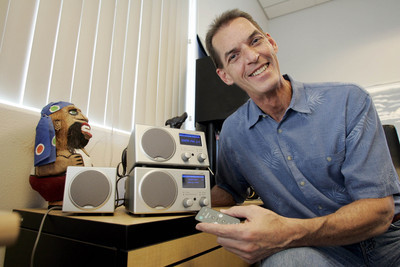


The signal is sharp, clear and strong. You tune it in on an only slightly different-looking radio. And when you do, you'll hear more programming -- and a wider variety of programming -- than you'll hear on basic radio.
And, surprise: It doesn't come off of a satellite.
HD digital radio, long overshadowed in the public mind by satellite radio, finally seems poised to come into its own. And when it does, Dr. Ralph Nietrzeba can say he told us so.
Nietrzeba has been listening to HD radio for a year-and-a-half, ever since opting to have an HD stereo put into his car.
"I had it put in because I thought it would be the future," explains Nietrzeba, a pulmonary medicine physician.
Nietrzeba listens mostly to classical music, jazz and news while he's driving, and loves the sharper, stronger signal HD radio offers. "It's truly equivalent, I think, to CD quality," he says.
Here's something else Nietrzeba loves: Unlike people who have XM or Sirius satellite radio, he pays no monthly fee to hear his favorite HD radio stations. Now that he has paid for the radio, Nevada's entire HD universe -- more than 20 stations with more to come -- is his for the hearing.
Technospeak aside, HD radio involves digitizing -- turning into zeroes and ones, in the same way information is processed to travel along the Internet -- a conventional, analog radio signal. The digital signal, piggybacking on the analog signal, is transmitted from the radio station to your HD digital receiver, which converts it back into sound you can hear. But, thanks to the nature of the digital signal, the HD signal you hear won't come with the static, hiss and dropouts you may hear on an analog station.
Broadcasting in HD digital offers listeners another benefit: The broadcaster can air, along with the original FM station in HD digital form, as many as two additional HD stations on either side of the primary frequency, denoted on HD radio displays as "HD2 and "HD3."
That means HD listeners can hear more stations than they can on a conventional radio. For broadcasters, it means the chance to attract more listeners by offering a wider variety of programming.
"I'm a guy that's really about content. The exciting thing for me is the variety of content available," says Rik McNeil, program director for Clear Channel Radio's KPLV-FM, 93.1, "The Party," which airs adult contemporary, and digital KPLV-HD2, which airs oldies.
In fact, the oldies format now airing on KPLV-HD2 is exactly what was heard on the former "Kool 93.1" before now-KPLV-FM changed its call letters and format. McNeil says he knows of oldies fans who bought HD radios just so they can continue to listen to the music they love.
"HD radio is going to bring that amount of variety, that breadth of variety, to terrestrial radio, and it's at no cost to consumers," McNeil says.
Nevada Public Radio, which airs classical music in HD digital on KCNV-FM, 89.7, offers on one of that station's HD channels "XPoNential Radio," which Phil Burger, Nevada Public Radio's director of broadcast operations, calls "sort of an odd mix of music that comes out of station WXPN in Philadelphia."
Beasley Broadcasting Group offers two HD channels to adult contemporary KFRH-FM, 102.7 (formerly KSTJ): KFRH-HD2, which plays dance club music; and KFRH-HD3, which airs nonstop weather information.
Danny Highsmith, Beasley's regional vice president, adds that KKLZ-FM, 96.3 will have its HD side-stations up and running within a year.
Burger says it's just this sort of diversity in programming that will give listeners reason to embrace HD radio, "as long as we can come up with interesting programming, something that people want to hear that they can't get anywhere else."
Conversely, Burger adds, "if it's just (another channel) of classic rock, what's the point?"
Probably not a problem, given the competitive nature of the Las Vegas radio market, according to Don Hallett, program director for Beasley Broadcasting's KFRH. "When people buy these radios and turn them on, we don't want to end up with six Top 40 stations on HD channels."
If listeners "tune into these (HD) radio stations for the first time, if they hear something totally unique and different than anything they've ever heard on a radio station before, it's what will endear them to the HD band," he says.
For the consumer, another advantage to HD radio is that buying the radio is all it takes. There are no monthly, satellitelike subscription fees. And, an HD radio will continue to pick up non-HD FM and AM stations, too.
Michael Hadfield, store director at Circuit City, 3778 S. Maryland Parkway, says most consumers still are more familiar with satellite radio than they are HD digital radio. Most ask about HD only when they see the notation on a product's tag, and many even then assume it's somehow related to satellite radio.
But, particularly among consumers who are "very passionate about music," Hadfield says, word is getting out.
HD radio sales have been "gaining more momentum" in recent months, he says, in part because "we are having more customers as radio stations continue to back this."
HD car stereos now can be purchased for less than $200, Hadfield says, and Highsmith notes that car manufacturers -- Ford, among them -- are beginning to offer HD receivers as a car audio option.
Consumers who don't already know about HD digital radio soon will be finding out, as the HD Digital Radio Alliance, a consortium of U.S. broadcasting companies, kicks up its public awareness campaign.
"You'll find, if you listen to one of our stations ... commercials for HD radio, making the point of what it is, and that there are radios available," McNeil says. "I think what's really cool about them is, they really do break it down out of all of our geekspeak: HD radio is like having stations between stations."
By the way, anyone who's still smarting over buying a quadrophonic stereo or picking Betamax over VHS during the early days of the VCR wars can relax. The fact that broadcasters are committed to HD means it's unlikely to end up in the graveyard of technologies that never quite caught on.
"This is just my opinion, but there are just too many big radio companies involved for this to go by the wayside," Highsmith says. "We've invested a lot of time, money and effort to getting the word out there through the HD Radio Alliance for it to just disappear. I really don't see that happening."
Contact reporter John Przybys at jprzybys@ reviewjournal.com or (702) 383-0280.
HOW IT WORKS Here, according to the HD Digital Radio Alliance (www.HDRadio.com) is how digital radio works. Like conventional radio, HD, or digital radio, is sent out from a radio station's transmitter and heard by a listener on a receiver. But, instead of sending out one analog signal (conventional radio), a station sends out a bundled signal that includes both analog and digital signals. And, because it's a digital signal, text data -- song titles and artists' names, for example -- can also be sent out to be seen on an hd radio display. The digital signal layer is compressed. The combined analog and digital signals are transmitted. When radio signals bounce off of objects, it creates what are known as "multipath distortions.&Quot; multipath distortions cause static in a conventional radio receiver. However, HD digital receivers sort through reflected signals, reducing static, hiss, pops and fades. The signals reach their destination. Both broadcasts are free, and listeners don't have to pay subscription fees. To hear the digital broadcast, all that's needed is an HD radio.