



Want to avoid the flu while flying? Opt for a window seat, study finds
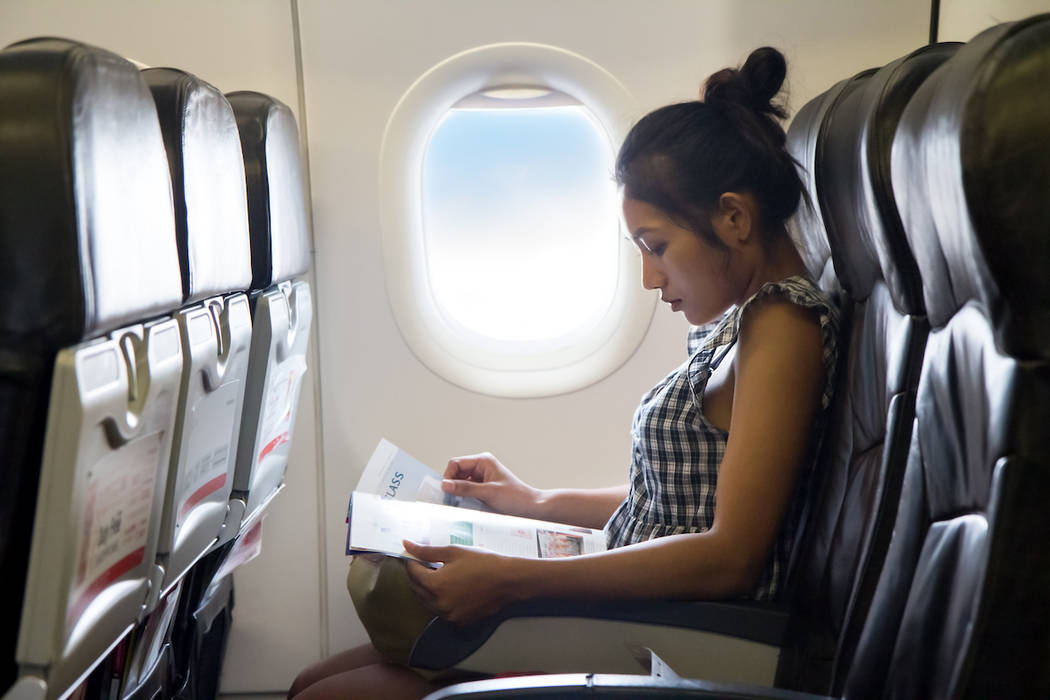


NEW YORK — Worried about catching a cold or the flu on an airplane? Get a window seat, and don’t leave it until the flight is over.
That’s what some experts have been saying for years, and it’s perhaps the best advice coming out of a new attempt to determine the risks of catching germs on an airplane.
It turns out there’s been little research on the risks of catching a cold or flu during air travel. Some experts believed that sitting in a window seat would keep a passenger away from infectious people who may be on the aisle or moving around.
The new study, published Monday, came to the same conclusion.
For somebody who doesn’t want to get sick, “get in that window seat and don’t move,” the study’s lead researcher, Vicki Stover Hertzberg of Emory University in Atlanta.
The study was ambitious: Squads of researchers jetted around the U.S. to test cabin surfaces and air for viruses and to observe how people came into contact with each other.
But it also had shortcomings. In a total of 10 flights, they observed only one person coughing. And though the experiment was done during a flu season five years ago, they didn’t find even one of 18 cold and flu viruses they tested for.
It’s possible that the researchers were unlucky, in that they were on planes that happened to not have sick people on them, Hertzberg said.
The new study was initiated and funded by Boeing Co. The Chicago-based jet manufacturer also recruited one of the researchers, Georgia Tech’s Howard Weiss, and had input in the writing of the results. “But there was no particular pressure to change stuff or orient it one way or the other,” Hertzberg said.
The article was released by the Proceedings of the National Academy of Sciences.
The researchers did some mathematical modeling and computer simulations to determine how likely people were to come close to a hypothetical infectious passenger sitting in an aisle seat on the 14th row of a single-aisle airplane. They concluded that on average, only one person on a flight of about 150 passengers would be infected.
Researchers who were not involved said it would be difficult to use the relatively small study to make any general conclusions about the risks of an airline passenger getting a cold or flu, let alone other diseases like measles or tuberculosis.
But it’s a novel study about a subject that hasn’t been well researched, they said. Studies have looked at how respiratory viruses spread in labs and in homes, but “this is the first time I’ve seen it done for airplanes,” said Seema Lakdawala, a University of Pittsburgh biologist who studies how flu spreads.
She and others not involved in the research were intrigued by the study’s findings about how people moved about the cabin and came in contact with each other.
It found:
—About 38 percent of passengers never left their seat, 38 percent left once, 13 percent left twice, and 11 percent left more than twice.
—Not surprisingly, a lot of the people getting up had an aisle seat. About 80 percent of people sitting on the aisle moved at least once during their flights, compared with 62 percent in middle seats and 43 percent in window seats.
—The 11 people sitting closest to a person with a cold or flu are at the highest risk. That included two people sitting to their left, the two to their right, and people in the row immediately in front of them and those in the row behind.
A lot of frequent fliers will be interested in the study’s results, said Edward Pizzarello, an investor in a Washington-area venture-capital firm who also writes a travel blog .
“It’s absolutely a fear I hear from people all the time. They just believe that they’re going to get sick from going on an airplane, or they got sick from being on an airplane,” he said.
Pizzarello said he’s an aisle person, because he doesn’t want to feel trapped in the window seat if he needs to get up.
Will he now go for the window?
Maybe, he said, if a sick person sits next to him.


