Allow children’s décor to grow, change with them




Few of us ever stop to think that a child's room is one of the most challenging of all spaces to design.
You may wonder, how difficult can it be? After all, what do children really know about design? Surely they'd be satisfied with a comfortable space of their own as long as they have their favorite toys, a comfy bed, TV, etc. Well, that may have been true once upon a time, but things are obviously different now and children expect so much more; and they seem to be growing up so much faster.
Take heart in knowing that great results can be achieved when certain basic guidelines are considered and followed through, despite budgetary restraints, utilizing little more than imagination, some paint and, most importantly, forethought.
Whenever I work with a client, more often than not, they've done a good deal of the "homework" before I even meet with them. They have already gone through countless design magazines, catalogues and websites in search of the "look" they'd like for their home. And that's exactly the same first step that needs to be taken when coming up against the challenge of designing a child's room.
What a break for the designer when parents have done their homework and already conferred with the little ones (provided they're old enough to understand) to find out some of their likes and dislikes. Couple this with the need for some homeowners to integrate the style of their child's room(s) with the overall design concept of the home and you can begin to see that situations can become sticky and just how much a designer's professional touch can help sort things out.
Perhaps most fundamental of all, besides scaling furniture to just the right size for the space, a designer will help you buy pieces that will not only appeal to the child's favorite themes and activities, but furniture that will grow with your child. It's so important to buy designs that will work now and into the future.
For example, an armoire that will store clothing today, can be used for electronics later on. Stackable bookcases, drawers and cabinets can work for a small child and then be used as components for a handsome wall unit many years later. That's forethought.
Choosing furniture that has timeless appeal and staying away from themes and characters that may soon begin to bother the child that they were meant to amuse are basics. But so is buying the best quality pieces that you can afford as they'll last so much longer than flimsily constructed ones that will often cost you more in the long run.
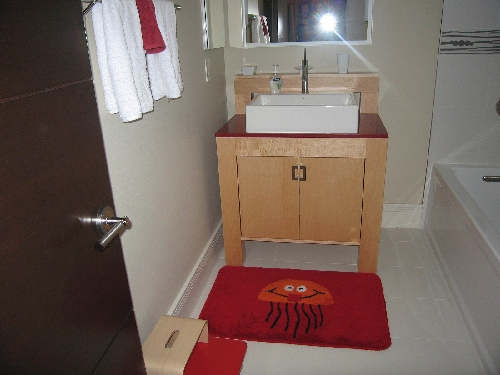
If new furniture is simply out of reach, then consider gently used furniture that you can "jazz up" with a new finish and fun hardware. Recently, a client of mine did just that by using the maple furniture from a former guest room in a child's bedroom. Together we created a wonderful new space that melds beautifully with the overall design of her contemporary home.
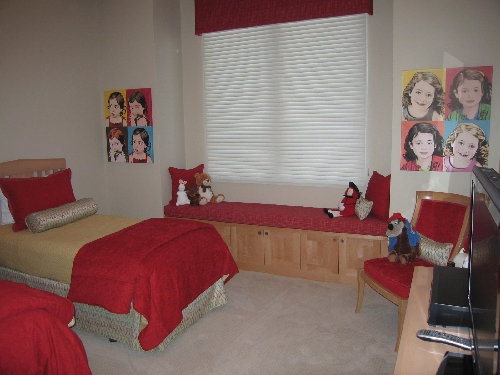
This savvy client certainly had done her homework when it came to designing for children because right from the get-go she specified a window seat that would serve the dual purpose of seating and storage for toys, games, etc., while making a significant contribution to our design scheme by topping it off with a custom-made red seat cushion -- a color that was repeated in key elements in the room, such as the valance, duvet covers, pillows and hardware.
Designs that can do double and even triple duty in a child's room, such as a sleep, study and storage unit all in one, are great ways to go.
On the very practical side, consider easy-to-clean surfaces -- nothing delicate, please! Heavy lids that can possibly slam down on those precious little fingers are verboten; as well as pointed or rough edges and hard-to-open drawers. Glass mirrors can be very dangerous for children and so it's much better to specify plastic mirrors, which are somewhat more expensive, but oh so much safer.
And when it comes to color, it goes without saying that children's rooms can be great fun because they provide an opportunity to actually play with color and be extremely creative in the process. Still, I urge you to use a neutral shade for the walls as a base and then use color in the furniture and accessories (as my client did) or maybe even on one accent wall only.
Using too much of a bright color may not prove to be such a good idea in the long run because children grow up so fast, developing their own likes and dislikes. Keeping things fairly neutral from the onset, choosing one color that will be the main focus of the room and making your decorating plans around that, will allow you to easily add and take away things that they grow .
With children's furniture, as with any room in your home, always begin by first considering the better-quality pieces, the cost, construction, size, finish, shape and their overall appearance. Allow your child to become involved in the design process. Listening as best you can to his or her needs and wants. Hopefully they will reflect and shape not only his or her personal style, but also be a welcome addition to the cohesive design of your home.
Stephen Leon is a licensed interior designer and president of Soleil Design International; he has been designing and manufacturing custom furniture and cabinetry for more than 25 years. He has served on the board of directors of the Central California/Nevada Chapter of the American Society of Interior Designers and is a certified professional in green residential design. Questions can be sent to stephen@soleildesigninter
national.com.