Built to perform






Excitement about The Smith Center opening next year is building nearly as quickly as construction on the downtown facility itself.
With tickets for the first performances -- a shortened Broadway series season -- going on sale Tuesday, area residents will soon have a chance to see for themselves what the fuss is all about.
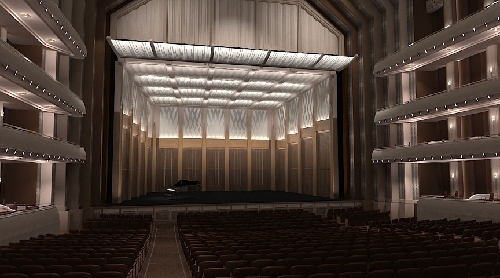
Once the doors to the facility open, people will experience a world-class performing arts center that will include a 2,050-seat main theater, 300-seat cabaret theater and 200-seat studio theater in addition to classrooms and multipurpose rooms.
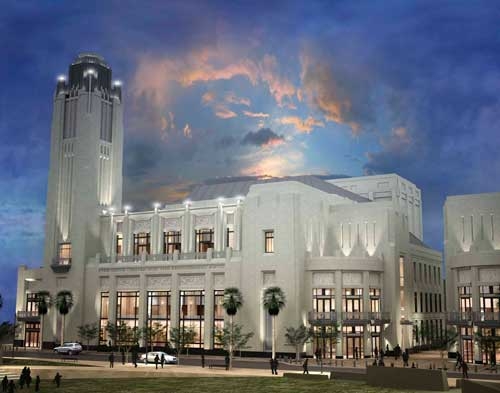
Situated on 4.75 acres in Symphony Park, the facility is being built to look as if it has been a part of the city's history for many years as well as last for many generations to come, said Myron Martin, president and CEO of The Smith Center.
"Our collective focus has been to create something that not only looks like it might have been here for a long time, but no one will doubt that it will be here for a long time ... and be elegant, tasteful and lasting," he said.
"The Smith Center was designed to make it feel like we live in a great city," Martin said. "One of the things that does that is architecture. We have designed something that has history and is sustainable."
Creating that illusion has not been an easy undertaking.
Aside from cutting giant blocks of Indiana limestone for the exterior walls and importing slabs of marble from Italy for the interior, building the facility has meant juggling the talents of 19 design teams.
"A performing arts center is the most complicated type of building to design," Martin said.
One of the challenges they faced was presented by the downtown location and proximity to railroad tracks. As a result, a subbasement with 36-inch thick concrete flooring was created to make sure "vibrations from the Union Pacific Railroad didn't cross through."
Martin said the core design team, including himself, toured the greatest performing arts centers in the world and took thousands of photographs to determine what features they liked and would definitely include and what they didn't like.
David Schwarz was selected as the principal architect because he instinctively understood the idea that they wanted to design something that would last for generations. Additionally, Schwarz has designed two of the most celebrated U.S. performing arts facilities: Bass Performance Hall in Fort Worth, Texas, and Schermerhorn Symphony Center in Nashville. Schwarz's firm also designed the American Airlines Center in Dallas and the Rangers Ballpark in Arlington, Texas.
"Early on with his napkin sketches, we did have a concept that was very Italian, right down to the statues along the top," Martin said.
But, taking the context of the facility and where it will be built, the overall look of the center took on an art deco influence.
"David, who also teaches architecture at Yale, takes time to think about these things. Las Vegas really became a city when Hoover Dam was built. The architecture that was in vogue then was art deco."
They agreed then that the architecture and design of the building should reflect that era and not become another caricature, much like the resorts along the city's famed Strip.
Although the center is influenced by the art deco style, it is more contemporary. For example, it has many more windows because daylighting is an important component necessary to achieve its Leadership in Energy and Environmental Design certification, Martin said.
When complete, the facility is expected to be the nation's first performing arts center of its size to achieve LEED certification, a program run by the United States Green Building Council.
Eco-friendly features, such as energy-efficient windows and water-saving fixtures, are found throughout the facility and will help it operate more economically and efficiently
But looks alone will not make the center a success. It is, after all, a performing arts center. As such, great care was taken to ensure that the acoustics were top notch.
Creating the acoustics for The Smith Center was Akusticks, which teamed with renowned theater designer Fisher Dachs of New York. Akustiks is known for refined acoustical design and is responsible for several recent acoustical successes including the restoration of Severance Hall, renovations to the John F. Kennedy Center Concert Hall and the new Schermerhorn Symphony Center.
"We start with the big picture and make sure it's right acoustically. If we start there and build around it, then you get something spectacular," Martin said.
Martin said he also made sure there wouldn't be a bad seat in the house by personally sitting -- or crouching -- in practically every square inch of the theater to ensure the view of the stage was not obstructed. And he tried out every chair to determine how comfortable it would be for center patrons.
No detail was too small to be overlooked. Martin said everything from the overall look of the center to the artistic touches right down to the number of bars and bathrooms was considered.
"We have 101 public bathroom spaces, two-thirds of which are for ladies," he said. "And they're on every level so there won't be any long lines."
It's the details like this that will help make the center stand out in the community. Then again, it could be the 19-foot-tall chandeliers in the grand lobby that were inspired by the Sunrise Mountains, the 18-foot sculpture in the lobby that is an homage to Hoover Dam, or the 170-foot-tall, four-octave carillon bell tower with 46 handcrafted bronze bells, the largest of which is 6 feet tall, weighs more than 5,500 pounds and turns the entire center into a musical instrument when it plays.
For more information about The
Smith Center, visit www.thesmith
center.com.