Flowering plants need more fertilizer


My last pruning class of the season will begin at 9 a.m. Saturday at the University of Nevada Cooperative Extension Master Gardener Orchard in North Las Vegas. It will focus on pruning grapes.
Future classes at the orchard include how and which fruit to thin for larger and better quality fruit and summer pruning. Dates will be announced later this month.
Sunday's class at Plant World nursery will be about how to get larger and better quality peaches; it will start at noon. Future classes at the nursery include growing sweet onions and asparagus; they will be held in March.
Q: I want to know when and how to fertilize most of my shrubs. I have a lot of photinia, iris, Japanese hollies and Italian cypresses.
A: Flowering plants should be fertilized a few weeks prior to flowering and the development of new growth. If flowering and new growth coincide with each other, then one application of fertilizer just prior to that combined event is all that is necessary.
If new growth starts and flowering occurs later, then you should probably fertilize a second or even third time during, or slightly after, flowering. Usually if we grow plants specifically for their flowers (roses are a good example), then regular applications of fertilizer through their flowering season might be considered. A slow-release fertilizer could be substituted for multiple fertilizer applications.
Once they stop growing in late summer and fall, they send food reserves into storage. So they should have nutrients available to them during fall as well. We sometimes call this late fall fertilization. This can be advantageous for woody trees, shrubs and even lawns.
Generally speaking, we can fertilize most plants once in the spring and now, and be done with it for the remainder of the year. Flowering plants that we appreciate for their flowers need to be fertilized a bit more often; once prior to new growth and then again after blooming to help build up reserves. So your iris probably fits into the second category. The others, into the first category.
Q: I spoke to you about my patch of Bermuda grass at one of your classes. You said that Bermuda grass could be controlled just by letting a fescue lawn shade the soil. Can I really get my Bermuda grass under control simply by mowing higher?
A: No, you cannot control existing Bermuda grass in a lawn just by letting the fescue grow taller. I think I was misunderstood. Once you have a fescue lawn established, by keeping the soil shaded you will reduce and possibly eliminate Bermuda grass from getting started. This is what I intended to be heard.
Bermuda grass cannot survive in shade. By keeping the soil surface shaded by a healthy lawn, Bermuda grass will be discouraged. Bermuda grass invades a home lawn where lawns are mowed too short or damaged, thus eliminating shade on the soil surface. Typical places where it invades include around sprinkler heads and the edges of the lawn near concrete. Both of these places are where line trimmers are frequently used to keep grass shorter.
It also invades damaged areas because of a lack of water, disease or insects. Once established in the lawn, Bermuda grass is nearly impossible to eliminate without renovating the entire lawn. This would mean fertilizing, watering and mowing the lawn to get it as healthy as possible and then killing it with Roundup.
This is best done in the fall around mid-September to mid-October. About 10 days after the Roundup application or applications, the lawn can be mowed extremely short, power raked until you see bare soil and reseeded directly into the dying or dead lawn.
The key to eliminating the Bermuda grass is getting a thorough kill with the Roundup before replanting. Spray once, mow in two days and spray again going 90 degrees to the first spray to get good coverage and a better kill.
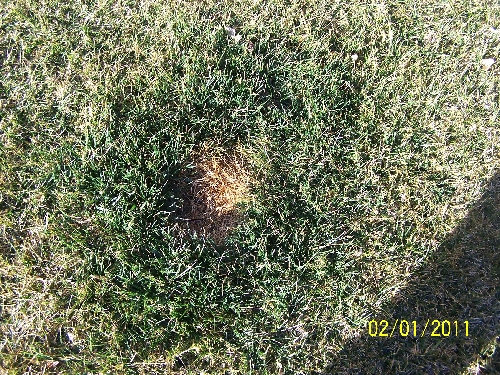
Q: I have nice green circles on my lawn. Yes, I have three dogs. The lawn was put in about nine months ago as sod. It suffered from minor fungus last summer and those areas were resodded about three months ago, which you can see in my photo. About a week ago I added a nitrogen-only fertilizer. Do I need to add something else to the lawn? I would like the lawn to look green like the circles, which I assume are a result of my dogs. Or is this some other issue?
A: Thanks for telling me you have dogs. You must read my column. Green spots or small circles can be from dogs. If it is from dogs, the spots are usually 6 to 10 inches in diameter with a smaller circle of dead grass in the center.
The dog urine kills the grass in the center of the green spot where it is concentrated but acts like a high-nitrogen fertilizer as it becomes more diluted further out. The diluted dog urine causes the grass to become greener and grow more rapidly. So the dark green grass surrounding the brown dead center is frequently taller than the surrounding grass.
If it is warm outside, an application of high-nitrogen fertilizer plus one or two mowings to remove the brown dead tips of grass should even the color out through your lawn. Nitrogen is the primary fertilizer responsible for a green lawn. The other is iron. You cannot substitute one for the other. Nitrogen also stimulates growth. Adding more nitrogen means mowing more often.
In the picture, your lawn appears very dense. This also might contribute to disease problems. You might try reducing your fertilizer applications to about half of what you are applying now to decrease the lawn's density and help improve air movement through the blades. This might help reduce the potential for disease when it is hot outside.
You also could try mowing your lawn a bit shorter in the summer months, but not any shorter than 1½ inches. This might help reduce disease potential. Make sure you are irrigating your lawn in the early morning hours, not at night where the water can sit on the lawn for several hours before it evaporates.
I will teach a class on lawn care management at noon Feb. 26 at Plant World nursery on West Charleston Boulevard.
Q: Would you happen to know why my eight pyracantha bushes did not produce red berries this year? I did not see birds helping themselves.
A: The only thing I can come up with is either that the pyracantha did not flower (you did not tell me if they flowered or not) or that a late freeze eliminated the fruit crop. We did have a late freeze in the spring that eliminated many plums and apricots this past growing season.
Another possibility could be how they were pruned. If they were pruned in such a way that the flowering wood was removed, then it is possible the fruit would be removed as well. If your pyracantha bloomed this past year and did not fruit, then this means it was most likely a late frost.
Bob Morris is a horticulture expert living in Las Vegas. Visit his blog at xtremehorticulture.blogspot.com.