Good to grow
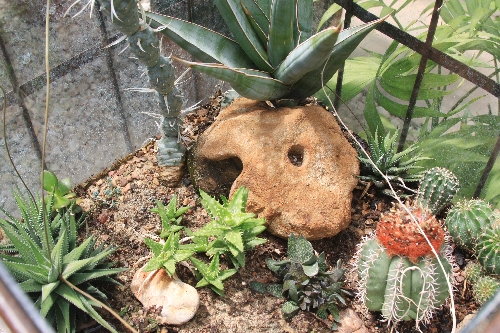

Some of us have green thumbs and some of us don't. For those who "don't," the answer is a terrarium, those miniature self-sustained environments. Why? A terrarium recycles its moisture and needs very little attention and care. The most remarkable point is that plants growing inside the terrarium don't require watering for long periods of time and can thrive for years without it.
Hallelujah!
Terrariums create microcosmic ecosystems inside an ordinary container, usually glass or acrylic. Moisture evaporates from the soil and plant leaves and condenses on the terrarium's roof and walls. The condensed water then drops down and remoistens the soil, replicating the natural rain cycle that keeps the world going. There is no need to feed the terrarium plants because they will grow naturally, slowly, but they will grow.
"Terrariums are fascinating to watch for they satisfy that motherly instinct in us," said Linn Mills, horticulturist at Springs Preserve. "The beauty of a terrarium is that it produces its own oxygen and takes care of itself. The one big problem is that most people tend to overwater and you know you're doing that when steam collects on the terrarium walls."
Terrariums come in all shapes and sizes. According to Shelby Ennis at PetSmart on South Fort Apache Road, many customers buy aquariums to build their terrariums.
"We have 2½-gallon aquariums all the way to 75 gallons and larger and all of them would make great terrariums," she said. "We also have the sand, rocks and some plants that can be used to create the terrarium environment. Not only that, some of the small reptiles that we have here do well in these creations, such as fire belly toads and red claw crabs."
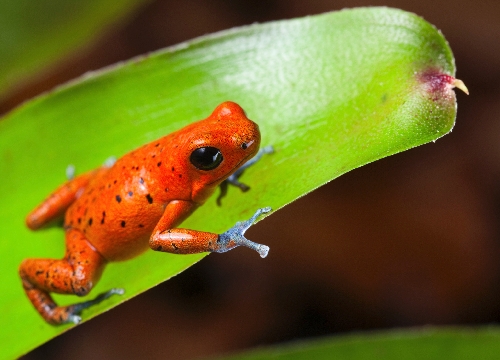
Plants do well depending on the environment being created. For instance, success can be found with small ferns, mosses, bromeliads, and ivy. Among animals that can live in a terrarium climate are chameleons, geckos, snakes, turtles, dart frogs and tarantulas.
Other plants that adapt well to terrariums are croton, palm, small-leafed philodendron, syngonium or nephthytis (often called the arrowhead plant) and schefflera. Medium plants include dracaena and fittonia or Chinese evergreen. Ground covers suitable for terrariums include baby tears and the small-leafed wandering Jew.
"If you're making one yourself, first decide on the type of terrarium you wish to make," advised Mills. "Is it a desert landscape or a tropical garden? Always start with a layer of inactivated charcoal on the bottom to help purify the air. Then it's up to your imagination and creativity. Create a dry creek or place some miniature plastic animals or flowers around, but not too much because you want the plants to be dominant. And don't combine plants with different cultural requirements, such as putting cactus in with tropical plants. The same goes for not combining blooming with nonblooming plants. To add interest, use plants with contrasting leaf size, texture and coloring."
Terrariums do best with indirect light. And remember, said Mills, water them sparingly.
"Those units with small or completely enclosed openings need just a few drops of water every three to six months," he said. "Those with larger openings need more. Remember that a terrarium has very little evaporation so only a few drops of water are needed. If drops of water form inside the container, it's getting plenty of moisture. We call this the rain cycle."
The first modern terrarium
It's known that Greeks grew and displayed plants in closed, transparent containers as early as 500 B.C., but an accident in 1827 was the beginning of the modern terrarium as we know it today.
While studying a sphinx moth emerging from a cocoon buried in moist earth, Dr. Nathaniel Ward, a London physician with a passion for botany, discovered tiny ferns and grass growing in the soil in the jar. To his surprise, these plants continued to grow inside the covered container for four years without any water. Ward's extensive research on this topic soon made terrariums popular as decorative household displays.