Green décor, furnishings make home healthier





Whether you've noticed or not, there's a new movement afoot in the world that's gaining greater attention and significance with each passing day. It's the inexorable movement toward global recognition and commitment that something must be done in order to sustain our planet and the quality of life as we know it and would like it to be in the future. This new track to salvation is often referred to as green living and it's taking the world by storm.
What exactly does green living mean? What makes a product green? Is it expensive to live a green life? These are all valid questions for the uninitiated and the answers are really quite simple.
First off, no, you don't need to be rich in order to lead a green life. With its ever-increasing impact and the attention being given to green living, green products are coming on line with greater frequency all the time. Green or organic products are to be seen everywhere these days and they're even less expensive than the traditional brands we've used in the past. But even though these cleaning products are an integral part of green living, they're by no means the only path to attaining it, nor are they the most vital. That distinction must assuredly go to the use of sustainable furniture.
It's easy to see how green and sustainable go hand-in-hand and are inextricably linked in this new movement.
Green is defined as a product that is made and distributed in such a way that it doesn't do any harm to our natural resources and is good for the environment as well; that it's safe and free from any harmful chemicals as well as low maintenance with less water and less energy used.
Sustainable is the capacity to endure with the use of natural resources that aren't destroyed in the manufacturing process so that we can be confident that they'll be there for future generations to have and enjoy. And what could be more fundamental to sustaining our quality of life than that?
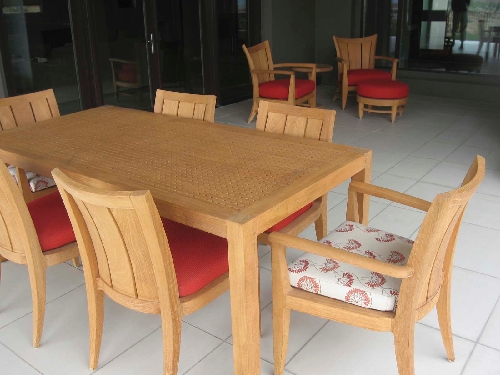
To this end, sustainable furniture must be made from sustainable or reclaimed wood, such as alder or oak, as well as a number of others. It's best if the wood is certified, meaning it comes from a well-managed forest where at least 25 percent of the wood is renewable and allowed to continue to grow and absorb carbon emissions. Of course, natural fibers such as birch, bamboo, rattan and wicker are also wonderful alternatives.
It's advisable to check the tags on your furniture to see if it's stain- or flame-resistant or is made with pressed wood. If so, it could very possibly contain chemicals that can wreak havoc with your hormones and may even contribute to cancer or high cholesterol. Many of us are still unaware of just how serious this can be as, over time, the flame-retardant chemicals (that are often used in fabrics) may slowly disperse into the surrounding air. And furniture made of medium density fiberboard or particleboard actually contains formaldehyde (another carcinogen), which will tend to diffuse from inside a table to the surface. (Note: it's advisable to keep relative humidity at 40 to 50 percent in rooms with pressed-wood furniture to help control this process.)
Sofas should ideally be made of organic fibers that are inherently less toxic; there are presently many in the marketplace, along with recycled or vegetable-dyed leathers, all in a full range of beautiful colors. When shopping for seating, whether retail or through your designer, try to specify a bio-hybrid foam for cushions. And, in case you aren't aware, your next glass-top table can be ordered with lead-free glass.
Be sure to use low volatile organic compound paints, which are now widely available. These paints give off virtually no smell and will allow you to sleep in a room the same day it's painted. There are even organic wallpapers to choose from in addition to window coverings now made from low VOC fabrics that are designed to filter out light while they save energy costs at the same time. They'll help to keep you cool in summer and warm in winter.
And finally, plants add so much character to our homes, not only by virtue of their beauty and warmth, but they're also among the best air filters you can own. Try to keep one of them per every 10 yards to keep the air clean in that area. Palms, ferns and rubber plants are great choices as air humidifiers and purifiers. Orchids (a night-synthesizing plant) lend an exotic touch to your décor and are a smart choice as well.
Bearing these facts in mind, it's clear to see why indoor pollution is often two to five times worse than outdoor pollution. (Who would have guessed?) But, it can be regulated and controlled by attention to not only how and what your furniture is made of, but also by using flooring such as reclaimed wood, recycled leather or glass tiles, concrete, organic wool carpet, jute, sisal, sea grass and New Zealand wool fibers. All are excellent choices.
Green living isn't really complicated. Simply put, it's just the process of living a healthy life, in which your choice of furniture can and does play an integral part.
Stephen Leon is a licensed interior designer and president of Soleil Design International; he has been designing and manufacturing custom furniture and cabinetry for more than 25 years. He has served on the board of directors of the Central California/Nevada Chapter of the American Society of Interior Designers and is a certified professional in green residential design. Questions can be sent to stephen@soleildesigninter
national.com.