One Groovy(stuff) contest






While having a proper education helps prepare you for a career on your chosen path, it's often the school of hard knocks that provides the most valuable lessons.
And when it comes to the world of design, a text book can teach you about the necessary nuts and bolts or fabrics and trims, while knowing what will look good and sell is more of an innate talent.
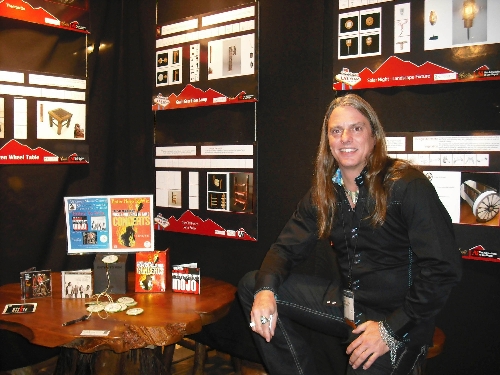
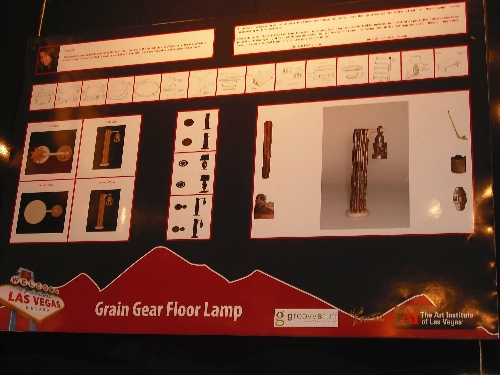
Students at The Art Institute of Las Vegas experienced this firsthand recently as they created furniture designs for Groovystuff's newly licensed Dick Idol Legends Collection. They were asked to create a piece of modern rustic furniture for the line using reclaimed teak and other components that are typical of the Texas-based firm's line. The environmentally friendly piece also had to be produced using sustainable manufacturing practices.
In all, 13 students from the interior design, graphic design and drafting technology and design programs participated.
The students debuted their projects in the Groovystuff showroom at World Market Center Las Vegas during the Las Vegas Market earlier this year. Buyers and other showroom visitors were asked to vote on their favorite project, with Jaclyn Donatelli's table incorporating an iron wheel rim and old fence post receiving the most votes. She earned $500.
"This contest was used as an assignment for our furniture design class. It wasn't mandatory, but what better way to learn about furniture design than to design a piece of furniture from conception to production. It was a great way to give us as students real-world experience under the supervision of our instructors," she said.
"This is the first time I have entered a design contest and it was extremely worthwhile," said Stephanie Cook. "I gained a valuable experience from it and also developed a new passion for furniture design."
Chris Bruning, co-founder of the Dallas-based manufacturer of unique home furnishings and accents produced from reclaimed teak, said that's one of the ideas behind the contest -- inspiring the next generation of furniture designers. There's really no internship program for furniture designers or a furniture-industry job fair, he said recalling the engineering internship he served while completing college.
"We need to embrace these talented young students from across the country and encourage them to seek a career in the home-furnishings industry. If we are going to appeal to Gen X and Gen Y consumers, we need designers with a fresh, young perspective," Bruning said.
"I had never thought of designing home-furnishing items before this contest, but it has spurred my interest for the future. I had a great time developing ideas conceptually with the recycled items I was given and this creative process was really fulfilling. Because of that, I have no doubt that I will be designing home furnishings, whether professionally or recreationally," said Cook, who designed a floor lamp for the contest.
Donatelli said she also hopes to design more furniture.
Bruning said one of the best parts of the contest was that it didn't cost the students or the school "a dime."
According to Grace Shurley, career adviser and job development coordinator at The Art Institute, the students didn't realize how big an opportunity this was until an instructor asked if the contest was open to them.
"It costs a lot of money to produce a piece and they realized this is not just any class assignment; it's the real deal," Shurley said.
All of the students' designs will actually be made and showcased by the manufacturer during the August market. The grand prize winner will be determined by which product generates the most sales.
"In August, we will display the original drawings along with the finished product so buyers can see the transformation of the concept into a fully executed consumer product. We'll ask the buyers once again for their comments and votes -- but also for their orders. The final winning design will be the one with the top sales. If it doesn't sell, did you really win?" Bruning said. "That student will not only win a $1,000 cash prize and a permanent royalty on all future sales, but will also be included in the prestigious and celebrity-endorsed Dick Idol Legends Collection."
All of the other student designers also will receive royalties on each piece sold, Bruning said.
"We all work so hard in school but none of our projects are ever constructed so to see my design for sale on the showroom floor will be very rewarding. It will be great to see what began as a quick sketch evolve into an actual piece of furniture in production," Donatelli said.
Cook agreed. "The hours and dedication necessary to become a successful designer are profound and this contest/project was no different. Because of these reasons, it will be extremely satisfying, exciting, humbling and surreal to see my design for sale on the showroom floor."
Shurley said the contest taught the students about the realities of designing furniture.
"They learned much more than they ever expected to learn, especially about business. Most art students don't learn the business end of design," Shurley said.
Not only did the students see what it takes to design a piece of furniture, they learned about selecting practical materials to make production cost effective and how much it actually costs to produce furniture. Although they can select materials that are beautiful, if they cost too much, no one will buy them, she said.
"We in career services like it when business meets design," Shurley said. "It makes for a successful artist."
To help with material selection, Groovystuff sent a 100-pound crate of raw material for the students to touch and become familiar with.
The project came about after Shurley contacted officials at World Market Center Las Vegas to see if they could ask their tenants about having design students work at the downtown facility during market week.
Instead of getting students to work in its showroom, Groovystuff proposed the furniture design contest, which it had previously done with the school's sister campus in Texas, and is repeating next month at the High Point Market in North Carolina with students from Auburn University.
"It just so happened that this quarter we were offering a furniture design class," Shurley said.
Because of the school's small enrollment, not every course is offered each term. It depends on interest and students' availability.