



Musicians often need strong back as well as talent




Want to be a professional musician in Las Vegas?
Study, learn all the musical genres, work hard, have a pleasant personality, be on time and have a strong back. That last part? Musicians are among the few professionals who often must carry their “offices” with them when they have a job.
Along with instruments and music, most musicians haul stools, lights, pedals, stands, cables, amplifiers, mixers, microphones, CDs, laptops, cellphones and carts every time they work.
Saxophonist Martin Mancuso works some one-man jobs. As such, he also uses prerecorded backgrounds on CDs. He brings CDs to the job along with the CD player, his stands, sound system and saxophone. Depending on the venue, he may make three or four trips to the car before everything is unloaded.
“It’s what we do,” he says.
Keyboardist Mike Clark began his career as an organist. In his younger days in New Jersey, he actually hauled a 500-pound organ, 250-pound speakers, a 75-pound bench and 50-pound pedals from job to job. A friend gave him the invaluable advice to use a refrigerator hand cart to move everything.
He’s almost amazed now that he was able to move everything … even up and down stairs. Today, Clark uses his church’s organ when he is organist and occasional choir director at Zion Independent Methodist Church in Las Vegas. He is also very grateful that electronics have given him today’s keyboards/synthesizers that weigh much less than the organ and duplicate many sounds.
Cellist Zoe Kohen Ley, a native Las Vegan, often carries her cello on her back. She remembers a summer in college when she attended a music festival in Aspen, Colo. She was playing and taking lessons at the festival. She was also strapped for cash, so had a room in a mobile home park in Aspen. The park was near a bus stop that would take her to the festival. Each morning, she took with her everything she needed for the day. In the evening, the bus would let her off across a very dark, but busy highway.
“The area also was known to have wild animals and I wondered if, in the dark, I’d either be hit by a car or be eaten by a bear,” she said. So with the cello on her back and her loaded backpack in front, Ley would make mad dashes across the highway. “I probably looked like some sort of monster with all that garb,” she said. “Maybe I frightened the bears.”
Ley has traveled to New York on jobs and there, she and her cello have taken the subway. “People who want seats probably don’t appreciate me taking up extra space,” she said, “ but then again, New Yorkers are accustomed to seeing musicians and their instruments on subways.”
Ley says that wooden cellos are quite delicate and typically should not be checked as baggage on an airplane, but she owns a $7,500 Luis and Clark carbon fiber cello that is less delicate and can be checked. Her instrument’s accessories include a bow, rosin, peddle board, tuner, cables and stand. For private events such as weddings, she also brings a set of “gig” books. Wardrobe and makeup changes may also be part of the package.
Guitarist/singer/comedian Dennis Blair toured with George Carlin for 18 years. Using his outdoor voice, he says, “Never check your guitar on an airplane!” Blair traveled with his “small” guitar that could be easily stored in an overhead compartment.
The instruments can be limiting even after a gig. Clark can’t easily take his keyboards with him for a casual drink. He always takes his equipment home before joining others for socializing. He learned that lesson early when a brand-new keyboard was stolen from his car in Newark, N.J. He had left the car for just 15 minutes, but in that time, a thief broke into it looking for a radio, then saw the keyboard and took that.
Among his jobs, Clark is the keyboardist for “Hitzville The Show” at the V Theater in the Miracle Mile Shops at Planet Hollywood. The show runs six nights a week, so Clark leaves two keyboards at the theater and they are wheeled into place each night.
Clark owns nine keyboards, so for other jobs, he will hand-deliver (by cart) the equipment he needs. Because he doesn’t like to be rushed, he will often deliver his setup hours before showtime, then return later to begin the job.
Clark is particular to avoid heavy lifting. His reminder is a titanium disc in his spine, the result of previous back issues.
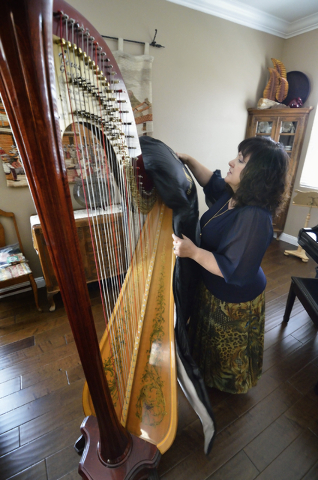
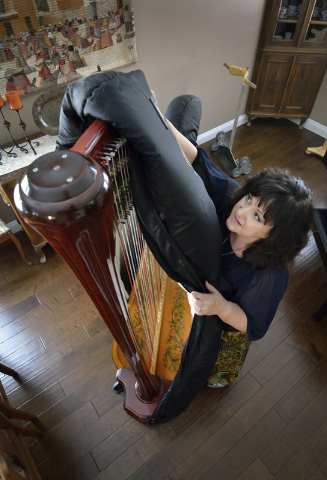
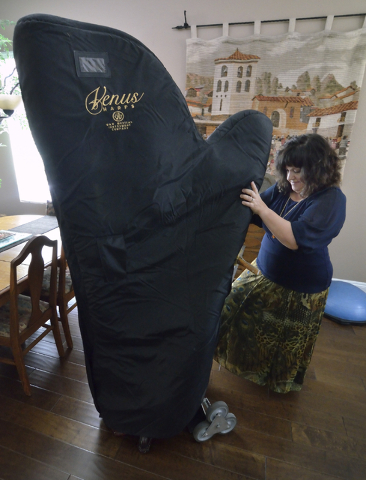
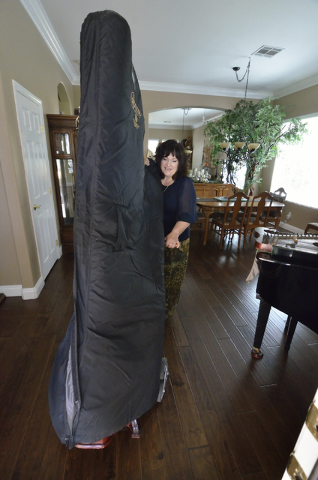
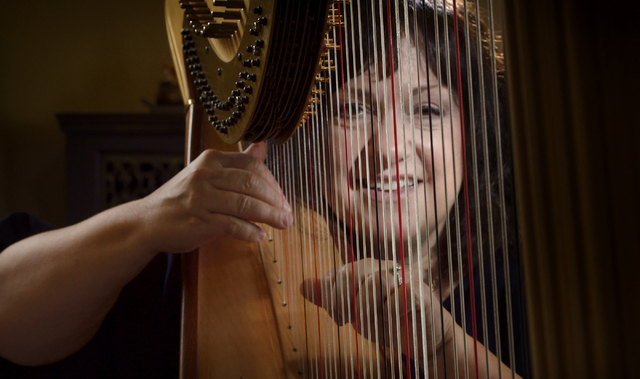
Wayne Newton brought Kim Glennie and her harp to Las Vegas 30 years ago. The harp weighs 100 pounds and bringing it to work in her Ford Explorer involves sheets, padding, cardboard, a padded harp cover and a special dolly.
“I’ve had to learn how to load and unload the harp without twisting my back,” she says. Other equipment she may bring to a job includes an amplifier, a bench, a tuning key, a string kit and tools “in case something breaks.”
When touring with Newton and Johnny Mathis, her harp had its own trunk and traveled by truck or was checked as baggage.
In addition to individual jobs, Glennie is harpist with the Las Vegas Philharmonic and the Nevada Ballet Theatre.
“People may think that we only work a couple of hours a night,” she says, “but other than the hour or so we need for setup and sound check, we’ve also spent weeks or even months working on the music.”
Glennie says a typical concert harp has a $30,000 value, but its size is an advantage. Although she will not leave the harp in her car in hot or cold weather, she once left a harp in her car in Peoria, Ill. Her car was burglarized, and everything was taken … except the harp.
Glennie owns five harps. One, a Welsh Triple Harp, was used by her in a TV commercial for Dignity Health.
Drummer Adam Shendal grew up in Las Vegas. His mother, Elaine Dunn, a singer/dancer/actress, was brought to Las Vegas in 1957 by Jack Entratter, entertainment director at the Sands. Shendal’s father was a musician, and his stepfather, Dean Shendal, was a casino executive.
As a youngster, Shendal had an ear for music, and because of his parents’ connections, he was introduced to drummer Buddy Rich.
Shendal loved watching Rich, who allowed Shendal to be on the sidelines with the band every night. Later, Shendal’s first drum set came from Rich. He says he is mostly self-taught (at UNLV he studied business, although he played in the jazz band). He feels through experience, he has learned from the best.
Shendal was playing professional jobs by age 17. He joined the Wayne Newton orchestra after a recommendation from drummer Louis Belson, and played with Newton on and off for 20 years.
Today, Shendal says he takes only the jobs he wants to take. His drum setup depends on the job, but whatever the assignment, he’s the labor bringing in the equipment. For a convention job and long distances to a venue, he and his 2005 Lexus 330 bring a cart to transport everything. If the venue has its own instruments, Shendal says he might just bring a few items: his foot pedals, a tuning key and a snare drum, for example.
Shendal says that Las Vegas drummer and colleague Jess Gopen helped solve some of the lugging problem by having a friend design and build a drum set where the drums fit inside each other, thereby reducing the bulk and the number of cases needed.
Electronics have made keyboardist Jeff Neiman’s job easier, particularly when, as musical director, he accompanies Clint Holmes for out-of-town performances. Neiman gives the venue a complete list of everything he needs, including the kinds of keyboards he uses.
He, like many of today’s musicians, will then prerecord tracks, carry them on a thumb drive, connect the thumb drive to the new keyboard and be in familiar territory.
Neiman can also tune an out-of-tune piano, if need be. Because Neiman lives in Las Vegas, he brings two of his own keyboards to Holmes’ performances at Cabaret Jazz at The Smith Center. “I carry them in by hand, no carts, but I do it as quickly as possible,” he says.
Does all the hauling encourage musicians to say, “Woe is me” when asked about their profession? Not at all. Every musician interviewed for this article was asked if he or she likes what they do. Their answers, as if in a chorus, was … they love it.


