



WHERE THE FUN IS


EDITOR'S NOTE: This is part of an occasional series of stories highlighting performers who played an interesting role in the history of entertainment in Las Vegas.
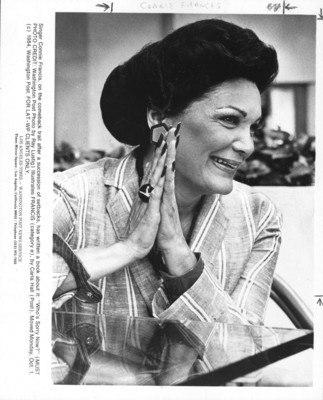
Connie Francis has warm feelings toward Las Vegas and believes she performed here during a special time in the city's history.
"Those were the happiest, most exciting days of my life. Oh, I loved it!" she told me last fall. "You see, in Las Vegas they used to have schools where anybody that was in the service industry, whether they were skycaps, or cabdrivers, or worked in the hotels, went to schools to learn how to treat tourists.
"When you got into taxicabs it was, 'Welcome to Las Vegas.' 'Let me recommend some shows to you.' 'Let me recommend some restaurants to you.' And it was a whole different thing. It was the most friendly town in the world -- very, very tourist oriented. And they treated their entertainers like gold, because that's what built the town -- the entertainers."
"When I was in Las Vegas, anything we wanted in the suite we had, whether it was liquor, or records or stereo system," she added. "If we wanted a suite, we had it. If we wanted them to rent us a house during the month we were there, we had a house."
Francis' career spans five decades, during which she conquered every part of the entertainment spectrum. Beginning in the mid-1950s, her recording career took off after her first No. 1 record in 1958, "Who's Sorry Now?" Since then, Francis has recorded 34 Top 40 hits, more than 70 albums, and starred in four successful movies, including the iconic "Where the Boys Are." She also has made many television appearances, and has performed in nightclubs and on concert stages all over the world.
But she has always had a fondness for Las Vegas. "I worked there eight weeks a year," she said. "One month and then another month. That's what I looked forward to more than anything else!"
Her first Las Vegas appearance was at the Sahara in 1961.
"The director of entertainment at the Sahara at that time was a man by the name of Stan Irwin. And he came to see me at the Cloisters (in Los Angeles). And he asked me if I would like to be on the bill with Dan Dailey for $6,000 a week, and I thought that was terrific," she said. "So I made my first appearance there, and I was second on the bill with Dan Dailey. And the next time I went back, I was offered $25,000 a week to start, and I was with them for eight years."
Some of her opening acts included Pepper Davis and Tony Reese (beginning in 1962 with Francis in the Congo Room at the Sahara), Pat Henry (with Francis in the Congo Room in 1965, in the days before he opened for Frank Sinatra) and Guy Marks (in 1970 at the Riviera's Versailles Room). Francis appeared in several hotels during this period, including the Landmark in October 1970, with musical direction by Ray Sinatra and his orchestra. With her on the bill was Danny Davis and the Nashville Brass.
Part of the excitement of Las Vegas for Francis was the glamour. Her stage gowns and outfits were designed by the Oscar- and Emmy-winning William Travilla. And, back then, everyone dressed up, including the audiences.
"It was like Broadway today," she recalled. "We would wear gowns and long white gloves, and furs. I mean ... there was glamour about Las Vegas. It was a whole different thing."
Stars appreciated the respect that was given them when audiences dressed for a show. And that respect, Francis said, was returned. "I was as careful as to what I wore to go to dinner or to go to a show as I was to do my own show."
Francis would take in other acts along the Strip after her own performances.
"There wasn't a night after my show that I didn't see another entertainer work in a lounge," she said. "If Don Rickles was in the Casbar Lounge, then I was there every night. And if Shecky Greene was at the Riviera at the same time, I would go and see Rickles one night and go see Shecky Greene the next night, and then go to Rickles the next night, or Mel Torme, or Louis Prima."
Francis performed during a legendary era for Las Vegas, and among her favorite entertainers was Frank Sinatra.
"When Frank Sinatra was in town, that was the most exciting of all, because after his shows he would hold court at the Sands Hotel, and we would go there almost every night and meet all the most fabulous stars. Just have a great time."
Francis also grew to know her audiences in Las Vegas.
"The audiences on the weekends (from the West Coast) were far different than the audiences during the week," she explained. "Of course, there were always a lot of transient audiences. That is why you could work a month, because it's never the same audience."
She sometimes even found herself on the same flight with her fans.
"There were so many people who would fly that 45-minute flight on TWA (from Los Angeles). I know I did! When I was doing movies, I would get on that Friday night plane and head back on Sunday night to be back on the set on Monday, just to go to Las Vegas. There were a lot of weekend people from the coast. It was very exciting."
While most of her time in Las Vegas was rewarding, there were exceptions.
"Actually, I found two husbands there, unfortunately," she said, chuckling softly. "Because it was the only place where I stayed long enough to get to know anybody."
And Francis remembered a terrifying incident that occurred during her first appearance on the Strip with Dailey.
"I closed the show (instead of opening) because the FBI had me stuck in Los Angeles. I went to Los Angeles for the day for a meeting, and I got out and I was on the plane headed back to the Sahara for the 8 o'clock show, and a man came on the plane and left a briefcase on the seat next to me, and then disappeared. And he never came back!"
"The plane was headed toward the runway, and I went to the stewardess, I was very alarmed, and I said, 'A man left his briefcase and he never came back for it,' " she continued. "They turned the plane around and the FBI found a bomb in the briefcase. So everybody had to stay there while they went through all our luggage and asked us questions. And I said I had to get back to the Sahara, I had to do a show. ... I didn't miss the show."
This was one of several harrowing experiences in her life, which she explained in her 1984 autobiography, "Who's Sorry Now?" Francis candidly wrote about her meteoric rise to fame and fortune, her four failed marriages (and an adopted son), her clinical depression, and her medical and other personal problems that almost ended her career and her life.
Her story begins on Dec. 12, 1938, when she was born Concetta Rosemarie Franconero in the Ironbound neighborhood of Newark, N.J. She began singing and playing the accordion at age 4, and by 11 was appearing locally on TV before reaching a wider audience on "The Ted Mack Amateur Hour," "The Arthur Godfrey Show" and "Ford Startime."
After high school, she changed her last name to the more marketable Francis, and signed a recording contract with MGM records.
Her first record in 1955 was "Freddie," and it went nowhere. After nine more failures, her father suggested she record a 1923 Bert Kalmar and Harry Ruby ballad called "Who's Sorry Now?" It skyrocketed her to national attention. Dick Clark told his teen audiences to keep an eye out for "this new girl" and her song "that is heading straight for the number one spot."
"Who's Sorry Now?" sold a million copies, and in 1958 "American Bandstand" voted her Best Female Vocalist of the year, a record she would continue for four years in a row.
Her career took off with TV, cabaret and concert appearances worldwide. She also starred in a handful of films including "Where the Boys Are" in 1960.
Her songs are anthems of a whole generation: "Who's Sorry Now?" "Everybody's Somebody's Fool," "Don't Break the Heart That Loves You," "Where the Boys Are," "Stupid Cupid."
She also recorded several of her hits, plus countless albums, in more than a dozen languages. She recorded a few country-western albums as well, having a moderate hit record in 1969 with "The Wedding Cake."
During the Vietnam War in 1967, Francis entertained U.S. troops, which she recalled "was the most rewarding experience of my career."
In the 2003 NBC television drama "American Dreams," Francis was portrayed by singer LeAnn Rimes, bringing her story to a younger audience.
Today, Francis is working on a new autobiography and involved in charitable work. She also plans to bring her life story to the silver screen. Francis continues to record and appear in concert; her most recent Las Vegas show was in 2004.
She speaks lovingly of those times when she appeared here.
"I don't think there will ever be days like that again," she reflected wistfully. "I always tell people I lived at the best time possible."


