



ACLU decries law against handbilling by wedding chapels
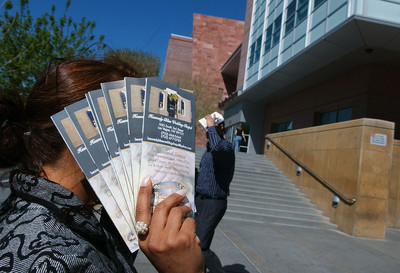


When researching new regulations for wedding chapels, city of Las Vegas attorneys found something they didn't expect: a state law that says chapels can't pass out fliers in front of the Las Vegas Marriage Bureau.
The discovery Monday night threw a monkey wrench into an already drawn-out process and set up, potentially, yet another showdown over free speech on Las Vegas' public walkways.
"That property around the courthouse looks like it's all courthouse property," said Brad Jerbic, attorney for the city of Las Vegas. That includes the sidewalks, and state law says that it's "unlawful" to solicit "any person to be married" while on courthouse property.
Even so, there's still a public forum, said Allen Lichtenstein, general counsel for the American Civil Liberties Union of Nevada.
"State law does not trump the United States Constitution," he said. "The courts have been clear that the status of a sidewalk is not dependent on who owns it."
The city has been looking at ways to better regulate handbillers who congregate at the corner of Clark Avenue and Third Street, hoping to steer couples getting marriage licenses to their respective chapels. "Our goal," Jerbic said, "is to see that the customer has some breathing room."
It's a thorny enough issue on its own, given free speech concerns and the fact that many smaller chapels downtown rely on handbilling to draw clients.
Handbilling isn't universally popular, though, because of aggressive tactics employed by some chapel agents.
Clark County Clerk Shirley Parraguirre said the state law could simplify enforcement. Security at the Regional Justice Center or Las Vegas Police waited until they witnessed a handbiller doing something untoward to take action.
"I will have to assume they will enforce what Brad has discovered here," she said Tuesday. "I think you could see Metro enforcing it now because if there are handbillers there, it's against the law."
Handbillers could still be nearby, such as across the street from the RJC.
Lichtenstein warned that the law's singling out of wedding solicitations is "a content-based violation." As long as a business is legal, "you can't have state laws that say you can't do this kind of advertising or that kind of advertising."
Jerbic stressed that more research is needed.
If they find that the city of Las Vegas does have some jurisdiction, the city will return to a proposal to set up zones where handbillers could pass out chapel information while leaving pathways for couples to reach the marriage bureau unmolested.
But "nothing's going to go before the council until I'm 100 percent sure where that property line is," Jerbic said, which means handbilling restrictions probably won't be part of an ordinance that's up for review next week.
Emma Mayberry of the Lily of the Valley wedding chapel said she hopes there's a way to keep handbillers in front of the marriage bureau, since it's how she generates business.
"We want to keep them in the frame of mind of it being a possibility, as opposed to them just being pushed completely out," she said.
Handbilling from across the street will make it harder to recruit customers, said Emilyrose Garcia of the Heavenly Bliss Wedding Chapel.
"But what can we do? It's the law," she said. "As long as we're going to have peace, I'm OK with it."
The city is moving forward with new licensing requirements for wedding chapels.
If approved by the Las Vegas City Council, the revised rules would require new chapels to get a privileged business license, which requires a background check of the principals and approval by the council.
Existing chapels could also be required to go through that process if, for example, the city documented complaints about the business.
Contact reporter Alan Choate at achoate@reviewjournal.com or 702-229-6435.


