



Allegiant Travel Company reports another solid profit
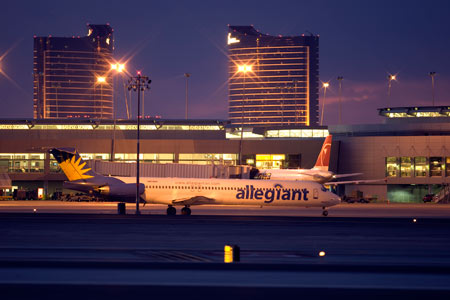


Las Vegas-based Allegiant Travel Co. soared above an awful leisure travel economy and some rare bad publicity to post a 25.5 percent profit on $148 million in revenue in the second quarter.
During a conference call Wednesday, the company, parent of the low-cost airline Allegiant Air, presented a financial position in stark contrast to the rest of Las Vegas and the travel industry.
Namely, Allegiant is making lots of money.
“We find ourselves in an exceptional place,” said Allegiant CEO and President Maurice Gallagher of the company, which posted its third consecutive quarter of double-digit profits while other airlines and Las Vegas as a whole sunk further into economic malaise.
Allegiant’s revenue of $148 million was up 12.5 percent from the previous year, net income was $23.9 million, up from $2.6 million in the second quarter of 2008, and diluted earnings per share rose from 13 cents to $1.17.
Much of Allegiant’s strength in the quarter came from the addition of 13 new routes to a new base in Southern California, which added to the airline’s list of destinations that already included Las Vegas, Florida and Arizona.
Allegiant also increased capacity on existing routes by 15 percent.
Allegiant officials said the airline benefited from still-strong economies in places like Bismark, N.D. Bismark typifies the type of noncompetitive, small town market the airline specializes in identifying and connecting to major destinations.
“Places like the Dakotas and the Great Plains are still doing quite well,” said Ponder Harrison, Allegiant’s managing director for sales and marketing.
Low room rates in Las Vegas have customers extending their stays, which means they are buying more room nights through Allegiant’s booking systems that allows them to add lodging while reserving seats on a flight.
In addition to raising revenue, Allegiant also managed to cut costs.
Average stage length, the distance of any given flight, decreased 1.1 percent to 828 miles, which shortens flight times and lowers fuel and labor costs.
Load factor, the percentage of full seats on a given flight, increased 0.3 percentage points to 90.8 percent, which equates to a slight increase in efficiency.
The per passenger cost, excluding fuel, was $46, down from a peak of $55 in December.
All the good economic news for Allegiant, including a 27.8 percent increase in passengers flown to nearly 1.5 million, came despite some bad publicity earlier in the second quarter.
Between April and June there were three unrelated in-flight mechanical problems that scared, but didn’t endanger, passengers who experienced them.
Fallout from the incidents included lots of angry and distraught e-mails to a Fresno television blog and other media outlets stating Allegiant workers seemed indifferent to passenger concerns and ill-informed as to the cause of the problems.
During the conference call Wednesday, Allegiant officials didn’t address that issue.
Instead, they spoke about how the company intends to remain fiscally strong despite the recession.
In the short term Allegiant intends to continue to tweak routes and markets it serves to ensure it only makes flights that are profitable.
“The routes that don’t work we get rid of. We’re not shy about that,” said chief financial officer Andrew Levy.
In the mid-term, the airline is working to enable customers to book hotel rooms through Allegiant even if they don’t buy a plane ticket.
Company officials also said they have considered upgrading Allegiant’s fleet of MD-80 aircraft to planes that can travel further without refueling, which could put Hawaii in Allegiant’s reach.
“We always are looking at the aircraft market and always asking if we should be in another type,” Levy said. He didn’t mention Hawaii by name but said different aircraft would help Allegiant “tap revenue opportunities that currently we can’t get to with the MD-80.”
Contact reporter Benjamin Spillman at bspillman@reviewjournal.com or 702-477-3861.


