Answers bring more tears





Since Nov. 9, the day Kathleen Shinn watched life leave her daughter's tiny body inside Summerlin Hospital's neonatal intensive care unit, she has searched for answers to how and why her child was given a lethal overdose of zinc.
The registered nurse finally got answers Wednesday.
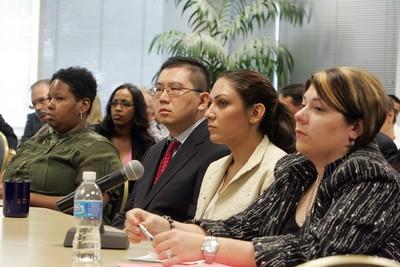
A day-long state Pharmacy Board hearing examined who was responsible for the error that ended Alyssa Shinn's brief life. Kathleen Shinn learned her baby girl was given a dose of zinc 1,000 times larger than her attending physician had ordered to be added to the intravenous solution that was her only source of nutrition.
"All you got to do is look and you could see the problem," Pharmacy Board attorney Louis Ling said. "The (IV) bag was larger than Alyssa's body.''
But the explanation for the error given by the three pharmacists and the pharmacy technician who handled the order was, "I did what I was supposed to do."
Each assumed the others had done their job accurately and therefore they didn't check for errors, Ling said.
For failing to verify the accuracy of the order, the Pharmacy Board fined each of the pharmacists $2,500 and ordered them to attend its Your Success RX continuing education program.
Pharmacists Nazanin Rezvan and Jackson Yu had their licenses suspended for 30 days. Yu was also ordered to complete 10 hours of continuing education on medication errors within 90 days.
Pamela Goff, the pharmacist who admitted to entering the wrong amount of zinc on the order-- she said she entered milligrams instead of micrograms when she placed the order in the computer -- had her license suspended for 30 days. The suspension, however, was stayed because her employment at Summerlin Hospital has been terminated.
Asia Cornelius, the pharmacy technician who filled the order, putting the zinc in Alyssa's Total Parenteral Nutrition IV bag, received no punishment.
Summerlin Hospital's pharmacy was ordered to pay the maximum fine of $10,000, plus fees associated with Wednesday's hearing and the cost of the Pharmacy Board's investigation.
Kathleen Shinn had a difficult time getting pregnant, according to testimony Wednesday. She had undergone in vitro fertilization. She had also had a miscarriage.
On Oct. 19, Alyssa was born premature, at 26 weeks. She weighed 1 pound, 4 ounces.
Still, the baby was growing and gaining strength.
"I used to talk to her, read to her so she could hear my voice," Shinn said during tearful testimony Wednesday. "She would open her eyes and look at me. I knew that she knew who I was.
"She was peaceful and breathing on her own.''
When Shinn visited her daughter on Nov. 8, she was told Alyssa would be taken off the ventilator. Shinn left the hospital about 11 p.m.
About 3 a.m. the next morning, Shinn was awake and called the hospital to check on Alyssa.
She was told the infant was OK. But around that time nurses were hooking Alyssa to the IV bag containing the lethal dose of zinc.
It wasn't until 6:30 a.m. that the pharmacy caught its error.
Hours after filling the order, Cornelius had expressed concern about it to another pharmacy technician who had just arrived to start her shift. The recently arrived technician informed Yu, who called the neonatal intensive care unit, or NICU, and told them to stop the IV.
"Six people touched this and somehow those checks, and balances in place didn't work,'' said Gretta Worthington, the hospital's former director of pharmacy, during her testimony.
Yu said he called the Poison Control Center and searched the Internet to learn how to treat a zinc overdose. He also alerted Worthington, who was at home.
About 7 a.m., Shinn called the hospital to see how her daughter was coping without the breathing tube. She said nothing was mentioned about Alyssa's condition or the overdose.
Not until Shinn and her husband, Richard, arrived at the hospital at 9 a.m. did they have any idea their child might be dying.
"I saw a woman in a suit, some doctors and nurses standing over my daughter,'' she said. "I knew something was wrong.''
Hospital officials escorted the Shinns away from their baby and shut the NICU. For hours they sat in a conference room without information on their daughter's condition.
Meanwhile, medical personnel were trying to flush the zinc from Alyssa's system. Officials said Wednesday that they didn't have the proper equipment to create the antidote. They had ordered antidote from a private pharmacy, but the treatment failed.
When the Shinns were finally told their daughter had been given too much zinc, Kathleen Shinn knew what was in store.
"I'm familiar with zinc. I knew it was heavy metal poisoning. ... I asked them what they were doing about it and they said they were looking it up on the Internet,'' she said. "I watched Alyssa turn blue from her toes to her head. The first time they let me hold her (that day), she was dead.''
Alyssa died at 4:20 p.m.
A coroner's report said she died from cardiac failure caused by zinc intoxication. The report listed "extreme prematurity" as a significant condition at the time of death.
"I'm the only one left of the four people involved," Yu told the board. "I have to face this every day. I have to face what happened that night.''
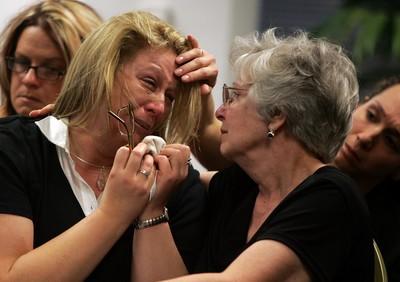
Shinn cried throughout the hearing listening to the explanation of her daughter's death.
Each of the pharmacists apologized to Shinn. At one point during Goff's testimony, the pharmacist turned toward Shinn.
"I'm a mother, and I could only think of Alyssa's parents," Goff said. "I think about them during the holidays. I think about them all the time."
As Goff spoke, Kathleen Shinn stood and walked to the table where Goff was testifying and embraced the pharmacist. The two hugged for about a minute as they sobbed.
The board recessed the hearing.
Officials concluded that communication between Summerlin Hospital's pharmacy and its NICU was faulty; the pharmacy's policies and procedures for compounding medications weren't up to date; and most of its pharmacists and pharmacy technicians lacked some training for their jobs.
Before she resigned in May, Worthington said Summerlin Hospital instituted about a dozen new policies because of Alyssa's death.
Pharmacy Board staff had recommended that Cornelius' license be revoked as a result of the overdose. However, some board members said they didn't have the authority to revoke her license because she isn't directly licensed by the board, and instead works under the direction of pharmacists.
Pharmacy Board member Katie Craven disagreed with that decision, arguing that the board should revoke Cornelius' licenses because she poses a threat to the public because she continues to work at a local pharmacy.
"We cannot revoke your license ... but by no means do you go unscathed,'' board president David Wuest told Cornelius. "If I thought we could revoke your license, we would. If I could suspend your license, I would.''