



Boggs talks to grand jury
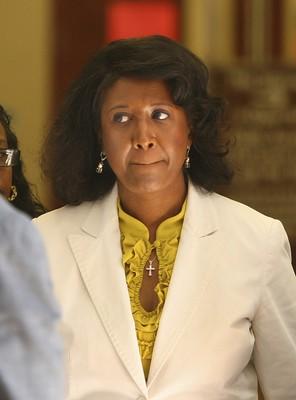


In an unusual and risky move, former Clark County Commissioner Lynette Boggs testified Tuesday before a Clark County grand jury that is considering indicting her.
As soon as today, the grand jury could indict the 43-year-old Republican on two felony counts each of perjury and filing of false documents.
Boggs was behind the closed doors of the grand jury hearing room for nearly two hours Tuesday afternoon before leaving the Regional Justice Center with her lawyer, Bill Terry, and a small entourage of friends. Neither Boggs nor her lawyer was willing to comment.
Boggs' decision to testify at her grand jury hearing was a "rare" and "bold" move, said one longtime courthouse observer, Charles Kelly, a defense attorney and former federal prosecutor.
"The Fifth Amendment is so strongly rooted in our system that people tend to rely upon that," Kelly said. "For somebody to feel they're going to testify before the grand jury, they must have a very profound sense of their innocence."
Only once has Kelly had a client testify at a grand jury hearing, he said.
"Once you testify before a grand jury, it opens the possibility of perjury, obstruction of justice, material false statements; and if you recall that's how they convicted (I. Lewis) Scooter Libby and Martha Stewart," Kelly said.
The grand jury proceedings marked a change in prosecutors' approach to Boggs' case.
On June 4, District Attorney David Roger filed a criminal complaint seeking to charge Boggs with two felony counts each of perjury and filing a false document. The charges focused on a pair of campaign documents Boggs filed last year in her failed bid to keep her commission seat for District F, which spans the southwest part of the county.
According to the criminal complaint, Boggs lied on her declaration of candidacy and said she lived within the boundaries of her commission district in the southwest part of the valley.
Authorities believe she lived at 3646 Dutch Valley Drive, a much larger house just outside that district; and they have many hours of video, which was provided by the Culinary union and the Las Vegas Police Protective Association, that indicate Boggs was living at that house.
Boggs had gotten on the wrong side of the Culinary union when she was a board member for Station Casinos, and she stirred the wrath of the police union when she challenged and opposed a contract that gave officers significant raises.
The charges also allege she falsely listed $1,230.52 in payments to Kelly McLeod for campaign expenses related to special events. Boggs paid McLeod for baby-sitting her children. Boggs has said she hired the baby sitter so that she could attend election events.
On June 7, Boggs appeared before Las Vegas Justice of the Peace Nancy Oesterle because a warrant had been issued for her arrest. Oesterle released Boggs on her own recognizance.
Boggs' preliminary hearing was scheduled for 9:30 a.m. Tuesday in Oesterle's courtroom.
During a preliminary hearing, prosecutors call witnesses and present evidence, laying out the basic elements of their case in Justice Court as they try to persuade the judge to send the case to District Court for trial.
Ninety minutes before the scheduled start time for Boggs' preliminary hearing, however, Oesterle allowed Boggs' lawyer to come before her and ask for a two-week postponement. According to the transcript of the hearing, prosecutors had no objections to Terry's requests.
If the grand jury does not indict Boggs, prosecutors could still pursue an indictment through a preliminary hearing in Justice Court.
At a preliminary hearing Terry would have the options of arguing his defense, presenting his own witnesses, cross-examining the prosecution's witnesses and calling Boggs to testify.
A grand jury hearing, on the other hand, is almost exclusively the prosecutors' turf. Defense attorneys can only attend a grand jury hearing while they have a client testifying; they can't address the grand jury and can't cross-examine their client.
The other key difference between a grand jury proceeding and a preliminary hearing is the secrecy of a grand jury hearing.
A source close to Boggs' case said a witness was reluctant to testify publicly, which was one reason prosecutors pursued a grand jury indictment rather than a preliminary hearing in an open courtroom.
The prosecutor for the Boggs' case, Eric Jorgenson, wouldn't comment on the hearing. His boss, District Attorney David Roger, likewise said he could not discuss the Boggs case specifically.
"If the case is complex or the witnesses are reluctant, a prosecutor might choose to present a case to a grand jury," Roger said.
"With complex cases involving many witnesses, it's easier to present a case to a grand jury, because there is no cross-examination of witnesses and prosecutors can get their witnesses in and out of the hearing in a timely fashion."
The secret hearings also are often used in cases in which witnesses fear intimidation, such as cases involving gang members, Roger said.
Once the grand jury hands up an indictment, that sends the case to District Court and the indictment becomes public. Eventually, so does the transcript of the proceedings.
If Boggs is indicted, it would be the latest low point for someone who was once a rising star in the Nevada Republican Party.
Her political career began in 1998 with a failed bid for the state Assembly. She had been a Republican but ran as a Democrat for the legislative seat. Afterward, she switched back to the GOP.
In 1999, the former Miss Oregon and assistant Las Vegas city manager was appointed to the Las Vegas City Council to fill the seat vacated by Arnie Adamsen when he launched a mayoral bid.
Boggs mounted a failed challenge to U.S. Rep. Shelley Berkley in 2002 and two years later was appointed to the County Commission. She defeated Democrat David Goldwater later that year to retain the seat and seemed positioned to win again before the new allegations surfaced heading into last year's election.
Boggs, a former reporter who once held public relations jobs with University Medical Center and the University of Nevada, Las Vegas, overcame bad publicity earlier in her political career.
In 2001, she faced state ethics charges for accepting a trip from Station Casinos to her alma mater, the University of Notre Dame. The state Ethics Commission cleared her with a 5-1 vote, saying she properly reported the trip as a campaign contribution.
Two years later, Boggs became a board member for Station Casinos but resigned the following year to become a county commissioner.
Boggs faced another ethics complaint in 2004 after former Assemblyman Wendell Williams accused her of trying to influence a bill during the 2003 legislative session that could have threatened her then-husband's job in the state treasurer's office.
The ethics complaint came a month before the election in her race against Goldwater, but it did not keep her from winning. The state Ethics Commission cleared her of any wrongdoing with a 5-1 vote.
In May, she announced the founding of FaithWorks, a nonprofit foundation that was to "address the physical and spiritual needs of the marginal and oppressed," according to the group's news release. She launched a weekly, hour-long religious talk show on the Internet on May 3.


