



Budget crunch, even less green


Nevada is experiencing lean times.
The Silver State faces a budget shortfall of $450 million. Public officials and business leaders alike are calling for sacrifice: Casino operators are clamoring for new levies on nongaming companies, while agencies ranging from school districts to corrections departments are paring millions from planned budget increases.
Legislators have even reined in scheduled tax cuts, canceling breaks to commercial developers building eco-friendly projects.
But one sector continues to enjoy a hefty tax advantage.
Thanks to a provision slipped into a catchall assessors' bill during the state's 2005 legislative session, golf courses across Nevada are paying a fraction of the property tax they shelled out before the law's passage.
The savings are dramatic. Assessed land values plunged from $25,000 an acre to $2,860 an acre on resort courses. Private courses, previously charged on a land value of $10,000 an acre, also enjoy the new, lower rate. And those reduced values have translated into substantially lighter tax loads, even for courses that members of the public can't use.
The assessor's and treasurer's offices in Clark County don't tabulate golf course taxes separately from other land revenue, so it's difficult to pinpoint exactly how much the 2005 law is costing public coffers. A few examples, however, show the magnitude of the relief.
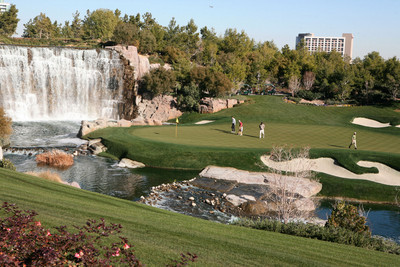
Taxes on the bulk of the course at Wynn Las Vegas dropped from $1.4 million in fiscal 2004-2005, two years before the law hit the tax rolls, to $53,900 in fiscal 2007-2008. For two half-acre parcels that Wynn Resorts Ltd. bought from former homeowners on the course, taxes dropped from $5,272 apiece to $13.17 each.
The tax decline at Wynn is especially pronounced because the course was out of commission in fiscal 2004-2005 while the resort was under construction. So the assessor's office based that year's taxes on the property's market value, said Gary Relyea, manager of property appraisal for the Clark County assessor.
Continuously operating courses have claimed their own sizable breaks. On two big chunks of the private Spanish Trail, taxes fell from $18,600 to $5,900. At TPC Canyons, taxes dipped from $146,000 to $75,200.
Multiply those tax cuts by the 60 or so courses in Clark County and the 115 courses across Nevada, and a bigger picture of the golf industry's property-tax benefit begins to emerge.
Lawmakers and county officials couldn't identify for certain which legislator wrote the golf-tax provision into the assessors' bill, but the Nevada chapter of the National Golf Course Owners Association and course developer Bill Walters were among those who pursued the addition.
To representatives of the golf industry, who initially asked for a $500-per-acre land valuation, the tax breaks aren't merely a sop for course operators. They're an important competitive measure designed to bring greens levies in line with the taxes course operators pay in states such as Arizona and Florida. The number of rounds played in Nevada has flattened in recent years, partly because golf destinations in other states command lower greens fees as a result of smaller tax bills, lobbyists argued. Throw in the expense of maintaining a desert course, and you have an ailing industry in need of a fiscal boost.
The bill also equalized disparate tax rates on golf land, and more importantly, it protected and preserved open space for community use, advocates said.
Those positives have come at a cost to local schools, though, because property taxes finance public education, on top of other functions such as library districts. That gave at least one legislator pause.
"I just was not convinced that they deserved a tax break at the expense of children's education," said Assemblywoman Sheila Leslie, D-Reno, who voted against the bill. "This was basically a tax break for golf courses that ended up giving us less money for education, and I couldn't justify that in my mind."
Leslie and other lawmakers also scoffed at the notion that golf courses constitute community open space, because some courses are closed to public play. Others charge prohibitive greens fees.
The golf course at Wynn, for example, hosts only guests of major local hotels, and golfers must fork over $500 in greens fees. Spanish Trail is closed to nonmembers. The TPC Canyons is open to the public and charges greens fees of $220 to $275, though a promotion through Jan. 23 has dropped greens fees to $75 for locals.
What's more, the law fixed tax increases on golf land at the rate of inflation. Through November, that gain was 4.3 percent year over year, roughly half the 8 percent increase in property tax that other local businesses face annually.
Golf courses can further shed taxes through an "obsolescence factor." That calculation allows operators to tally the number of rounds played in the busiest month of the year, apply that top activity level to all 12 months, subtract actual rounds played in the period and apply the difference to lowering land values. Course owners said the obsolescence element was essential to Northern Nevada greens shuttered during snowy months, but golf clubs statewide can use obsolescence to reduce values.
The golf course tax break didn't sit well with state Sen. Terry Care, D-Las Vegas.
Care was traveling Thursday and Friday and couldn't comment by press time on what he thinks of the law today, but he said in a 2005 hearing that he didn't appreciate its elitist undertones.
"We have run into golf courses before," Care said, "... but this, to me, especially this late in the session, smacks of uptown provincials wanting some special treatment in the Legislature."
Spokespeople for Wynn Las Vegas and the Nevada chapter of the National Golf Course Owners Association didn't return calls seeking comment on why breaks on land taxes remain important to the health of their business or whether the concessions would encourage them to open their greens to more citizens.
But they may soon have to defend the fee structure before legislators, who meet again in February 2009.
Leslie said she'd support a repeal of the tax breaks, though she noted that it's tough to reverse reduced levies once they're in place. A "groundswell" of support from other lawmakers would help push a change, she said.
"Clearly, giving specific businesses tax breaks is damaging to our overall ability to provide for essential state services," Leslie said. "I still think it was the wrong thing to do."
Contact reporter Jennifer Robison at jrobison @reviewjournal.com or (702) 380-4512.
Vote for your favorite Las Vegas holes to form a fantasy golf course.


