Child welfare cases argued
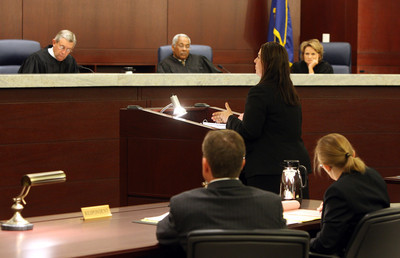
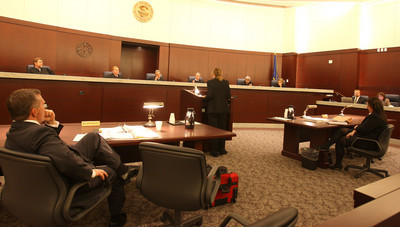



A small fortune in federal funds for Nevada's cash-strapped child welfare system appears to be riding on two Nevada Supreme Court cases.
Family Court Judge Gerald Hardcastle -- who no longer handles abuse and neglect cases -- previously ruled that Clark County Family Services personnel had not made a reasonable effort in finding permanent homes for two children referred to in court documents as Ashley J. and Derek K.
On Tuesday, a prosecutor from the Clark County District Attorney's office went before the Nevada Supreme Court to ask the justices to set aside those rulings by Hardcastle.
Deputy District Attorney Brigid Duffy said that Ashley J. and Derek K. are representative of many other cases in which there have been rulings regarding a "lack of reasonable effort," and each time such a ruling is made, Nevada's allocation of federal dollars for adoption assistance and foster care is reduced.
In 2005, for example, Nevada lost more than $840,000 because of the cumulative impact of "lack of reasonable effort" findings, Duffy said. Some of those funds can be claimed retroactively if those findings are reversed, she said.
"The purpose of those funds is to support children in foster care," Duffy said. "The purpose of the D.A.'s office is to protect the public's interest in these cases. The public wants these children supported."
But these cases aren't just about money, Duffy told the seven Supreme Court justices assembled at the Regional Justice Center. They are also about making decisions based on the law and serving the best interests of children who are designated wards of the court, she said.
"There's some arbitrary decision-making going on," Duffy said. "We have statutes telling a judge what to consider when determining if a reasonable effort has been made."
In the cases of Ashley J. and Derek K, those statutes weren't followed, Duffy argued. At the time Hardcastle entered his finding on Ashley J. in 2006, the girl was in a home where she'd been for two years, Duffy said. The girl, who was 16 at the time, told the court she did not want to be adopted.
In Derek K.'s situation, efforts to place him with family members were stymied when his grandmother died.
Duffy's arguments were countered by Nevada Senior Deputy Attorney General Jill Davis, who represented Hardcastle.
"This is all about money," Davis contended. "Who's going to benefit? It's DFS (the Department of Family Services)."
Davis also argued that Hardcastle was well within his discretion and authority to make the findings that he did. Over the course of nine years, the child welfare system had failed to find Ashley J. an adoptive home. She had gone through 14 different placements by the time Hardcastle ruled that there had been a lack of reasonable effort in finding her a permanent home, Davis said.
Davis also argued that a ruling going against Hardcastle would diminish a judge's ability to be a check on the Department of Family Services and how it spends the federal money it's received.
"If a ruling goes against Judge Hardcastle today, it could possibly handcuff other judges trying to define if lack of reasonable effort has occurred," Davis said.
Justice James Hardesty commented that decreasing funding for the Department of Family Services seemed self-defeating.
"You have to have some control over DFS," Davis responded.
Justice Michael Douglas said that the question before the court hinged on the best interests of the individual children and not on who should be a check on the system. He also noted that determining the best interests of the children would be problematic. Ashley J. was not in a permanent home, but she was showing positive results in her placement.
"Isn't a judge supposed to be looking at best interests and not just permanency?" Douglas asked.
"She was thriving where she was. What else was DFS supposed to do in this case?"
Duffy also was questioned by the justices. Hardesty wanted to know why these cases hadn't been challenged before.
In the case of Ashley J., Duffy said a motion to reconsider was filed and denied by the family court.
The justices also questioned whether the Clark County District Attorney's office had the standing to bring these cases before the court.
Duffy maintained the authority to do so is spelled out in Nevada statute.
The justices accepted the arguments and adjourned. Their decision will be issued at a later date.
Contact reporter Lisa Kim Bach at lbach@reviewjournal.com or (702) 383-0287.