DOE files to build Yucca
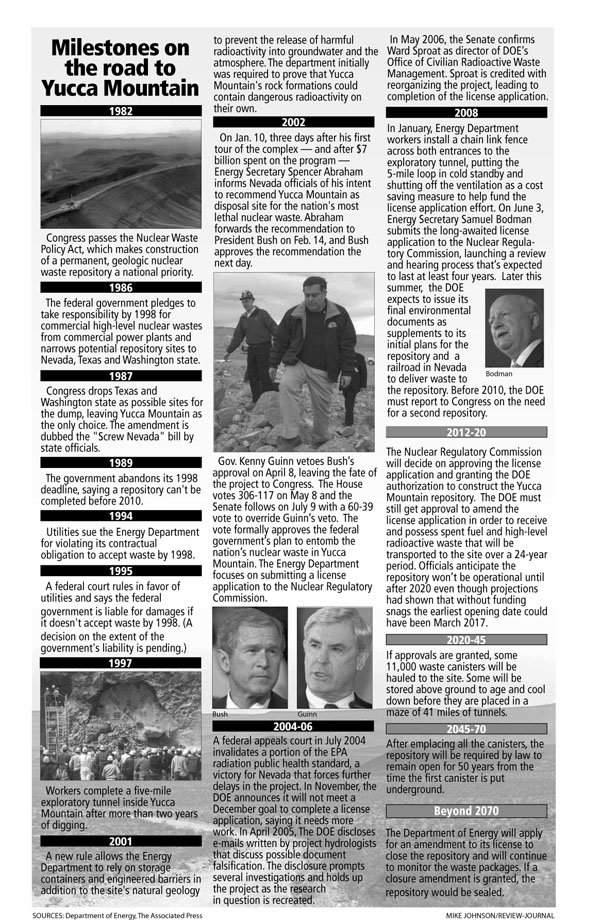





WASHINGTON -- After years of setbacks and delays, the federal government's plan to bury nuclear waste in Nevada took a significant step forward Tuesday when the Department of Energy applied for permission to build a repository at Yucca Mountain.
A moving truck pulled up to the Nuclear Regulatory Commission at 8:40 a.m. and dropped off 15 sets of the department's construction license application. Each set consisted of 17 binders and totaled 8,647 pages, with electronic copies on DVD.
The license application represents a milestone once thought out of reach for the project that was conceived more than 25 years ago to locate a resting place for 77,000 tons of spent nuclear fuel from commercial power plants and highly radioactive waste generated by the U.S. military.
"Today's application begins a new phase for the Yucca Mountain Project," Energy Secretary Samuel Bodman said at a news conference. "This is a filing that will put this project in a new frame of mind moving forward."
Long roads still lie ahead. The project faces NRC technical reviews that are expected to take four years or more, continued fights for funding, and anticipated legal and political challenges from Nevada officials and other critics who charge the project is flawed and unsafe and will never be built.
Bob Loux, director of Nevada's Nuclear Projects Agency and a longtime opponent of the project, said the license application is so "grossly deficient that a fair and unbiased NRC would reject it."
"Science fiction is what this is," Loux said from his office in Carson City.
Project chief Ward Sproat said the Yucca site could start accepting nuclear waste by 2020 at a cost of $70 billion to $80 billion under a best case scenario for DOE. Other experts think a more realistic goal might be the middle of that decade or later, if ever.
On Tuesday, Energy Department officials celebrated with cookies and punch at Washington headquarters. DOE also gave workers commemorative Yucca Mountain medallions that cost $3.75 apiece for 2,000 copies.
The licensing paperwork was drawn from decades of study into the geology of the mountain, 100 miles northwest of Las Vegas, and a number of engineering add-ons. The project envisions storing radioactive waste in as many as 11,000 containers in a 41-mile warren of tunnels spaced 1,000 feet below the surface.
"There are a lot of emotional people today because some of them didn't think they would be around long enough to see this happen," Sproat said.
In recent years, the project was buffeted by an e-mail scandal, a series of deep budget cuts and management missteps. A target date of 1998 to start accepting waste at the site fell aside, as did a 2010 planned repository opening.
Sproat, who was installed in 2006 following a career as a nuclear industry executive, said Yucca Mountain managers "have turned around a program that was known for continually missing milestones into one that has met or beat every milestone set for them two years ago despite significant budget cuts."
Nevada's opposition
Still, DOE's application came under immediate attack Tuesday by top Nevada officials, who vowed to redouble their efforts to keep high-level nuclear waste out of the state.
Nevada Attorney General Catherine Cortez Masto planned to file a petition today with the NRC calling on the commission to reject the license application out of hand. Attorneys for the state have said they planned to prepare 250 to 500 challenges to be aired during license hearings.
Nevada officials were reviewing the application Tuesday to determine how many key elements were missing, which would provide the state with opportunities to challenge, said Marta Adams, deputy attorney general.
"It is our understanding there will be significant gaps," Adams said. "We anticipate challenging the completeness of the license application."
When NRC hearing boards convene, the state, Clark County and the rural counties surrounding the site will be formal participants, with the Nuclear Energy Institute and California.
The Timbisha Shoshone, the affected Indian tribe in the proceedings, reacted bitterly to the license application and said in a statement from tribal Chairman Joe Kennedy that the project "is moving ahead over the rights and need of the tribe to conduct our own planning, oversight and monitoring for the protection of all living things."
Loux argued that the application does not contain a final design of the repository and that there is no design covering transportation, aging and disposal canisters.
The Energy Department "relies on this 'drip shield' concept that they're not going to install for 300 years, yet they want credit for that" as a barrier to retard corrosion of the canisters, he said.
Also, the Environmental Protection Agency has not issued a final radiation safety standard that the NRC would have to adopt and to determine whether the license application conforms to it.
"Virtually on every front, the political, the technical and procedural fronts, this thing isn't going anywhere," Loux said.
That sentiment was echoed by members of Nevada's delegation.
"This latest attempt by the DOE is merely a last-ditch effort to breathe life into bad policy that is wrong for America. Yucca Mountain is dead, and it is time to move forward in a new direction with on-site waste storage," Sen. John Ensign, R-Nev., said.
Senate Majority Leader Harry Reid said the application includes designs that are "only 35 percent complete."
The document "lacks critical information that cannot simply be overlooked," he said. "For example, just how would the Energy Department respond in the event of an emergency? We can't answer that question because the department doesn't even know."
Rep. Shelley Berkley, D-Nev., said the license application "should be seen for exactly what it is -- an $80 billion goodbye present to the nuclear industry from President Bush at the expense of the health and safety of families in Nevada and nationwide."
'Start the review'
Officials from DOE and NRC contend a license review could be started without an EPA-finalized regulation setting public health limits on radioactive materials.
The materials would escape from the repository over periods stretching to a million years.
Having an EPA standard in hand "is not a requirement," Bodman said. "It is certainly possible and appropriate for us to file an application prior to EPA determining the standard. Let's get the review started."
"This application is a very high-quality, extremely detailed document," Bodman said. "It is our collective judgment that the Nuclear Regulatory Commission will conclude that this project can and will be completed in a safe and secure manner."
The NRC will undertake a 30-day initial review of the application for completeness, spokesman David McIntyre said. If the paperwork passes muster, the agency would formally docket the application and start in-depth safety reviews that could consume the next year and a half.
Nevada's congressional lawmakers scheduled to meet today to determine what actions to take now that the project will be under the umbrella of the NRC, which focuses on safety matters. A majority of Nevadans in polls oppose the repository on the belief it will be unsafe.
Nevada officials argue that delay has been a valuable ally against Yucca Mountain.
As time has worn on, new thinking has raised questions about whether a repository as designed still is the best approach for the United States to manage nuclear waste.
Some members of Congress have become interested in reprocessing nuclear fuel to draw out more energy.
"It is my belief that America needs a solution to the nuclear waste question, and I believe that reprocessing could in fact be the best way to meet our nation's needs. Nevertheless, it is important that the NRC begin work on its review process for Yucca Mountain so that all of our options remain on the table," said Sen. Pete Domenici, R-N.M., a leader on nuclear issues who is retiring this year.
DOE expects its application will be a confidence-booster for the program and for allies in Congress who have failed to act on bills to move the project along, Sproat said.
"I believe they will be energized and very supportive now that we have actually done this," Sproat said.
Sproat acknowledged that with DOE applying for a license now, NRC safety reviews could be well under way by the time a new president takes office next January and that Yucca Mountain could be shielded if there is a new critic in the White House.
Expected Republican nominee John McCain supports Yucca Mountain. A spokeswoman for probable Democratic nominee Barack Obama has said he would withdraw the application.
Sproat said a new president might find that easier said than done given a web of DOE contracts with utilities and states and lawsuits that are costing taxpayers millions of dollars in damages because the government has yet to open a waste site.
"Regardless of what the rhetoric is on the campaign trail, and regardless of who wins. ... I personally think they are going to say let's wait to see what the NRC does with the license application," Sproat said.
Contact Washington Bureau Chief Steve Tetreault at stetreault@stephensmedia.com, 202-783-1760, or reporter Keith Rogers at krogers@reviewjournal.com, 702-383-0308.
On the Web View the license application