Down memory lane at inaugural ball


Former Gov. Richard Bryan remembers the first inaugural ball he attended.
It wasn't his. And it wasn't exactly glamorous.
In 1959, Bryan already was politically active as a senior and student body president at the University of Nevada, Reno. And so, when Grant Sawyer became governor, it was only natural that Bryan attended his January inaugural gala.
"His ball was held in the high school gym in Carson City," Bryan recalled. "It's not quite the way it is today."
Bryan's memories of balls past resurfaced as he and his wife, Bonnie, attended Friday night's inaugural party for Republican Gov. Brian Sandoval and his wife, Kathleen. Bryan, a Democrat like Sawyer, went on to have two inaugural balls of his own, in 1983 and 1987, before he left the governor's office midterm after he was elected to the U.S. Senate in 1986.
The ball for the Sandovals in Las Vegas was held for 2,000 guests at the Wynn Las Vegas resort, all glamour on the splashy Strip. And it was paid for through corporate sponsorship of at least $700,000, a practice that began when the balls became big productions. The first couple also danced and dined at a Reno ball Saturday night at the Silver Legacy Reno resort.
Bryan looked dapper in his formal black tux, an outfit that may have been a bit out of place at Carson High.
"I hate wearing this stuff. I really do," he chuckled, with a dismissive wave at his bow tie.
Bryan wasn't the only former governor traveling down memory lane Friday night.
Bob Miller, a Democrat who succeeded Bryan, held his first inaugural ball two years into the job. He had been lieutenant governor, took over for Bryan and then won election to the top state office for the first time in 1988.
Miller and his wife, Sandy, laugh when they think back to their first dance at their 1989 inaugural ball.
Sandy Miller had borrowed some expensive jewelry to wear from an Ivana Trump collection since she didn't have the budget to buy any fancy earrings or necklaces of her own. In the middle of their dance, the necklace slipped off.
And thus began a search.
"I found the necklace, but I spent the rest of the night counting jewelry so it wouldn't get lost," Sandy Miller said.
She learned her lesson. At their second inaugural ball, she wore her own simple jewelry.
Her dress was simpler, too, after wearing what she called a "theatrical dress" the first time around. Made by a Nevada designer, the dress worn by the former first lady had a big skirt and was a mix of the state colors, blue and silver.
"It felt like I was playing the role of first lady," Sandy Miller recalled.
The Millers' son, Ross, has his own special memories of those inaugural balls.
Now secretary of state, Ross Miller said he was just starting high school when he attended the first evening of dinner and dancing to celebrate with his parents. The thing he remembers most, he said, was "feeling very awkward in a tuxedo."
His eyes lit up when he recalled the second inaugural ball, held when he was a high school senior.
"I got my own table and I got to invite as many girlfriends as possible, so that was good," Miller said.
Now, he and his wife, Lesley, are expecting their third child on March 15. After two girls, the Millers are expecting a boy, said Lesley, who wore a flowing black dress and wrap covering her shoulders.
"Black is always a good color for a pregnant girl," she said.
-- Laura Myers
fight over budget numbers
Democrats and Republicans in Carson City are debating education in advance of the upcoming legislative session.
But they aren't talking about how to make it more efficient or effective. They are fighting over whose numbers they should use to set the terms of the conversation.
"No one is actually talking about improving educational attainment of students," said Jeremy Aguero, a principal at the economics research firm Applied Analysis who is preparing his own budget report. "That is not even part of the discussion right now."
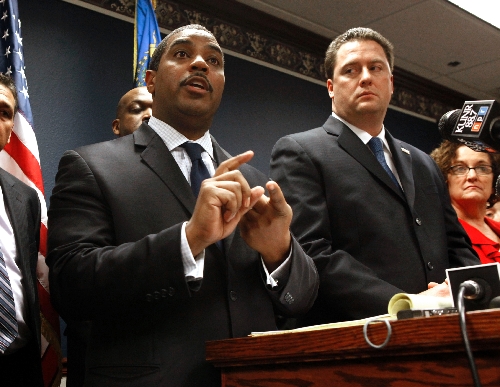
Late last week, after two days of meetings in which a Democrat-controlled legislative commission grilled officials from the administration of Republican Gov. Brian Sandoval, Democrats led by state Senate Majority Leader Steven Horsford, D-Las Vegas, and incoming Assembly Speaker John Oceguera, D-Las Vegas, sent press releases pushing their own versions of budget numbers. They suggest greater cuts than the governor is letting on by comparing the proposed budget to the 2009 legislatively approved budget.
Horsford accused Sandoval of seeking to cut higher education 30 percent, while Sandoval says he is cutting it 7 percent.
Horsford justified the higher figure by throwing in a proposed 5 percent cut in state worker pay that would affect higher education employees and a potential 12 percent tuition hike that would affect students.
In addition to throwing out new numbers, Horsford accused Sandoval of "cutting off the possibility of a robust economic recovery" by cutting higher education.
Oceguera accused Sandoval of cutting $668 million in state support from K-12 education, which he says adds up to 27 percent, as opposed to Sandoval's stated proposal to cut $212 million, or about 9 percent, of general fund support from K-12.
Oceguera said Sandoval proposed "draconian cuts to education funding."
Sandoval, in turn, wants to stick to numbers that compare his proposed budget to the revised budget former Republican Gov. Jim Gibbons and the Legislature approved in the 2010 special session, which involved cutting about $330 million in part by cutting K-12 and higher education 6.9 percent.
On K-12, Sandoval's budget shows state general fund support shrinking from $2.4 billion in 2009-11 to $2.2 billion for 2011-13, a difference of 9 percent.
Total K-12 spending in the Sandoval budget falls from $3.6 billion to $3.1 billion, or 12 percent.
In a press release that arrived moments after Oceguera sent his statement, Sandoval said: "Other figures, such as numbers from 2003 before the current economic crisis, are only being used to make a case for higher taxes and to mislead the public."
On higher education, Sandoval's budget shrinks total funding from $1.4 billion in 2009-11 to $1.3 billion, or 7 percent.
Sandoval leaves out of his comparisons one-shot money that came through the federal American Recovery and Reinvestment Act of 2009, also known as the economic stimulus.
Sandoval's chief of staff, Heidi Gansert, concedes that if stimulus money is included the higher education cuts are 17.7 percent.
Documents Sandoval included with his budget disclose the stimulus figures, but he didn't include them in his State of the State speech.
Using numbers based on spending proposals from 2009 or earlier "doesn't make sense," Gansert said, because Sandoval wants to compare actual money spent in the 2009-11 biennium to his proposed budget for 2011-13, not the amount legislators and Gibbons wanted to spend in 2009 when they set spending at levels that exceeded available revenue.
True spending is "the current and accurate budget, and that is why we are using those figures," Gansert said.
-- Benjamin Spillman
Contact Laura Myers at lmyers @reviewjournal.com or 702-387-2919 and Benjamin Spillman at bspillman @reviewjournal.com or 702-477-3861