Dream coming true for son who lost father to Alzheimer’s
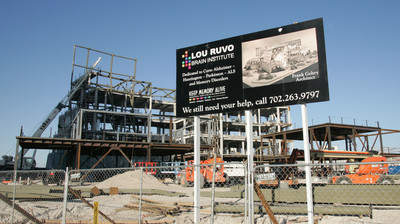



Dwarfed by the behemoth World Market Center, the structure of the Lou Ruvo Brain Institute is starting to take shape.
Although it's not scheduled to be completed until late 2008, it's already easy to tell that it won't be the largest building downtown. Far from it. At 67,000 square feet, the Institute would fit on many Strip casino floors with plenty of room left for slot machines
It's months away from mirroring architect Frank Gehry's vision. One day, passersby won't be able to resist staring at its assemblage of shapes and wavy outer grid that appears to have been drawn in a dream. For now, you must use your imagination.
There, up near the top of the construction project, you can see the first sign that this building, like its greater purpose, will be unlike any other in Las Vegas. A crane, far from the tallest on the job in town, stands at the ready. The steel framework that will brace Gehry's grid is going in, its roller-coaster curve giving it away.
The Ruvo Institute will stand at the corner of Grand Central Parkway and Bonneville Avenue near the Clark County Government Center in the heart of Union Park.
I drive by the construction site often. For some reason, it makes me feel good. I think of the building, diminutive by our gaudy current standards, and am already reminded of the mind's delicate balance. My own family members who suffered from memory loss at times seemed as jumbled and extraordinary as Gehry's dreamy design.
Gehry is considered the most famous living architect. His creative vision is found in the Guggenheim Bilbao art museum in the northern Spanish city, the Walt Disney Concert Hall in Los Angeles, and the Experience Music building in Seattle, among many. He is such a colossus that it's almost as much fun to watch architecture critics play "Twister" as they struggle to capture his modern style in words as it is to drink in his designs.
The institute is the passion of Southern Wine and Spirits of Nevada senior managing director Larry Ruvo. His father, Lou Ruvo, the owner of the popular Venetian restaurant on Sahara Avenue, was stricken with memory-ravaging Alzheimer's disease prior to his 1994 death. Larry Ruvo carried forward his dream of a Las Vegas-based research center for diseases of the brain and nervous system. Along the way, he forged a friendship with Gehry and has raised millions toward achieving his goal.
In a 2006 interview with institute director Libby Lumpkin, Gehry gave insight into his decision to embrace Ruvo's dream. The architect had spurned previous offers to design major projects in Las Vegas. But Ruvo's idea was different and held greater meaning.
"The creative process is not something you can plan," Gehry said. "It's sort of opportunistic. Something happens, you take advantage of it, and it unfolds. When Larry came to me, I thought, 'My God. This tiny little building for medical research, on a topic close to my heart. What a wonderful way to show Las Vegas that I don't hate the city.' Before Larry, I didn't see how I could contribute to Las Vegas. But in this case, I felt I could, so I was willing."
The institute will feature 13 examination rooms, medical research offices, a "Museum of the Mind," auditorium, and Wolfgang Puck café. It will offer outpatient treatment and will focus on Alzheimer's, Huntington's, Parkinson's, Lou Gehrig's and other neurodegenerative diseases.
In a world brimming with renowned medical research centers, the building rising from downtown's barren real estate might turn out to be among the smallest facilities of its kind. But its size is not a reflection of its importance to this community.
The Lou Ruvo Brain Institute is a testament to the dangerous idea that we can be more than a gambling town, more than a gigantic resort destination and tourist trap.
In a city that insists on burying its past, it is a reminder that memories are to be prized and protected.
As I watch the Lou Ruvo Brain Institute steadily take its amazing shape, I am heartened by the thought we live in a place where dreams of a higher purpose can also come true.
Where such dreams are possible, there is hope.
John L. Smith's column appears Sunday, Tuesday, Wednesday, and Friday.
JOHN L. SMITHMORE COLUMNSDiscuss this column in the eForums!