



Ensign sponsors tax-cut measure
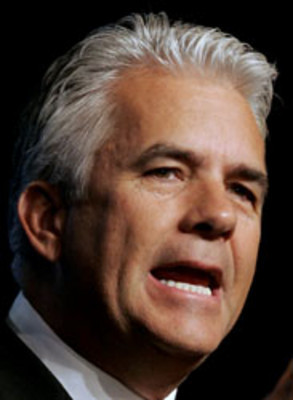


WASHINGTON -- Sen. John Ensign introduced on Wednesday an ambitious measure to cut taxes, as much to make a point as to get it passed into law.
The bill sponsored by the Nevada Republican would make permanent tax cuts for capital gains and dividends, as well as the lower marginal tax rates that were approved by Congress in 2001 and 2003 but are set to expire at the end of the decade.
It also would repeal the "alternative minimum tax," a glitch in tax law that is forcing growing numbers of middle-income taxpayers into higher brackets. An estimated 23 million households nationally including 128,000 in Nevada would be hit with higher taxes if Congress does not pass at least a one-year fix to the alternative tax.
At a news conference, Ensign and co-sponsor Sen. Mike Crapo, R-Idaho, said their legislation could cost about $1.5 trillion if enacted, making it the most far-reaching and expensive tax bill that Congress could consider this fall or next year.
Further, unlike the cases of other tax bills set for debate, the senators said they are not proposing ways to pay for theirs. Congressional rules require tax cuts to be offset by revenue hikes elsewhere unless sponsors can gain 60 votes in the Senate for a waiver.
Crapo said the senators want to make a point that it has become almost impossible for Congress to cut taxes because "pay-as-you-go" offset rules require taxes to be raised elsewhere in turn.
Ensign and Crapo's bill "is intended to bring this issue before the American public so we can engage them in what the proper tax policy should be," Crapo said.
The legislation is politically tinged. Ensign, who sits on the Senate Finance Committee, said it supposes that Republicans would vote to waive the pay-as-you-go rules in order to repeal the alternative minimum tax, at a cost of about $870 billion.
At the same time, he said, Democrats would support making permanent the lower marginal tax rates and lower taxes on capital gains and dividends.
Those factors combined would amount to about $750 billion in tax breaks that President Bush proposed and that Republicans engineered when they controlled Congress earlier this decade.
"We have to start by putting the issue out there, which is what we are doing today," Ensign said.
"We will challenge the Democrats to join us in doing something that is good for the American taxpayer."
Ensign argued that tax cuts are best for the economy, although others dispute whether that is always the case.
The Nevadan said voters are signaling that they want fewer taxes. He said he disagreed that his bill would cost $1.5 trillion.
"I do not buy into that this is going to cost us money," he said.
"When we cut tax rates, we produce way more tax revenue. It will incentivize people to work more and invest."
If Democrats are not willing to go along, "this will become an election issue," said Ensign, who forms campaign strategy as chairman of the National Republican Senatorial Committee.
Rep. Shelley Berkley, D-Nev., a member of the House Ways and Means Committee, which writes tax bills, said the approach by Ensign and his co-sponsors is not realistic and "is going to blow up in their face."
War spending and the needs of social programs such as Medicare make it difficult to justify deep tax cuts, particularly without ways to pay for them, she said.
"I think this is the most fiscally irresponsible proposal I have heard," Berkley said.
"Because of Republican reckless spending we are experiencing record deficits. The bottom line is, the money is not there."
House Democrats have a year-end tax bill including a one-year fix for the alternative minimum tax. They would pay for it by raising taxes on investment managers.
"The Republicans had seven years to do this, and they did not do it," Berkley said.
"The Democrats are trying to install some structure and discipline."


