



EPA says dust has settled in Las Vegas
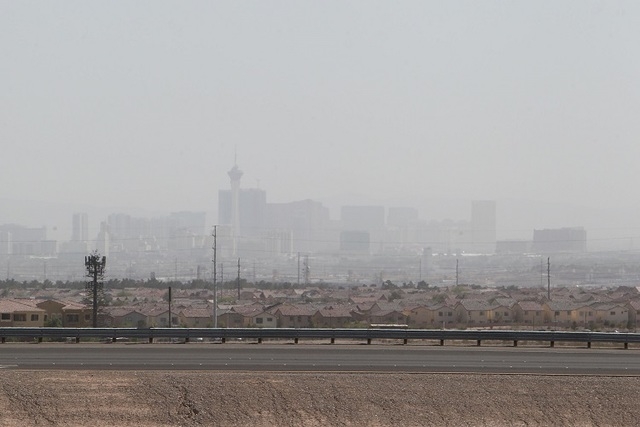


After a decades-long push to clear the air of dust pollution, the Las Vegas Valley is about to get a clean bill of health from federal environmental regulators.
The Environmental Protection Agency has determined the valley now meets federal standards for airborne dust particles small enough to be inhaled, known as PM-10, county officials announced Wednesday.
The EPA designated the valley as a serious non-attainment area for PM-10 pollution in 1993, a label that could have cost the state millions of dollars in federal highway money and prompted a federal takeover of local clean-air programs.
Instead, county officials helped reduce dust levels through tighter regulations, a permit and inspection program at construction sites, a dust complaint hotline and a “Don’t be a dusthole” public education campaign.
They were also helped by a sharp decline in construction after the collapse of the housing market about eight years ago, though most contractors already were doing a much better job controlling dust when the downturn hit, said Mike Sword, the Clark County Department of Air Quality planning manager.
Most of the valley’s PM-10 emissions are caused by windblown dust from construction sites, travel on dirt roads and disturbance of the desert’s natural crust on vacant land. The fine particles get into people’s lungs, where they aggravate existing health problems such as heart and pulmonary conditions. The very young and very old are among the most susceptible to the effects of dust pollution.
Sword said millions of dollars were spent over the past 20 years to hire enforcement staff, inspect work sites, pave roads and produce public-service announcements.
Scientific studies were funded to determine how much wind it takes to create dust in the undisturbed desert and to test soil stabilization methods. Construction companies were slapped with fines of $100,000 or more for violating dust restrictions.
As a result, the valley went from experiencing as many as 50 days a year with dust levels in excess of federal standards to averaging only about one dusty day a year over the past six years or so, Sword said.
“It’s been a huge effort,” he said. “The biggest thing the community got out of this was better quality of life.”
The EPA last month formally notified the county of its reclassification, which become official this month when it is published in the federal EPA register.
In a statement Wednesday, Clark County Commission Chairman Steve Sisolak called it “a historic moment and significant victory for Clark County.”
“The dust-control program we put together as a community was nothing short of groundbreaking,” he said.
“The loss of federal highway dollars would have been catastrophic for meeting the ongoing transportation needs of this community,” said Commissioner Larry Brown, who also is chairman of the Southern Nevada Regional Transportation Commission. “It was extremely important for us to meet this challenge and overcome it.”
To keep its new designation, the county must maintain its existing dust control program. Sword said that won’t be hard, even as construction activity picks up again.
“We still have active enforcement staff,” he said. “We still require dust permits.”
This marks the first time in decades that local air quality has met all federal pollution standards. The EPA previously classified the valley as a non-attainment area for carbon monoxide and ozone, but both pollutants are now within allowable limits.
Sword said he expects that to change in the coming years when the EPA adopts a new standard for ozone pollution. Meeting that lower benchmark could take years, he said, but it can be done.
“That was the biggest complaint when we were designated (for dust pollution): ‘We live in a desert; what do you expect?’ But we achieved compliance,” he said. “Ozone will be a similar challenge, but we’ll figure it out.”
Contact Henry Brean at hbrean@reviewjournal.com or 702-383-0350. Find him on Twitter: @RefriedBrean.


