



Exhibit puts focus on atomic bomb


When animator Peter Kuran worked on special effects for the first "Star Wars" movies, his colleagues told him they wanted to see something that never had been seen before.
With that, his mind whirled like electrons around the nucleus of an atom, and through it all he managed to find the right touch. His work in the late 1970s and early 1980s would help captivate the imaginations of millions of "Star Wars" fans.
Then after that first trilogy he set out in search of photographers who had faced a real-world challenge three decades before him: The government photographers who had captured on film the awesome power of nuclear bombs.
They were the inspiration for his new book, "How to Photograph an Atomic Bomb," and for his exhibit about it opening today at the Atomic Testing Museum, 755 E. Flamingo Road.
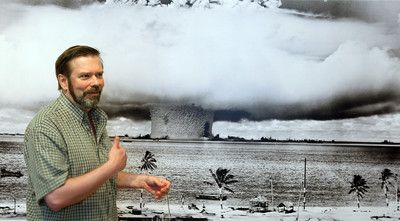
"To me it's like there's the image, but there was a camera photographing it, and somebody was with that camera," he said Friday as he strolled among the 57 images that will be on display at the museum through March 30.
From 2 p.m. to 5 p.m. today, he will be there to sign books. He also will team up in a lecture on the subject with Harold Agnew, a former director of the Los Alamos, N.M., national laboratory who flew as a scientific observer aboard the Great Artiste and filmed the atomic bombing of Hiroshima, Japan, on Aug. 6, 1945.
With relatively few images and film clips of the first test explosion, Trinity, and the combat use of atomic bombs at Hiroshima and Nagasaki, Japan, Kuran said the government was intent on perfecting the art of nuclear bomb photography.
During the era of above-ground testing between 1945 and 1963, "photography was the best way of being able to capture data," he said.
For the 21-kiloton, Crossroads Baker detonation near Bikini Atoll on July 24, 1946, special 100-foot towers were erected on the island for photographers to get unobstructed views.
One black-and-white image captured on an 8-by-10-inch negative shows a ship standing on end after the device, positioned 95 feet beneath seawater, erupted in a plume that raised 1 million tons of water in a column 300 yards wide. A cloud could be seen rising 6,000 feet up.
A year later, the job of photographing atomic bomb tests was delegated to the Air Force's 4881st Motion Picture Squadron. The squadron, which later was redesignated as the 1352nd Photographic Squadron, operated out of a secret production facility in Hollywood, Calif., known as Lookout Mountain Studios.
While atmospheric tests continued in the South Pacific, much of the squadron's work was devoted to the Nevada Test Site, 65 miles northwest of Las Vegas.
A company founded by Harold Edgerton, known as EG&G or Edgerton, Germeshausen and Grier, pioneered ultra-high-speed strobe techniques for producing split-second images of nuclear fireballs erupting. This allowed scientists to tailor their design of bombs to produce special effects.
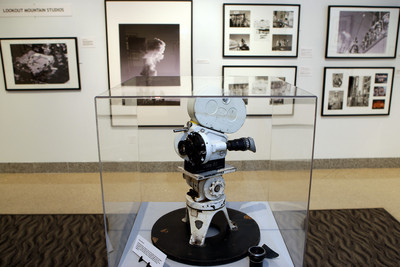
In addition to many historic still photos taken at the test site, Kuran's exhibit features a video clip and camera equipment used by atomic photographers. The 35mm high-speed Mitchell camera he used for "The Empire Strikes Back" is also on display.
ON THE WEB:
Stories on the history of nuclear testing at the Nevada Test Site


