



Gasoline prices more taxiing
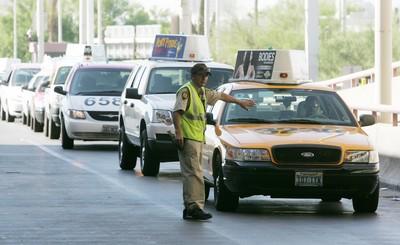


Sky-high gasoline prices now will soon mean record-high taxicab fares for Las Vegas Valley travelers, after the Nevada Taxicab Authority on Tuesday approved a 20-cent fare surcharge on every mile traveled by cab.
The surcharge, which goes into effect June 1, comes amid sustained gasoline prices over the $3 mark. On Monday, a gallon of regular-grade gasoline in the Las Vegas area averaged $3.20, an all-time high, according to AAA's Fuel Gauge Report.
Taxicab Authority officials said they would revisit the fare hike in the coming months, but they also expressed concerns that high gasoline prices are here to stay.
"There's no denying that fuel prices are doing what they're doing," said Kathryn Werner-Collins, the authority's chairwoman. "This is not something that is ever going to go away, unfortunately."
Authority officials did not directly say how long the surcharge may be in effect. The last fuel surcharge was in 2004, when a 20-cent fee was tacked onto the "drop," a charge for simply entering the cab. That was made permanent one year later when fuel prices remained high.
"Is this a temporary problem or permanent? We've been dealing with it for quite some time," said Jason Awad, owner of Lucky Cab Co.
The surcharge will bring the per-mile rate to $2.20, up from the current $2. That is on top of the "drop," now set at $3.20. Passengers are also charged up to 36 cents per minute of waiting time, and pickups from McCarran International Airport are billed an additional $1.20.
Under the new fare structure a customer taking a four-mile trip would be charged $12, up 80 cents from the previous rate. If the pickup was at the airport, that fare would become $13.20, also up 80 cents.
Even before the surcharge's approval, Southern Nevada cab fares were among the nation's highest. A study by Schaller Consulting last year found valley cabs charged the eighth-highest average fare among the nation's 23 largest cab markets.
The per-mile surcharge plan -- offered by Frias Companies, which owns five valley cab firms -- was widely backed by other valley cab firms, after the board and cab companies dismissed an authority staff recommendation to instead increase the "drop" by 30 cents.
Mark James, chief executive officer of Frias Cos., argued that a hike in the "drop" wouldn't be equitable, since a passenger traveling a short distance would face the same surcharge as one travelling a long way. Others agreed.
"The people using the cabs more, (who travel) more miles, should pay more," Awad said. "It's just logical."
Others argued any hike in the "drop" -- the first price passengers see when entering a cab -- would create sticker shock and drive riders away.
"That is going to price us out of the market," said Cheryl Knapp, general manager of Whittlesea Bell Transportation.
Werner-Collins acknowledged the taxi industry was increasingly at risk of pricing some potential passengers out of the cab market with fare hikes. "That's the last thing in the world the industry wants."
The only opposition to the per-mile plan came from the Industrial Technical Professional Employees union, the valley's largest labor representative of cab drivers, which approved of the surcharge in concept but wanted it classified as a fare hike instead.
Some companies keep fuel surcharges but split base fares and rates with drivers. The 2005 surcharge was eventually reclassified as a fare change to more fully allow drivers to partake in proceeds.
"Any increase should be an increase all drivers can share in," said Ruthie Jones, the union's local vice president, arguing that gasoline price hikes have been a cost-of-living burden on drivers beyond what they may contribute to fueling up their cabs.
Owners made a similar argument on their own behalf. Desert Cab Co. owner George Balaban said his company was being socked with fuel surcharges from various suppliers. He and other managers even claim to be paying fuel surcharges on deliveries of gasoline to their companies.
"Anybody who delivers anything to us has raised their rates to cover that," Balaban said.
Given pricing trends that have gradually pushed gasoline prices up over the past few years, industry officials were pessimistic that prices would ever again stabilize under the $3 per gallon mark.
"Fuel prices are not going down," James said. "They're going to blow through $4 (per gallon), and they're going to stay there."
$2.20 The surcharge will bring the per-mile rate to $2.20, up from the current $2. UNCHANGED ADDITIONAL RATES • $3.20: "Drop rate" • 36 cents per minute: Charged while waiting • $1.20: Additional charge for pickups from McCarran International Airport


