



H1N1 vaccine in short supply
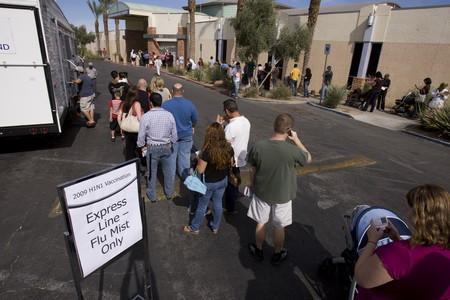


The Southern Nevada Health District's supply of injectable H1N1 vaccine has dwindled to the point that the district temporarily will stop offering it after today to keep from running out.
But the district still has plenty of the H1N1 FluMist vaccine, which is administered as a nasal spray, said Dr. John Middaugh, director of community health for the district.
"Beginning Friday, we'll only be able to provide the mist," he said.
The district blamed the shortage on high demand for the shot version and a delay in manufacturers' production of the vaccine.
Health district officials don't expect another shipment of the vaccine until late next week.
Because of the shortage, the health district also postponed a clinic that was scheduled for Saturday.
Some people worry about taking FluMist because it is made with a weakened live virus, tamed in the laboratory so it cannot cause illness. The shot contains a dead virus.
"There's a lot of unnecessary concern" about FluMist, Middaugh said. "People expect to get a vaccine with a needle, so getting something squirted up your nose is different and new."
People also worry that FluMist could make them sick or that it can spread the flu to others.
"None of that is true," Middaugh said.
The health district on Saturday began administering H1N1 flu shots to priority groups, including pregnant women, young children and health care providers.
Thousands of people showed up at the district's main center, at 625 Shadow Lane, the first day with some waiting more than two hours in line to receive the shots.
The FluMist has been available since Oct. 10, but demand for it has been much lower.
Pregnant women and children with underlying medical conditions cannot take FluMist, and the health district doesn't want to turn people away because it ran out of doses of injectable vaccine, Middaugh said.
Neither vaccine is yet available to the general public, and the health district was unsure when they would be.
"We're anticipating it'll take at least another month," said Stephanie Bethel, a health district spokeswoman. "We're really focusing now on priority groups."
Priority groups eligible for the vaccine include pregnant women, people who live with or care for children younger than 6 months, health care and emergency medical personnel with direct patient contact, children 6 months through 4 years old, and children 5 through 18 who have chronic medical conditions.
The health district on Wednesday attempted to ease concerns about FluMist and about there not being enough H1N1 vaccine to go around.
"There is no question we will be receiving ample shipments of the vaccine and there will eventually be enough to give to everybody who wants it," Middaugh said.
That is because production of the vaccine continues; it is just progressing slower than anticipated, Bethel said.
Whether the vaccines will come before H1N1 peaks, which some epidemiologists have said could be as early as this month, remains to be seen.
"Flu season is very unpredictable," Bethel said.
Nationwide, federal officials initially projected that as many as 120 million doses of the vaccine would be ready to dispense by mid-October. They later reduced their estimate to 45 million. As of Tuesday, 12.8 million were available.
The government now hopes to have about 50 million doses out by mid-November and 150 million in December.
The health district has received 49,000 doses of H1N1 vaccine. About 11,000 of those doses have been distributed to Clark County doctors' offices that serve at-risk populations.
As of Monday, the district had administered 8,127 doses, Bethel said: 3,100 FluMist vaccines and 5,027 shots.
District staff members had not finished tabulating how many doses were administered Tuesday and Wednesday, Bethel said.
But Middaugh estimated that only about 6,000 injectable doses remained Wednesday afternoon, with more than 20,000 FluMist doses left.
By Wednesday afternoon there were long lines, made up mostly of parents with children, for both the mist and the injected vaccine, and the parking lot behind the health district's offices was packed.
One of those parents was 40-year-old Marnie Taylor, who brought 6-year-old son Jaiden.
She said she was getting the mist for herself and her son because he did not like needles. Taylor said she was worried about H1N1 because her son has the potential to catch it at school. Her high-school-age nephew in California got the virus at school but recovered, she said.
In the injectable vaccine line, Jennifer Cunha had not heard about the shortage. Her mother, a health care worker, had urged her and her three children to get the shot and not the FluMist.
But she's still not confident about getting either one.
"I'm a little nervous about the vaccine, but my mom is pressuring me to get it," she said.
The district has an express line for the FluMist.
Twelve Clark County residents have died from swine-flu related deaths, according to the health district.
Another person, a 70-year-old New York woman who was ill before she arrived in Nevada, died in Clark County in June.
Review-Journal writer Lawrence Mower and The Associated Press contributed to this report. Contact reporter Lynnette Curtis at lcurtis@reviewjournal.com or 702-383-0285.


