Lake level trigger for pipeline project
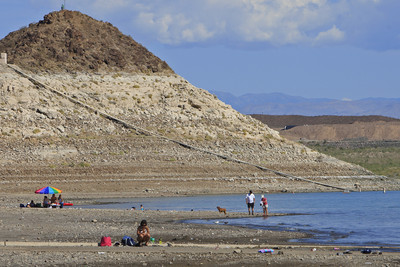
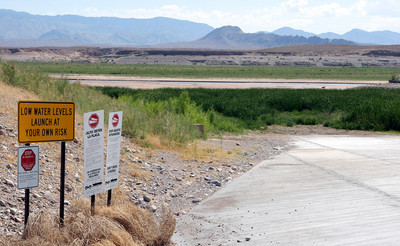




Opponents of a proposed pipeline to tap groundwater across eastern Nevada now have one more way to fight the project: Pray for the drought to end on the Colorado River.
For the first time, the Southern Nevada Water Authority has established a direct link between its multibillion-dollar pipeline project and the shrinking water level at Lake Mead.
Actually it's more than a link; it's a trigger.
If Lake Mead's elevation falls another 23 feet, the water authority board will be asked to give the official go-ahead to construct the pipeline.
The lake trigger is the newest addition to the authority's Water Resource Plan, which plots how the valley's wholesale water supplier expects to keep local taps running amid unprecedented drought on the Colorado.
Board members have already approved the pipeline concept and signed off on ongoing efforts to secure water rights and environmental permits, but they have never actually voted to build the project.
That decision will come if, or perhaps when, the surface of Lake Mead sinks to elevation 1,075, a low-water mark not seen since 1937 when the reservoir was being filled for the first time.
Water authority General Manager Pat Mulroy doesn't know when the trigger point might be reached.
Current projections by the U.S. Bureau of Reclamation call for Lake Mead to remain above 1,075 for the next two years at least. The closest it is expected to come is in July, when the reservoir is projected to slip below elevation 1,092 for the first time since March 1965.
The problem, Mulroy said, is that bureau projections are based on average flow, and the Colorado has been anything but average over the past 10 years.
Between 1999 and 2008, the river has seen about 66 percent of its normal inflow, most of which comes from melting snow in the Rocky Mountains. Over that same period, lakes Mead and Powell, the two largest man-made reservoirs in the United States, lost about half their total volume.
Elevation 1,075 could arrive quickly if the drought deepens, Mulroy warned. "It could be next year."
The trigger point was set at 1,075 to give the agency enough time to reach its closest groundwater holdings in rural Nevada, Mulroy said.
If the lake level falls to 1,050 feet above sea level, the authority will be forced to shut down one of the two intakes it uses to draw about 90 percent of the valley's drinking water from the reservoir.
The surface of Lake Mead now stands about 1,098 feet above sea level. The last time it was that low was April 1965, when much of the Colorado River's flow was being withheld upstream to fill Lake Powell for the first time.
Mulroy said it will take about three years to build a pipeline from Las Vegas to Delamar and Dry Lake valleys, the first two Lincoln County basins from which groundwater will be drawn.
From there, the pipeline is expected to push into Cave Valley in Lincoln County and Spring Valley in White Pine County.
The authority also has applied for permits in Snake Valley that would allow it to pump more than 16 billion gallons of groundwater a year, enough to serve about 100,000 average Las Vegas homes. A state hearing on those applications is tentatively set for September 2011.
The groundwater project is expected to take 10 to 15 years to build, Mulroy said.
When it is done, the network of pipes, pumps and reservoirs is expected to stretch about 300 miles north and cost between $2 billion and $3.5 billion, according to authority cost estimates now several years old.
Opponents of the project expect the scheme to cost billions of dollars more and deliver less water than the authority expects. Some fear that large-scale groundwater pumping in the arid valleys of eastern Nevada would threaten wildlife and the livelihoods of ranchers and farmers.
The authority's 2009 Water Resource Plan, which the board adopted on May 21, calls for Las Vegas to eventually tap 134,000 acre-feet of groundwater a year from eastern Nevada.
The plan calls for that water -- enough for almost 270,000 homes -- to be put to use by 2020, though it "may be needed sooner if drought conditions persist or intensify," the document states.
Critics argue that the drought is used as a smokescreen for the pipeline's real purpose: to fuel unfettered development in Southern Nevada.
Bob Fulkerson is executive director of the Progressive Leadership Alliance of Nevada, an advocacy group that has come out against the groundwater development project. He said the new trigger point seems "arbitrary" and a little suspicious to him.
"It could be just a Trojan Horse to allow more unrestrained growth in Las Vegas," Fulkerson said.
"If there's going to be a trigger, why not a trigger for curbing irresponsible water waste and growth?"
Of course, authority board members could always vote not to build the pipeline when the time comes.
Mulroy said the board's decision will come down to a question of risk, as in can the community risk losing access to some of its Lake Mead supply before the pipeline goes on line.
Elevation 1,075 is significant for another reason. It is the legal threshold for a shortage on the Colorado River, a federal designation that would force Nevada and Arizona to reduce the amount of water they pull from the river.
Nevada's share of such a shortage would be 13,000 acre-feet a year, roughly the amount used by 26,000 average households. Arizona would be shorted more than 10 times that amount.
Water authority officials long have said the pipeline is not about sustaining growth, but protecting the community from extended drought on the Colorado River.
In that respect, the new trigger point seems like good news for even the pipeline's staunchest opponents. It means the project might never be built so long as the river rebounds and Lake Mead remains above 1,075.
Mulroy isn't optimistic about that. As chief of the agency charged with keeping water flowing to Las Vegas, she gets paid to plan with pessimism.
"If we can avoid building it, we won't build it," Mulroy said of the pipeline. "But we haven't had a lot of luck on the Colorado River lately."
Contact reporter Henry Brean at hbrean @reviewjournal.com or 702-383-0350.