Making tough choices
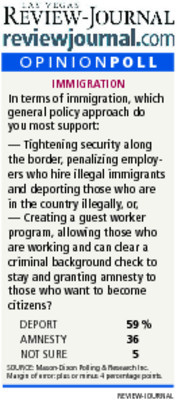




A majority of Nevadans favor an immigration policy that would tighten border security, penalize those who hire illegal immigrants and deport people who are in the country illegally, according to a poll commissioned by the Review-Journal.
The telephone poll of 625 registered voters found that 59 percent of Nevadans believe a tough approach to immigration policy is preferable to one that would create a guest-worker program, allow those who are employed and can clear a criminal background check to stay, and grant amnesty to those who want to become citizens.
Thirty-six percent of those surveyed preferred the amnesty approach, while 5 percent said they weren't sure.
The poll was conducted Tuesday through Thursday by Washington, D.C.'s Mason-Dixon Polling & Research Inc. The results have a margin of error of plus or minus 4 percentage points.
The firm early last year asked Nevadans a similar question but gave three options to choose from: tightening border security while deporting illegal immigrants; allowing certain illegal immigrants to stay if they paid a fine, cleared a background check and learned English; and creating a guest-worker program with a path to permanent legal residency.
The results of that poll were more evenly split, with 35 percent opting for the toughest policy.
Brad Coker, managing partner with Mason-Dixon, said pollsters gave only two options this time "to see which way people are really coming down."
"When you give three choices, the answers get scattered all over the place," he said. "People would end up picking the safe middle ground."
It was an approach that bothered Andres Ramirez, director of outreach for the Nevada Democratic Party.
"It's unfortunate that you would give two options that aren't being legitimately considered."
State Sen. Bob Beers, R-Las Vegas, who has spoken in favor of stricter immigration laws, said "there's more than two choices any time you're talking public policy."
He wasn't surprised by the poll's results, and said people remain frustrated by the federal government's failure to act on immigration reform.
Unfortunately, states can't do much about it, Beers said.
"We don't have access to the tools."
Nevada Republicans fell more strongly in favor of the tougher immigration policy, with 79 percent opting for it. More Democrats, at 52 percent, chose the amnesty approach.
The number of Hispanics polled and the results among them weren't available, Coker said.
The poll also found that immigration was the fourth most important issue to survey respondents when considering their presidential votes, after the war, health care and national security/terrorism.
"People understand that there are issues more pertinent and relevant to their day-to-day lives, such as access to health care and having to comfort grieving families who've lost loved ones in the war," Ramirez said.
Beers said immigration has fallen in importance to people lately because "you can only pound your head on a brick wall for a period of time before you decide to stop."
Pollsters routinely ask the "most important issue" question and, other than the war in Iraq, the responses are usually driven by the news cycle, Coker said.
"It's been mostly health care in the news lately."
But, he added, "Immigration is one of those issues, all you have to do is poke it and it'll get hot."
Contact reporter Lynnette Curtis at lcurtis@reviewjournal.com or (702) 383-0285.
Review-Journal Polls