



Many state employees retiring or seeking greener pastures


CARSON CITY -- Guy Rocha retired as Nevada archivist two years ago, after 32 years with the state.
While he could have worked much longer, he said he didn't want to preside over the dismantling of his agency.
What he predicted has occurred. The Department of Cultural Affairs will be eliminated Friday. State archives, museums and libraries are being transferred to other agencies. Positions already have been reduced. Many employees now work 32-hour weeks. The state library in Carson City is open just 20 hours a week.
"It's over," Rocha said about people serving lifetime professional careers with state government. "If state employees can retire, they are retiring. State government in many ways has been reduced to a sweatshop."
David Wrobel, History Department chairman at the University of Nevada, Las Vegas, plans to pack up his dog and family Wednesday and drive 1,140 miles to the financially greener pastures of Oklahoma and an endowed chairmanship at the University of Oklahoma.
Wrobel could have stayed on until retirement. He said he loves Nevada, but since becoming department chairman in June 2008, all he has been able to do is watch in dismay as state support for higher education was repeatedly reduced, including a 15 percent cut due Friday.
"There was wonderful opportunity when I came here in 2000," Wrobel said. "There were merit increases. Productivity was rewarded. Property values were skyrocketing. But since I became chair, we have been in a budget crunch. What bothers me is the attacks by some people on state employees. It is like people transferred their anger from illegal immigrants to state employees."
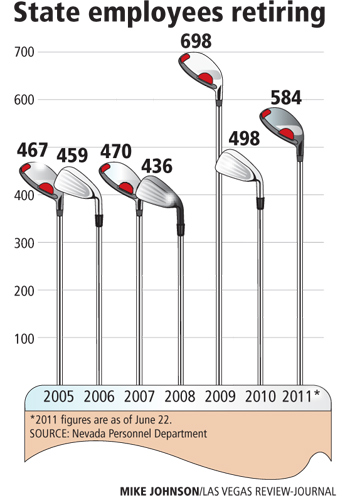
As of June 22, 584 state employees had retired during the current fiscal year. That is about 100 more than during the previous year. That followed two years of higher-than-normal retirements. Many more retirements are expected soon after Friday when the next round of wage and benefit cuts start.
When people such as Rocha retire or such as Wrobel just leave, state government loses trained and skilled workers who cannot be replaced quickly, said Vishnu Subramaniam, chief of staff of the American Federation of State, County and Municipal Employees Local 4041.
As a result, the public suffers through longer waits in offices and less efficient and productive agencies, he said.
WAGE AND BENEFIT CUTS CITED
There are plenty of reasons for the retirements.
With the start of the new fiscal year Friday, typical state employees will see their take-home pay drop by 10 percent or more, Subramaniam said. "They are doing the math and realize they are better off retiring."
He said employees nearing retirement age question why they should work harder than ever to keep up with growing demands when they earn only 25 percent more than what they would earn by retiring.
"That state is losing a lot of qualified, experienced people. Look at Clinger. If he is moving to greener pastures, so will many other state employees," Subramaniam said.
Subramaniam was referring to state Budget Director Andrew Clinger, who resigned in June from his $115,323-a-year job. Rather than continuing in the most prestigious nonelected job in state government, he will earn $190,500 in a less demanding job as city manager of Reno. He wasn't eligible for retirement, having worked for the state only 15 years.
The 10 percent wage cut includes a 4.8 percent pay decrease, plus additional health care and retirement pension costs. State employees' pay will be cut 2.5 percent, and they must take six unpaid furlough days per year, equivalent to an additional 2.3 percent cut.
It also includes health insurance costs that will increase dramatically after Friday . The annual deductible before state workers receive any medical benefits climbs to $1,900 for individuals and $3,800 for families. It had been $800 for individuals and $1,600 for families.
An additional 1.25 percent of their salaries must be paid into the Public Employees Retirement System to cover future pension costs. For the past two years, the state's 15,777 employees have been making do with 4.6 percent smaller salaries by taking mandatory 12 unpaid furlough days a year.
A Las Vegas Chamber of Commerce study released in February found state workers in 2009 earned $55,500, 107 percent of the national average for state employees. Local government employees in Nevada earned 117 percent of the national average for their types of workers.
When schoolteachers in Nevada, who earn 5 percent less than the national average, are taken out of the local government mix, the chamber reported local government employees earn 31 percent more than their counterparts around the nation. Of course, the figures are for 2009, when pay cuts were starting in Nevada.
FUNDING LEVELS BLAMED
Wrobel is sad about leaving. He worries about the drop of faculty quality and the difficulty of students finding classes because the "level of funding is not there."
While colleges in Nevada must rely on state support, Oklahoma covers one-quarter of its faculty pay through endowments. That means they are not as susceptible to cuts during economic downturns, he said.
Wrobel said UNLV has a "highly mobile" and attractive faculty. Many professors can and will find jobs elsewhere, hurting the university's attempt to attract a higher-quality faculty. He said 48 professors recently took buyouts rather than continuing to teach.
Last summer, Reno welfare worker Debby Frenzy retired early after being saddled with a 4.6 percent pay cut and a caseload that once stood at 400 but climbed to more than 1,000 clients.
"The stress was killing me," said Frenzy, who had worked 22 years with the state. "It was harder than when I worked at the DMV. At least with the DMV you don't take the job home with you at night."
For Frenzy, the monthly furlough days meant she had to work harder when she returned to work to keep up with her office caseload.
She now receives a little more than 50 percent of her last state salary as a pension, and retirement isn't as golden as she had hoped.
But she sleeps at night and doesn't worry as much about the plight of poor people struggling to survive during the recession.
Subramaniam is tired of people who believe state employees are well-paid, lazy fat cats.
Because of its average pay, too often state government has become a training ground for young people and college graduates, he said.
Once they gain experience, he said, they transfer to better-paying jobs with Clark and Washoe counties or the cities of Reno and Las Vegas.
"The problem with so many state workers retiring is we have the lowest number (on a per capita basis) of state workers in the country," Subramaniam said. "That's why this (retirements) hurts us even more."
MANY WORKERS CHOOSING TO STAY
Dana Bilyeu, executive officer for the Public Employees Retirement System, said interest in retiring early is increasing but not by an unusually high percentage.
She said 1,671 employees now are eligible to retire and receive full benefits, based on them working 30 years and receiving 75 percent of their average pay for their three highest pay years.
That means only about one-third of potential retirees are leaving.
"It's an individual decision," Bilyeu said. "What is your best interest?"
Bilyeu conjectured retirements this summer would have been higher except the Legislature did not approve a bill that would have cut a week off state employees' vacation time and a week off their sick leave.
"It could have been worse," she said. "There is a feeling that maybe things will get better."
Contact Capital Bureau Chief Ed Vogel at evogel@reviewjournal.com or 775-687-3900.


