Moon rocks going on display at CSN





To paraphrase our vice president, this is kind of a big deal.
The College of Southern Nevada is inviting the public this week to view a moon rock collection on loan from NASA.
These things aren't loaned out to just anybody. They've never been on display like this here, and they probably won't be again anytime soon.
"These lunar samples, this is our national treasure," said Charles Kotulski, a CSN chemistry instructor.
He compared the moon rocks with such national icons as the Egyptian pyramids. They are a thing that defines a people.
"We are the only country that ever went to the moon," he said. "That landed on an object in the solar system and brought pieces of it back to Earth."
In all, about 800 pounds of moon rocks were collected between the first manned moon landing in 1969 and the last in 1972. Most remain in storage in NASA facilities. Small bits were given to states and countries as gifts. A few are on display in museums.
NASA also encased a small number of the rocks in clear plastic for educational purposes. These are what CSN will have on display this week.
Physics and astronomy professor Peter Lanagan said the lunar samples are scientifically invaluable, and even he has never seen one outside of a museum.
"These moon rocks have taught us an awful lot about the formation of the Earth and the moon and the solar system," he said.
He has offered his students extra credit to attend the information sessions, he said. But he noted that the sessions are not just for students. They're for anybody who wants to learn.
Kotulski, who said he has been teaching science for 43 years, went through a NASA certification process almost 30 years ago that allows him access to the lunar samples, he said.
He petitioned the agency several months ago for an opportunity to display the rocks at CSN. His request was approved, but he said he had to follow several rules.
First, they'll be locked up in a safe deposit box when they're not on display. And second, he and Lanagan will have to be on hand to supervise whenever the rocks are on display. There will be no pile of rocks for the public to peruse.
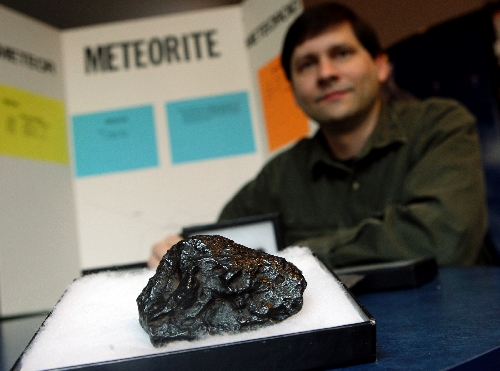
There will be a collection of meteorites, however, and these are not encased in plastic. Kotulski said the public will be able to handle these samples of space debris.
"You'll have something in your hand that is older than our solar system," he said.
He and Lanagan said they have a couple of goals with this event.
They want to teach the public about the importance of science, of course.
But they also want students to get excited about science at a time when, it seems to them, science education isn't as strong as it should be.
Maybe, Kotulski speculated, a student who hasn't yet decided on a direction will come to the presentation and get excited by it. And who knows where that could lead.
Contact reporter Richard Lake at rlake@reviewjournal.com or 702-383-0307.
ON DISPLAY
The moon rocks are scheduled to be on display at the College of Southern Nevada's Henderson campus, 700 College Drive, in Room C-133. Presentations are scheduled for:
■ 3:20 to 5:30 p.m. today
■ 12:20 to 2 p.m. Tuesday
■ 12:30 to 2:30 p.m. Thursday
■ 9 to 11 a.m. Friday
Las Vegas Review-Journal