More without a home
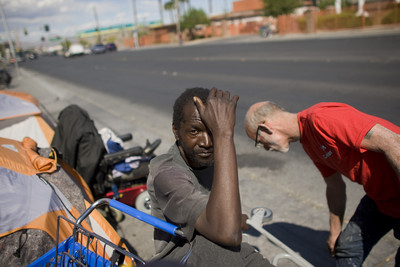



Nearly 2,000 more people were homeless in Clark County this year than two years ago, according to the results of a large-scale January homeless count to be released today.
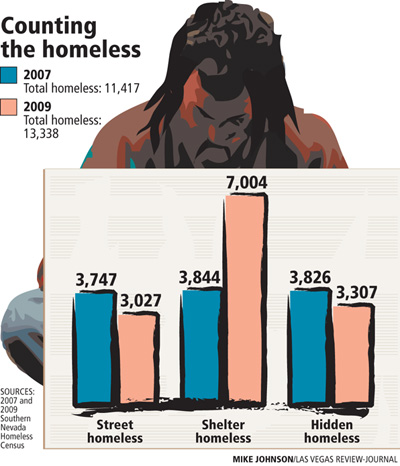
The results obtained by the Review-Journal on Wednesday show that 13,338 people are homeless in the county on any given day, compared to 11,417 who were homeless in 2007.
Those who work with the homeless blame skyrocketing unemployment, which nearly doubled in Nevada in the last year, and an otherwise sour economy for the spike.
"It surprises me that it's not more," Phillip Hollon, director of residential services for Catholic Charities of Southern Nevada, said when told of the results. "Given the economy, I'm happy it hasn't climbed even higher."
He and others worry the numbers will continue to rise as people who've been struggling to make mortgage or rent payments, or have been living doubled up with family and friends, finally exhaust their options.
"It absolutely could get worse," said Linda Lera-Randle El, director of the Straight from the Streets outreach program that has worked with the valley's homeless for decades.
But there was some good news in the census commissioned by the Southern Nevada Regional Planning Coalition's Committee on Homelessness: many more homeless people are living in shelters or other temporary housing than on the street.
The number of "street homeless" actually decreased by about 19 percent, while the number of sheltered homeless grew a whopping 82 percent.
That's partly because hundreds more shelter and transitional housing beds are available now than were two years ago, funded mainly by federal "Continuum of Care" grant monies, said Shannon West, regional homeless services coordinator for Clark County.
"We can't control the economy, but we can increase the number of available beds and the number of people using them," she said.
Local governments and nonprofits have also in recent years been pooling their efforts to steer more homeless people into shelters and programs that can help get them off the street for good.
"We're not tooting our own horn, but our efforts have been extraordinary," West said. "Everyone has been working together on this."
That effort has included a "mobile crisis outreach team" made up of outreach workers from a coalition of local nonprofits that focuses on providing intensive case management to the "chronically" homeless.
Service providers typically define chronic homelessness as experiencing several bouts of homelessness over a few years or being homeless for a year or more.
Although only 20 to 25 percent of the homeless are considered chronic, they are responsible for about 80 percent of the costs associated with homelessness, West said.
"They frequent detox, shelters, jails and emergency rooms," she said.
Housing and stabilizing a chronically homeless individual costs about $12,000 a year, compared with the estimated $50,000 a year in resources that individual would consume while living on the street, West said.
The January census used hundreds of volunteers to conduct a point-in-time estimate of homelessness that included shelter, hospital and jail numbers, people counted on the street and those identified as the "hidden homeless" -- those camping or "squatting" on private property.
The number of hidden homeless also has decreased significantly, according to census results. West said that may be because in 2007 the hidden homeless comprised more families. That trend has changed.
"They were all individuals" this year, she said.
West wasn't sure why there were fewer hidden homeless families.
"Maybe it's because folks have been so focused on moving families inside," she said.
The overall spike in homelessness mirrors that found in many similar January counts conducted in cities and counties nationwide. Municipalities are required to complete homeless censuses every two years to apply for federal grant money to fight homelessness
The planning coalition funded the $130,000 census, which was administered by Applied Survey Research, a California-based nonprofit social research firm that did the 2007 count and has completed similar censuses in Los Angeles and Atlanta.
Contact reporter Lynnette Curtis at lcurtis@reviewjournal.com or 702-383-0285.
HOMELESS POPULATION DEMOGRAPHICS TO BE RELEASED
More demographic information from the local homeless count, such as how many of the valley’s homeless are children or veterans, is expected to be released today by the Southern Nevada Regional Planning Coalition’s Committee on Homelessness. The Review-Journal will have that information in Friday's edition.