



Nevada last in U.S. spending per person
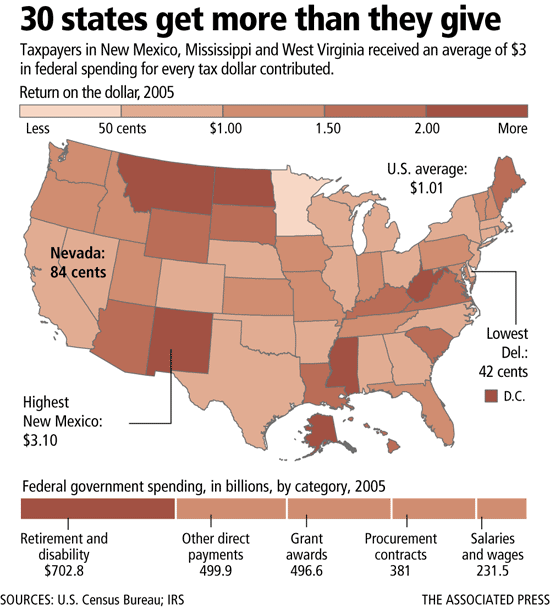


WASHINGTON -- The federal government spends less per person in Nevada than in any other state, according to a 2005 report by the Census Bureau.
The report released Tuesday showed the federal government spent $5,840 per person in Nevada, almost $2,000 less than the national average of $7,706.
For every tax dollar Nevadans sent to Washington, they received 84 cents in return.
The national average was $1.01.
Forty-one states received more money than Nevada in return for every federal tax dollar. New Mexico received the most: $3.10.
The states that received less than Nevada included: Delaware (42 cents); Minnesota (46 cents); New Jersey (57 cents); Connecticut (67 cents); Illinois (68 cents); New York (73 cents); Nebraska (79 cents); Ohio (80 cents), and Colorado (83 cents).
Carole Vilardo, president of the Nevada Taxpayers Association, said the report shows the federal government needs more accurate information to account for Nevada's surging population.
"When it comes to federal grants for education programs like No Child Left Behind, we have not received what we should have," Vilardo said.
But Vilardo also questioned the accuracy of the Census Bureau report. For example, she noted Utah ranked 14th in federal salaries and wages while Nevada ranked 35th.
"I find this odd because Utah does not have the military facilities we have in Nevada," Vilardo said.
In 2005, Sen. Harry Reid, D-Nev., was still on the Senate Appropriations Committee which oversees federal spending in states. But after becoming majority leader this year, Reid gave up his seat on the committee.
"Nevadans don't sit around thinking about what states are getting the most money. They just want to make sure the state is getting everything it needs, and no one has delivered more for the state of Nevada than Senator Reid," Reid spokesman Jon Summers said.
Summers said Reid helped steer more than $93 million last week to Nevada in military projects included in a defense spending bill.
Rep. Jon Porter, R-Nev., who sits on the House Ways and Means Committee which oversees tax legislation, joined Vilardo in calling for more accurate federal data.
"Because our growth outpaces the census, our return on each tax dollar is substantially lower than many states with declining populations. Whether it is in the areas of transportation, education or health care, federal agencies must restructure their formulas to adapt to the needs of states like Nevada," Porter said.
The Census Bureau report documents the geographic distribution of $2.3 trillion in government spending, including salaries, grants, military pay, government contracts and Social Security payments. It excludes interest on the national debt, overseas spending and the classified budgets of intelligence agencies.
The Associated Press compared the census data to IRS figures for 2005 federal tax collections. The IRS data includes individual, corporate and excise taxes.
The analysis shows that wealthy states pay more than poor ones, blue states subsidize red states, and states with powerful politicians on key House and Senate committees fare well in federal spending.
High-income states such as New Jersey, Connecticut and Massachusetts paid more in taxes than they received in federal spending, while low-income states such as Mississippi, West Virginia and Alabama got a much higher return for their tax dollars.
The exceptions were Alaska, Hawaii, Virginia and Maryland -- high-income states that also received high levels of government spending.
Scott Hodge, president of the Tax Foundation, a Washington research group, said the numbers represent a massive redistribution of the nation's wealth.
"I don't think the tax code should be used to redistribute wealth around the country," Hodge said. "It should simply be a tool to pay for government programs."
Why not redistribute wealth? asked James Horney, director of federal fiscal policy at the Center on Budget and Policy Priorities, a Washington think tank.
"I think it is appropriate for people doing well to pay a higher share of their income (in taxes) than those at the bottom," Horney said.
Among the other findings:
• Nearly half of all federal spending went for Social Security, Medicare and Medicaid, a percentage that is likely to increase as Baby Boomers near retirement age.
• Taxpayers in the District of Columbia paid the most federal taxes per person ($31,250), and received the most federal spending per person ($65,044). However, federal spending for Washington is inflated because many federal employees who work in the city live in Virginia or Maryland. The census counts federal salaries where they are paid, not where those receiving them live.
• Among the states, Delaware paid the most federal taxes per person, at $15,714. Alaska received the most federal spending per person, at $13,916.
The Associated Press contributed to this report.
ON THE WEB
• Census Bureau's Consolidated Federal Funds Report
• IRS tax statistics


