No rush for H1N1 vaccine
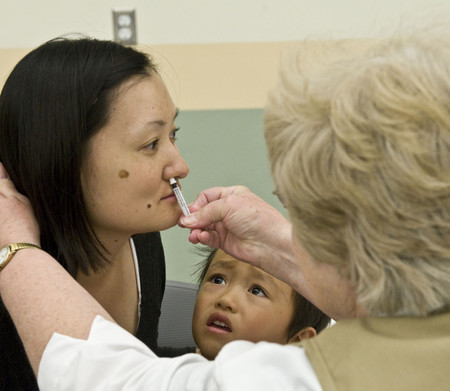
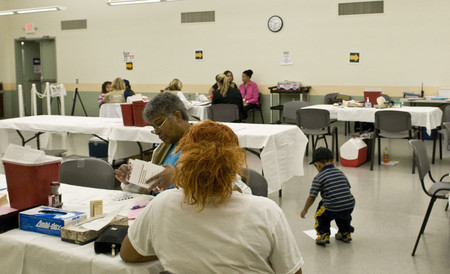





A dozen or fewer of the 550 emergency first responders with the Las Vegas Fire Department received the inhaled H1N1 FluMist vaccine Saturday, an indication they are probably concerned about the problems that could arise from a vaccination involving a live virus, an official said Monday.
"I know I'm leery about a live virus going into me," said department spokesman Tim Szymanski.
He said most department personnel may have "elected to wait for the shot ... My wife is a nurse and she feels the same way."
There were no long lines at the Southern Nevada Health District on Shadow Lane on Saturday as the first of more than 20,000 doses of the FluMist H1N1 vaccinations were made available to medical providers and first responders.
Only 326 people showed up, a number that health district spokeswoman Stephanie Bethel said could have been handled by nurses in an hour.
"A significant number of health care workers, paramedics and firefighters are concerned about the FluMist," said Dr. Dale Carrison, head of the emergency department at University Medical Center. "I wish it weren't that way, but it is."
The fact that Las Vegas Valley medical providers and first responders were reluctant to take advantage of a clinic held expressly for them is evidence that public health officials must redouble their efforts "to educate the public about the H1N1 vaccination program," said Dr. John Middaugh, director of the health district's division of community health.
"There are a lot of myths and misinformation being circulated out there," he said.
The nasal vaccine is made of a weakened live virus, tamed in the laboratory so it cannot cause illness, Middaugh said.
Measles and chicken pox vaccines also are made from a weakened live virus.
Sprayed into the nose, the flu vaccine multiplies on the mucous membranes in the nose and throat, triggering the body's immune response without causing any sickness.
Middaugh said the fact that many first responders and health care workers are not taking advantage of the inhaled vaccine could affect Southern Nevada if many of them took ill with H1N1.
"We wanted to give it (the vaccination) to them first so they would be able to take care of those who were sick," he said
Misinformation, Bethel said, could have been at work again Monday as few caretakers of children younger than 6 months took advantage of a FluMist clinic for them and for children ages 2 to 4.
By 2:30 p.m., fewer than 120 people had trickled in.
Or, Bethel said, it could have been that people just want to do what they've done in the past.
"I think people are more comfortable with shots," she said.
FluMist is approved for people ages 2 to 49 who have no underlying or chronic medical conditions, such as asthma or diabetes, and who are not pregnant.
The injectable flu shot is made from a killed influenza virus, which can stimulate the immune system to evoke a protective response.
Middaugh said millions of Americans have received FluMist vaccinations for seasonal flu for years "without any problems."
For some health care providers, FluMist is not appropriate, such as "those who work in bone marrow transplant units," said Tom Skinner, spokesman for the federal Centers for Disease Control and Prevention.
Theoretically, Skinner said Monday, someone who had recently received a FluMist vaccination could spread the virus to someone who was profoundly immunocompromised, such as AIDS patients.
"So if they get vaccinated with FluMist, we want them to wait seven days before returning to work with severely immunocompromised patients," he said.
Middaugh said the wait is "an extra precaution." He noted that there has never been a case where someone who has been vaccinated with FluMist has spread the flu to another person.
Both Middaugh and Carrison said few Clark County adults, including health care workers, have received the H1N1 FluMist vaccination.
"Whenever you do something new, people are suspicious," said Carrison, 70, adding that the only thing that stopped him from taking the inhaled vaccination was his age.
"I can understand people's concern," he said. "People want to know it's safe for them and for others. It's just natural."
Talk shows and the Internet are full of concerns that the government rushed the H1N1 vaccine. A recent poll by Consumer Reports found that only 35 percent of parents surveyed would definitely have their children vaccinated.
Middaugh said the inhaled vaccine will soon be sent to area hospitals, where it will be made available again to health care workers.
Another shipment of H1N1 vaccines is expected to arrive later this week, he said. He did not know what percentage of it will be injectable and what percentage inhalable.
There have been 12 deaths in Clark County from the H1N1 virus and two in Washoe County.
At least another month will pass before the vaccine is made available to schoolchildren, Middaugh said.
The number of children who have died in the United States since the H1N1 virus was identified in April climbed to more than 75 last week, according to the Centers for Disease Control and Prevention. Seasonal flu kills 46 to 88 children each year in the United States.
Jaime Ross showed up at the health district Monday for the inhaled vaccine with two of her children, Dawson Seria, 3, and Taylor Seria, 6. Her 7-week-old son remained at home.
A dietician for the St. Rose Dominican hospitals, Ross said she is very worried about the H1N1 flu.
She and Dawson took the FluMist. Taylor, who has asthma, couldn't.
"I just hope the vaccine protects my family," Ross said.
Contact reporter Paul Harasim at pharasim@reviewjournal.com or 702-387-2908.