



Obama points out differences with Clinton
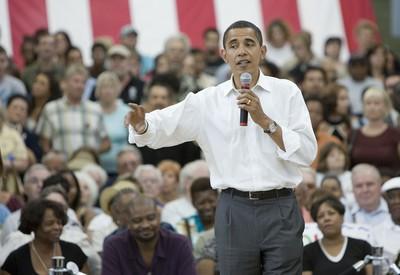


Campaigning in Las Vegas the day after his chief rival, Democratic presidential candidate Barack Obama's visit Friday seemed like a rebuttal to Hillary Clinton's.
The Illinois senator, who trails the former first lady in national polls, followed nearly the same route Clinton had trod through town. But where she chose anodyne, serious discourses on domestic policy, Obama dove right into the two candidates' chief differences. At one point, he seemed to put her in the same category as Vice President Dick Cheney and former Defense Secretary Donald Rumsfeld.
"Being experienced is not enough," Obama told the convention of the National Association of Black Journalists. "The question is what lessons you learn from your experience. ... Nobody had a better track record of experience than Dick Cheney and Donald Rumsfeld. But they had bad judgment."
Obama's campaign speeches still center on his themes of hope and change, but as lines like that one show, he has added some pointed remarks clearly directed at Clinton.
On Friday, Obama made stops at the Culinary union, the journalists' convention and a high school.
Along the way, he frequently derided the value of "experience" in a politician's resume, the byword of Clinton's campaign.
And in condemning the culture of Washington politics and the influence of lobbyists, Obama said Democrats were also partly to blame, another jab at Clinton's status as the Establishment candidate.
In addition to his criticism of a possible future Clinton administration, Obama seemed to cast aspersions on the past one, suggesting that the presidency of Bill Clinton was at the root of some problems.
Obama started his day at the Culinary union hall, where he reiterated his pledge to walk the picket line if the workers strike.
But it was at the convention, held at Bally's, that Obama took on Clinton most explicitly, elaborating on the two-part foreign-policy debate the two have been having in the media for the past few weeks.
The first shot came in a debate last month, when Obama answered affirmatively to a question about whether he would pledge to meet with the leaders of hostile nations during his first year in office.
Clinton pounced, saying she would engage in diplomacy but wouldn't promise personal meetings that could be "used for propaganda purposes."
Playing the experience card, Clinton later called Obama's answer "irresponsible and, frankly, naive."
On Friday, Obama defended his stance, saying, "I think the president of the United States should be willing to meet with anybody. That person may not like what I have to say. If I talk to Iran, I'm going to tell them, 'We don't think you should have nuclear weapons.' "
Obama said meeting without preconditions "sends a message to the world that America is not so arrogant that we are going to insist that you agree to everything we want you to do before we even talk to you. What we have to do is move away from this Bush-Cheney unilateral agenda that is so dangerous."
The second clash has been over Obama's recent statements that he would aggressively pursue terrorists in Afghanistan, going into Pakistan without permission if necessary, but that he would not consider using nuclear weapons there.
Clinton has criticized him for making "blanket statements" about hypothetical situations, and Pakistan's government has responded with alarm.
A local Pakistani group is planning a rally this weekend where members plan to issue a statement critical of Obama.
Obama painted Clinton as not being open to debate.
"She said, 'Well, I'm not sure, we should talk about it,'" Obama said of Clinton's criticism. "I think we should talk about it. I think the American people need to have a debate about our foreign policy because it has gotten so messed up. If we don't talk about it, we'll end up repeating the same mistakes again and again."
Obama said he wants people to question some of the "wisdom of Washington, because the people who have been criticizing me for the last few weeks are the people who engineered what is the biggest foreign policy fiasco in a generation. I don't think they're qualified to tout their experience."
In addressing the convention Thursday, Clinton laid out policy proposals to improve the lives of young black men.
Asked about Obama, she stayed positive, praising the Democratic field's diversity.
The audience of more than 2,000 received Clinton warmly, but Obama clearly generated more enthusiasm, with some giving him a standing ovation.
However, when Obama was asked whether he thought the president should apologize for slavery, his obvious evasion of the question -- he said he thought deeds were more important than words -- was greeted with silence.
Along the same lines, Obama professed to be puzzled by the media's dissections of whether he is "black enough," saying the question couldn't be based on his appearance or record on black issues.
The reason for it, he concluded, must be that "we're still locked in this notion that if you appeal to white folks, there must be something wrong."
The root of the "black enough" debate most often cited is that because Obama's father is from Africa, he is not descended from American slaves.
At all three stops Friday, Obama described the life of a 61-year-old California home care worker with whom he earlier this week spent what he called "probably the best three hours I've spent on this campaign."
Pauline Beck can't support her family on her salary, and her plight reminded him of why he went into public service, Obama said.
"For too long -- at least the last six years, and some would argue for longer -- Ms. Beck and her counterparts have had no representation in Washington," Obama said.
"We've had drug companies and insurance companies writing our health insurance legislation. We've had oil companies writing our energy bills. We've had corporate lobbyists writing the tax code and our trade legislation, and Ms. Beck has been forgotten."
Obama and former North Carolina Sen. John Edwards have criticized Clinton for her abundant contributions from lobbyists.
Obama claims he is less beholden to moneyed interests because he no longer accepts contributions from federal lobbyists, although he has done so in past campaigns.
Clinton has defended her contributions, saying her vote can't be bought.
Cleaning up Washington was also the ostensible theme of Obama's speech to about 1,500 people at Rancho High School.
In a news release distributed to reporters, his campaign advertised, "Speaking at Rancho High School, U.S. Senator Barack Obama called on President Bush not to stand in the way of reform and to sign into law the ethics bill that Congress recently passed."
Obama didn't quite do that. Nor was ethics the central focus of his talk, although he did discuss the bill at the end of a speech.
He pointed out that Democrats are part of the reason "Washington has become an insider's game." Of the influence of lobbyists, he said, "That was true even under a Democratic president and Democratic Congress."
Obama ended with a rousing chant he said he'd learned from a small-town councilwoman in South Carolina: "Fired up! Ready to go!"
Audience member Louise Fobbs, a 67-year-old retiree, said she liked Obama's candor.
"He's honest. He's got character. He's even funny. He livened it up in there," Fobbs said. "He's not all just promises about 'I'll do this, I'll do that.'"


