



Obama’s history-making election amazes black and white
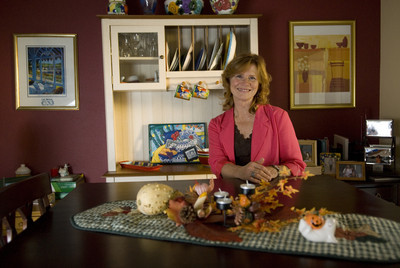


Pam Dimings sits in her seniors apartment in Las Vegas and shudders as she remembers what she said as a little girl when she first saw a black woman: "Mama, look at how dirty that lady is."
The woman, the 63-year-old Dimings recalled Thursday, smiled at the 4-year-old on the bus who had mistaken the color of her skin for grime.
"For years my mother would tell people that story, and I'd always say, 'Mama, don't tell that story on me. It's so embarrassing.'"
Dimings' experience as a child was innocent; but as she grew up in Ashland, Ore., in the 1950s, she began to understand what racial division was really about.
"When the first black family moved into the neighborhood -- the man worked in the Forest Service -- they were run out of the area," Dimings said. "It wasn't that anybody was violent towards them, but people weren't friendly and they couldn't make friends so they left.
"That I could see that kind of attitude in my own neighborhood and then vote for a black man for president in my lifetime is phenomenal."
In the days since Barack Obama became the first black person elected to the nation's highest office, the heartfelt discussions about what it means to live in a nation divided by the color line are taking place on more than just "The Oprah Winfrey Show."
That Obama made history because of his race and in spite of it -- and the role everyday Americans played in his achievement -- has become the subject of conversations in schools, senior centers, coffee shops, bowling alleys, the workplace and the dinner table.
And the more people talk about their country -- where schools weren't desegregated until the 1950s, where the civil rights movement met bloody resistance in the 1960s -- the more many marvel at another page turned in the nation's bitter racial history.
"I didn't vote for him (Obama) because he was black," Dimings said. "I voted for him to get out of a war we never should have been in and to get the economy going."
Without millions of ballots cast for Obama by white voters, Dimings realizes, he couldn't have been elected.
"It's more incredible the more you think about it," she said.
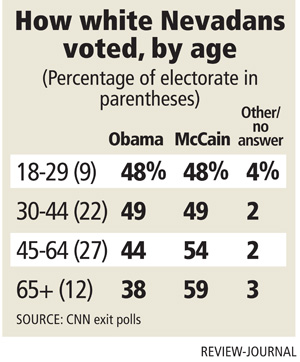
Dimings fell into the bracket with the greatest number of white voters who cast ballots in this year's election: 27 percent of white voters were between 45 and 64. For this story, the Review-Journal interviewed several people in this demographic who shared how they viewed Obama's election in terms of their own personal past.
"I just wanted to vote for someone smarter than I was," said Dr. Ed Fishman, 54, a retired physician. "I didn't think about my being white and him being black. In my home, you were brought up never to disrespect anybody. With our family being Jewish and a minority, we were very conscious of that."
Nationally, 55 percent of white voters cast their ballots for GOP nominee John McCain; 43 percent for Obama.
In Nevada, Obama's percentage of the white vote was 4 points higher, at 47 percent. McCain took 51 percent of the white vote.
The younger the white voters were, the more apt they were to vote for Obama. Analysts says say that's because they were born after civil rights legislation created a more integrated society.
In Nevada, 48 percent of white voters 18 to 29 went for Obama, the same percentage that voted for McCain. Forty-nine percent of white voters between the age of 30 and 44 went for Obama; again McCain drew the same support in that age bracket. Forty-four percent of white voters between 45 and 64 voted for the Illinois senator.
But among whites 65 and older Obama's support dropped to 38 percent, while McCain's rose to 59 percent.
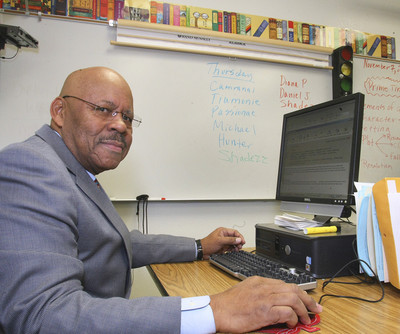
Don Bernard, a 64-year-old West Prep Academy teacher who has long studied the civil rights movement, was impressed with Obama's overall strength among white voters.
"Doing 2 percentage points better than (Sen. John) Kerry in 2004 is not too shabby," said Bernard, who is black and was forced to attend segregated schools in his native Louisiana.
Bernard said he has seen tremendous progress in race relations. He believes Obama considerably strengthened his position among whites when he delivered a speech on race after his candidacy was threatened by his ties to his former pastor, the Rev. Jeremiah Wright.
"The profound mistake of Reverend Wright's sermons is not that he spoke about racism in our society," Obama said in his March talk in Philadelphia. "It's that he spoke as if our society was static, as if no progress has been made."
Bernard is a former New Orleans attorney who became a teacher because he decided he wanted to help educate needy children.
As far back as 1971, Bernard said, he could see how race relations were shifting among baby boomers.
One of only five black students out of a Tulane University Law School student body of 400, Bernard was elected president of the Student Bar Association.
"We still have a ways to go in race relations when it comes to opportunities and fairness," he said. "But hopefully people will see this election as a signal to put race behind us. This gives us hope that the issue of race becomes frivolous one day."
Among whites, he said, "there are many people who believe in justice. ... We just need more."
For Susan Boswell, 52, the election gives her hope and makes her proud. "Our words are finally matching our actions," she said.
A former head of the local chapter of the National Conference for Community and Justice, she said it might not be easy for whites to stand up for equality, but whatever they go through is nothing compared to the prejudice suffered by blacks.
Discrimination in employment, housing and education, coupled with police often having a double standard for blacks, she said, makes her own personal challenges seem small.
After her father learned that she was marrying a black man, he disowned her. When her father died and the will was read, he left her one dollar, she said, "for reasons known unto her and known unto me."
Boswell, now in corporate communications, said the election has her feeling euphoric.
"My friends and I are talking about this all the time," she said. "I got misty-eyed when I saw us living up to our promise."
Steve Bradshaw said he voted for the man who had the best chance "to correct three major issues: economic equality, health care and appointments to the Supreme Court."
The 61-year-old recently returned from a stint as a Peace Corps teacher in Eastern Europe. Bradshaw said he never found it easy to clash with his father on racial issues, but his own value system made him do just that.
"My father is a Democrat, but he said he could never vote for a black man," he said. "I made a pledge in college not to prejudge people, and I've stuck to that."
Steve Fernlund, the 54-year-old head of the Red Rock Democratic Club, said he voted for Obama for one reason: "He's brilliant."
After growing up in "a lily white suburb of Minneapolis where the household was not accepting of minorities of any kind," Fernlund said he became acquainted with blacks during work and school. He found his father's position preposterous and said so.
His father didn't like that he bought a house next to where a black man lived, Fernlund said, "but he got over it and left me alone. Now it's nothing for my kids to have black friends over to the house."
Registered Republican Pam West, 63, said she voted for Obama largely because of his emphasis on education and the way he stressed that people should work hard to achieve their dreams.
She got interested in Obama after John McCain named Sarah Palin as his running mate.
A former science teacher whose formative years were spent in Idaho and Utah where few blacks lived, West said her family never spoke about race.
"I was worried once because some older Indians became part of my class, but that was just because they were so big," she said.
On Election Night, West was surprised by how emotional she became about the idea of the country electing a black man as president.
"It's such a huge deal," she said. " I think I was in shock that night. I would never vote for someone because of race, but it was like an added bonus. It really makes me feel good about the country. Maybe now we'll recover our standing in the world. We stand for what we say we do. But I keep thinking that maybe I'll wake up and it will all be taken away."
Contact reporter Paul Harasim at pharasim@reviewjournal.com or 702-387-2908.


