Objections to water pumping dropped


The Southern Nevada Water Authority has won another major concession for its plan to tap groundwater across rural Nevada and pipe it to Las Vegas.
Under a deal inked Tuesday, federal officials have agreed to drop their protests of the project in Lincoln County in exchange for assurances that the proposed groundwater pumping won't harm sensitive wildlife and fragile habitat in the area.
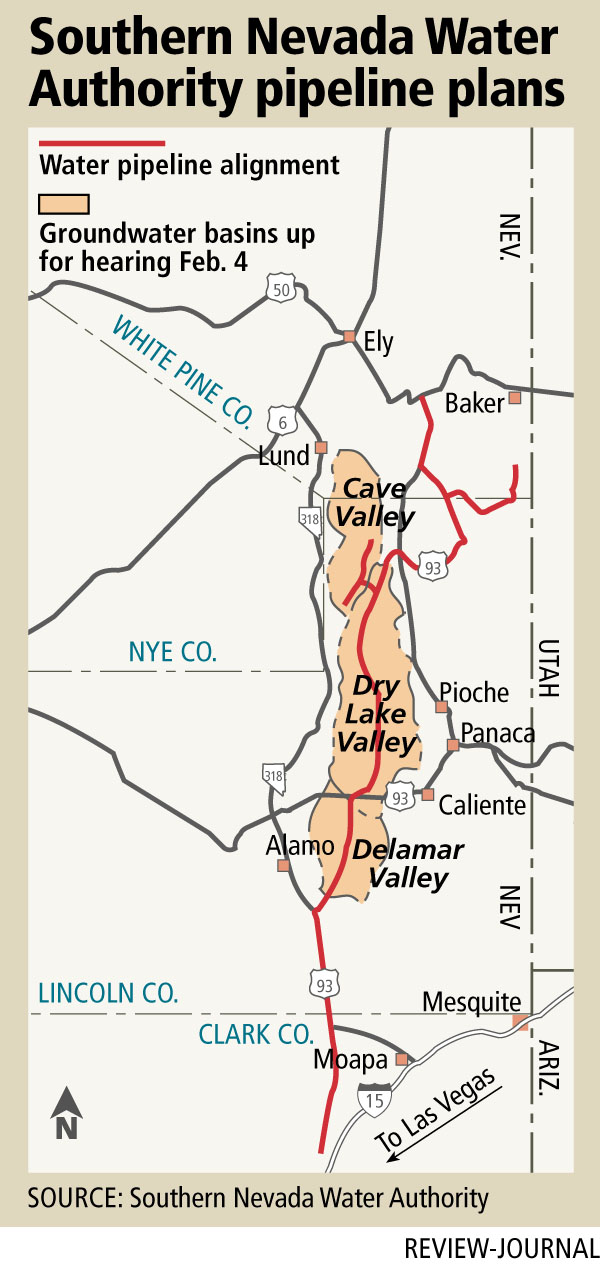
The authority is hoping to pump more than 11 billion gallons of groundwater a year from Cave, Delamar and Dry Lake valleys in central Lincoln County. When stretched through reuse, that's enough water to supply more than 115,000 homes.
State Engineer Tracy Taylor will have final say over how much groundwater the authority should be allowed to pump from the three valleys, which lie in a north-south line bracketed by U.S. Highway 93 and state Route 318.
Taylor will convene a hearing in Carson City on Feb. 4 to review the authority's applications. A ruling will follow sometime after the public comment period closes on Feb. 29.
Last spring, Taylor granted the authority permission to eventually pump nearly 20 billion gallons a year from Spring Valley in White Pine County, about 250 miles north of Las Vegas.
In September 2006, mere hours before the hearing on its Spring Valley applications, the authority reached an agreement with federal agencies similar to the one struck this week.
Authority spokesman J.C. Davis said more deals like this will be sought as Southern Nevada's wholesale water supplier pushes ahead with its plans to build a massive well and pipeline network -- at a cost of well over $2 billion -- to supply growth in the Las Vegas Valley.
Outspoken pipeline opponent Bob Fulkerson was disheartened by the news.
"We're profoundly disappointed that these federal agencies have decided to put politics over science," said Fulkerson, who is executive director of the Progressive Leadership Alliance of Nevada.
"They were under tremendous political pressure to roll over ... and that's what has happened."
Federal officials don't see it that way at all.
"We don't view it as rolling over. The way I characterize it is working with the water authority outside the state engineer's process," said Bob Williams, field supervisor for the Fish and Wildlife Service in Nevada.
"This is our assurance upfront that if we see any impacts, immediate action will be taken."
Williams said the protections are particularly important for the Pahranagat Valley National Wildlife Refuge, a water-filled valley that serves as prime nesting habitat for the endangered Southwest willow flycatcher. The refuge along U.S. Highway 93 in Lincoln County is one valley removed from the three watersheds being targeted by the water authority.
For its part, the authority agreed to fund the construction of four monitoring wells and eight new spring monitoring sites in the area.
Davis said those wells and monitoring sites will serve as an early warning system for the springs and seeps that could be impacted by the authority's project.
The authority also has agreed to draft an operation plan before any pumping begins, to define specific mitigation measures and the conditions under which they would occur.
"Monitoring alone isn't enough. You have to be willing to take preventative measures if the groundwater tables change as a result of your pumping," Davis said.
That drew a skeptical response from Fulkerson, who said the agreement has "holes so big you can drive an 84-inch pipeline through them."
If springs start to run dry, the water authority will simply blame it on something other than its groundwater pumping, he said.
But Davis said hydrology doesn't work like that. If there are impacts from pumping, they will appear first at the source and move outward from there.
The National Park Service, U.S. Fish and Wildlife Service, Bureau of Land Management and Bureau of Indian Affairs all signed on to the agreement with the water authority.
With protests from those agencies now settled, Davis predicted the Feb. 4 state hearing could end as much as a week early.
The only remaining protesters are conservationists, farmers and ranchers who warn that the water grab could devastate the environment and the economy of rural Nevada.
ON THE WEB
Water rights applications