



Officials cheer U.S. 95 widening
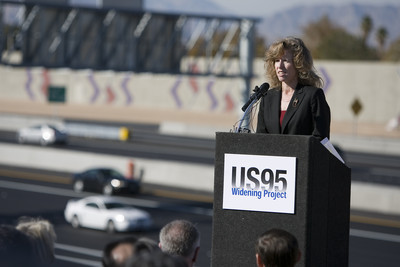


Politicians and dignitaries celebrated Monday the completion of the most expensive project in the history of the Nevada Department of Transportation: the widening of U.S. Highway 95.
Most speeches given about the project sounded more like part of a post-game press conference by elated college basketball coaches, with lots of references to teamwork and leadership.
But Susan Martinovich went out of her way to thank the people who probably have spent the last 10 years cursing the Transportation Department, of which she is the director.
"First, I'd like to thank the general public," Martinovich said as motorists buzzed by behind her podium on the freshly paved lanes of U.S. 95 at Valley View Boulevard. "Many of these people who drive this (road) every day, lived through this every day, through a variety of different circumstances, and put up with the changes and put up with the construction."
The decade-long project widened U.S. 95 north of the Spaghetti Bowl to the edge of the valley at a cost of about $500 million, with the final construction cones being removed by late November.
But a problem emerged from the unprecedented growth during the widening: U.S. 95 still wasn't wide enough. There is a chokepoint at the Rainbow curve, where northbound U.S. 95 narrows from five lanes to three.
It is a problem state transportation officials became aware of in 2003 and are addressing with the U.S. 95 northwest project, to begin soon. This next widening will be from Washington Avenue north to Kyle Canyon Road and will include reworking several interchanges at a cost of hundreds of millions of dollars.
The U.S. 95 widening also saw the valley's first High Occupancy Vehicle, or HOV, lanes. State officials hope HOV lanes will benefit proposed express-bus service on U.S. 95 and encourage carpooling. Such lanes can be used by vehicles carrying more than one person, as well as by motorcycles and buses regardless of the number of passengers, and are marked by a solid white line and a white diamond.
The widening project took nine months longer than expected because of a lawsuit by the Sierra Club that contended the state did not adequately consider health risks from air pollution. The suit was settled out of court, and state officials think the delay cost taxpayers an extra $20 million from rising construction expenses.
Contact reporter Francis McCabe at fmccabe@reviewjournal.com or (702) 387-2904.


