Report: Horses whipped, shocked in Nevada
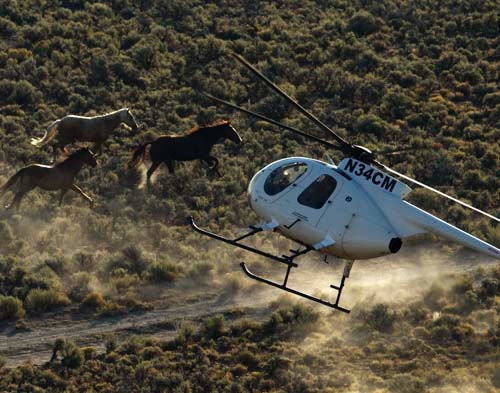
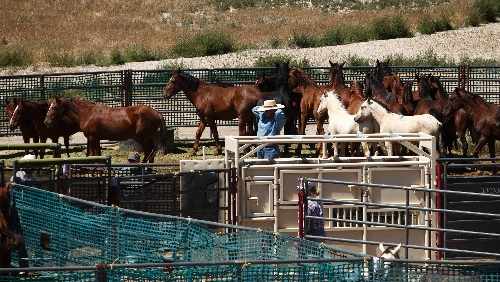





RENO -- The U.S. Bureau of Land Management's internal review of a wild horse roundup in Nevada found some animals were whipped in the face, kicked in the head, dragged by a rope around the neck and repeatedly shocked with electrical prods, but agency officials concluded none of the mistreatment rose to the level of being inhumane.
BLM Director Bob Abbey, however, determined additional training is needed for the workers and contractors involved.
Abbey, the former BLM state director for Nevada, said the roundup this summer near the Utah line was done correctly for the most part. But he said the review cited some incidents of inappropriate practices, including helicopters jeopardizing the health and safety of horses by following too closely or chasing small bands or individual animals for too long.
"Aggressive and rough handling of wild horses is not acceptable, and we are actively taking steps to ensure that such behavior is not repeated," Abbey said in a statement announcing procedures intended to improve and further review the BLM's standard operating procedures for roundups.
In addition to prohibiting helicopters from making contact with horses, Abbey said he would order more training for both the agency workers and contractors involved. The review team also recommended the agency develop a system for tracking a variety of incidents, "from the use of electrical prods, to roping, to injuries or reports of animal welfare concerns."
"The review team believes this will demonstrate that issues like the specific incidents at the Triple B gather are the exception, not the rule," the report said.
Officials for Sun J Livestock in Vernal, Utah, the contractor for the Triple B Roundup between Elko and Ely, did not return messages seeking comment.
Animal rights advocates complain that the roundups are inhumane because some animals are traumatized, injured or killed. Ranchers and other groups say the roundups are needed to protect fragile grazing lands that are used by cattle, bighorn sheep and other wildlife.
Horse protection advocates said they were encouraged by a series of steps Abbey outlined this week to rein in the airborne cowboys and wranglers on the ground who they say don't always act in the horses' best interests.
"This review is a first step in addressing the cruelty that is pervasive in the BLM's wild horse and burro program, and we commend the BLM review team for its honesty," said Suzanne Roy, director of the Americas Wild Horse Preservation Campaign, a coalition of more than 40 groups that includes the American Society for the Prevention of Cruelty to Animals.
But the groups also expressed concern that the BLM didn't find some of the more egregious incidents to be "inhumane" treatment.
"What is their definition of inhumane?" asked Anne Novak, founder of the California-based advocacy group Protect Mustangs.
"They are stepping up to the transgressions and treatments that occurred -- finally fessing up to some major problems," Roy added. "But now, what are they going to do about it? How it translates to an agency-wide policy is the big open question."
The BLM review team was composed of Gus Ward, the BLM's lead wild horse and burro specialist in Utah; Ken Collum, BLM field manager for the Eagle Lake district in California; Steven Hall, BLM communications director for Colorado; and Dr. Owen Henderson, a veterinarian for the USDA's Animal and Plant Health Inspection Service.
The review was prompted by videotapes that animal protection activists shot of treatment at the Triple B roundup in July and August.
Some of the footage shot by the Texas-based Wild Horse Freedom Federation was used to secure an emergency court order from U.S. District Judge Howard McKibben in Reno at the time requiring that helicopters be kept a safe distance from the animals.
Laura Leigh, the federation's vice president, remained skeptical that the issues would be resolved.
"This is just words, not action," said Leigh, who founded Wild Horse Education, an Internet clearinghouse for information on roundups.
"They say, 'We found this wrong, but we did nothing wrong,' which is typical BLM contradictory speech. Nothing has changed," she said.
The review team said it analyzed the footage and acknowledged a "small number of videos indicated incidents that did not rise to the level of inhumane treatment but which the team did determine amounted to poor practices that should be improved."
The incidents included excessive and inappropriate use of electrical prods and wranglers kicking horses, slamming gates against them and twisting their tails to persuade them to load onto trailers.
"Horses were observed being struck in the face and often confused due to aggressive loading procedures and excessive pressure by multiple handlers," the report said. "Several videos reveal that a few horses were repeatedly shocked with an electrical animal prod, sometimes in the face."
The report said animal welfare experts told BLM officials during the investigation that electrical prods should be used only as a last resort when human or animal safety is in jeopardy. They said the prods should never be used on a horse's head.
Deniz Bolbol, a videographer who observed the roundup on behalf of the American Wild Horse Preservation Campaign with funding from the ASPCA, questioned whether the practices were more widespread given that activists captured only a small fraction of the overall gather on videotape.
"Without the video, this report wouldn't have ever been done," said Bolbol, whose own video is cited extensively in the BLM report.
"This is how this Sun J crew worked knowing that observers were videotaping, knowing that BLM personnel were around," she said. "So when there are no observers and no cameras, what is happening?"
U.S. PROGRAM
impossible situation
Forty years after Congress passed a law protecting America's wild horses from harm, the federal program to manage the animals is out of control. The government is holding more wild horses in Midwest pastures and corrals than are roaming the Western states, including Nevada. And it's costing taxpayers tens of millions of dollars a year. A Dec. 18 package of stories in the Las Vegas Review-Journal will examine the Bureau of Land Management's wild horse program and the long-standing conflict between wild horse and burro advocates and ranchers.