



Retirement spurs memories
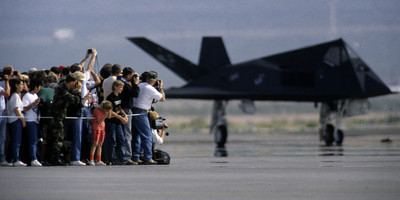


Eighteen years ago when the F-117A Nighthawk made its public debut at Nellis Air Force Base, Bobby Shelton thought he would never see the day they would be retired and put in mothballs.
Now, with the last four planes making their farewell flight Tuesday from where they were made in Palmdale, Calif., back to their first Air Force home at the Tonopah Test Range, he hopes he never sees the day that their wings will be bolted back on and they will fly again on combat missions.
"I would like to think the world conditions never get to that point. But I'm one of those people who never say never," the master sergeant said Thursday, sitting at a picnic table at Nellis' Freedom Park, where one of the black stealth jets that used to be cloaked in secrecy sits atop a pedestal for visitors to see.
"I would like to think that the technology we have today can do what it is designed to do and take care of us," he said.
Shelton remembers the time when he joined the stealth team when the Nighthawk was still a covert program.
He was chosen as an Air Force enlisted man to be the public information officer for the nation's stealth fighter jet unit, the 4450th Tactical Group. His job after he arrived at Nellis in 1989 was to usher in the fleet from the so-called "black world" to the public's eye.
"They took me into a little room and sat me down and showed me a video of this black airplane," he said. "That was the first time I had heard of the organization."
After viewing the film, Shelton wondered, "That thing actually flies? It was the most unique aircraft at that time.
"If you didn't know any better, you would have thought it was some kind of experimental aircraft, which I guess kind of technically it was," he said. "You look at it, you see a lot of straight lines and angles. It was just a breakthrough technology at the time."
In December 1989, he helped put a plan in motion to bring it out to the public.
The Air Force, he said, "had just barely acknowledged the existence of the aircraft on or about Nov. 10, 1989. It was the first fuzzy, black picture that we released. So, yeah, everybody had an idea that something was out there, but nobody had seen it in operation except for maybe people around the Tonopah Test Range and the city of Tonopah."
The challenge faced by Shelton and a cadre of Air Force public affairs specialists out of Washington, D.C., was to decide when the stealths would be trotted out.
The decision was made to bring the planes out the following April. The debut was enormous, with a crowd that rivaled those at the air shows that are held at Nellis every year.
"When it all got said and done, we had approximately 350 media people from around the world (and) there was only going to be two aircraft. ... We had probably 100,000 people at least, not counting the 350 media people," he said.
The pair of stealths flew by, 500 feet off the ground. After they landed and were parked, they were cordoned off to let spectators get within about 25 feet of them. Armed guards were posted.
"We were probably on the flight line for two to three hours just so people could stand around and look at the airplanes," he said. "They were just in awe.
On Aug. 19, 1990, four months after the debut event, the first wave of planes now in the 37th Tactical Fighter Wing headed out for the Persian Gulf War. Transport aircraft carried ground crew and support staff including Shelton.
In mid-January 1991 the call came in for the stealths to attack targets in Baghdad, the Iraqi capital.
Shelton recalled how one pilot described to him the ordeal of flying through anti-aircraft fire.
"If you could imagine a popcorn popper and just trying to take a pencil in your finger and drive it through that popcorn and not get hit, that was what it was like flying ... that first night at Baghdad."
The stealths flew more than 1,200 missions during Desert Shield and Desert Storm and dropped more than 2,000 bombs.
The team returned to Tonopah in March 1991 to a parade. "You could feel the pride of the people of Tonopah," Shelton said.
After all, the town's citizens had a stake in the program from its secret beginnings.
"They took a lot of pride in keeping it secret for the United States Air Force. If it weren't for keeping it secret, it wouldn't have had the success it had," he said.
ON THE WEB Remembering the F-117A Last flight of the StealthRELATED STORIES Flying Into History Lockheed built 59 stealth fighters


