Scientists’ trenches hold clues to quakes
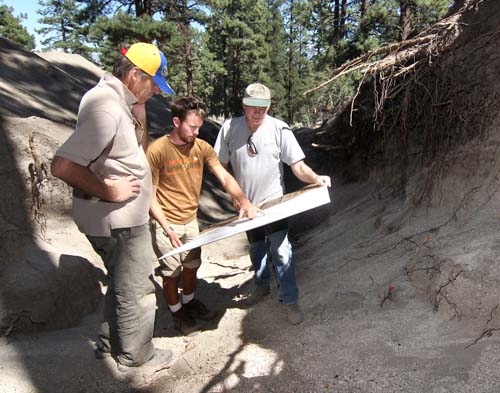
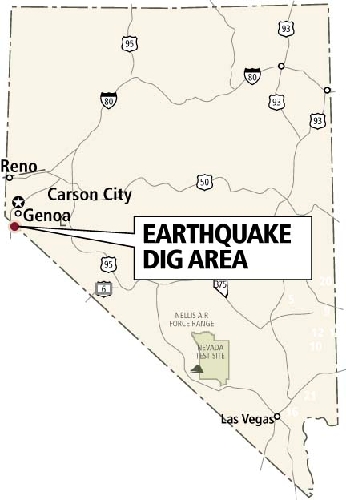


GENOA -- Hikers wandering through the mountains here in the picturesque Carson Range cannot help but be perplexed when they come across two long and deep trenches in the midst of alpine forest just north of the California state line.
For the last few weeks, geoscientists from the Nevada Bureau of Mines and Geology and the Lawrence Livermore National Laboratory have been studying rock fractures and charcoal found in digging the trenches. The fractures were created by earth tremors, and the charcoal is what remains from repeated forest fires over thousands of years.
They want to determine specifically when earthquakes have occurred along the Genoa Fault, the most seismically active fault in the state. The charcoal will be put through carbon-14 dating this fall to better learn the history of earthquakes along the 25-mile fault that runs from Woodfords, Calif., to south of Carson City.
In coming years, they hope what they learn here and improved technology will give at least some advanced warning of earthquakes.
"Earthquakes move at the speed of sound," state geologist Jonathan Price said. "If you had the right instrumentation, you could have a few seconds, maybe 20 seconds, before an earthquake along the Genoa Fault was felt in Carson City or Reno. That would give you time to open doors to fire stations, turn on generators at hospitals, turn off computers, shut off gas lines. It's not far-fetched. The Japanese have it. They slow down bullet trains with real-time warning systems."
In the short run, the information they gain will be useful for contractors and building codes. People planning a school, hospital or fire station could decide if they want to build near a known fault, Price said. If they do, then steps could be taken to reduce the possible destruction from an earthquake.
"It's not a smart idea to build a structure right across a fault," added Price, who also is director of the Nevada Bureau of Mines and Geology.
The Mackay School of Mines building on the University of Nevada, Reno campus is designed so it can move one foot in each direction during an earthquake without suffering major structural damage.
EARTHQUAKE-ACTIVE NEVADA
Nevada is the third most-active state for earthquakes behind Alaska and California.
A highly destructive earthquake of the 7.0 or greater magnitude generally occurs every 30 years in Nevada, but one of 6.0 to 7.0 range occurs each decade.
The largest Clark County earthquake in the last 10 years was one of 3.5 magnitude in 2001. But even in recent days two small tremors were recorded near Indian Springs by the Nevada Seismological Laboratory at UNR.
Las Vegas does not have earthquakes nearly as often as Reno or other parts of Northern Nevada. But a 2002 study found eight faults in Clark County, including one under the Strip. Strong earthquakes, meaning of 6.0 or greater magnitude, are expected to occur in Southern Nevada every 1,000 years to 10,000 years.
The most intriguing find in the Southern Nevada study, done by geoscientists from Lawrence Livermore and Nevada's two universities, was that soils under Las Vegas are subject to liquefaction in an earthquake.
That means big buildings could be toppled as the earth under them turns to liquid.
In a 2009 study, Price and his staff determined that a 6.0 earthquake centered in the Frenchman Mountain Fault in Las Vegas could result in 280 deaths and $7.2 billion in damage.
Based on their study of the Genoa Fault over two decades, geologists have determined that an earthquake of 7.5 magnitude there potentially could kill hundreds of people and cause $2 billion in damage in Northern Nevada cities.
"It is difficult to understand an earthquake unless we understand how frequently a fault moves," added Al Ramelli, principal investigator and research geologist on the Genoa Fault project.
PAST EARTHQUAKES
To give an indication of how big of a tremor that would be, the Aug. 23 earthquake in central Virginia measured just a 5.8 magnitude and still was felt by some people as far away as New York and Boston. Items fell off shelves in stores, unreinforced brick broke off buildings and spires fell from the National Cathedral in Washington, D.C. No deaths were reported.
But the 6.9 Loma Prieta or "World Series" earthquake in Northern California on Oct. 17, 1989, caused 63 deaths and $6 billion in damage.
Although it had few structures in 1932, Las Vegas survived one test from strong ground motion generated from outside the valley during the magnitude 7.2 Cedar Mountain earthquake, which struck Dec. 21 that year near Gabbs, 240 miles northwest of the valley.
The valley was tested again during the 6.2 magnitude Clover Mountain earthquake near Caliente, 120 miles north of Las Vegas, on Sept. 22, 1966; and again during the magnitudes 7.4 and 6.5 Landers, Calif., earthquakes on June 28, 1992, 150 miles southwest of Las Vegas. In California, the twin quakes killed a boy, injured 350 people, destroyed 20 homes and damaged 1,100 more. Ten businesses also were destroyed.
Nevada's largest earthquake in the 21st century was a 6.0 tremor that rocked Wells in Elko County on Feb. 21, 2008. No one was killed but damage exceeded $9 million. The only buildings toppled by the quake were the 100-year-old brick and rock structures, many that had been abandoned. Newer buildings suffered little damage.
But the old buildings included City Hall and the Sheriff's Department.
"We just finished fixing our City Hall," Matt Holford, president of the Wells Chamber of Commerce, said earlier this month . "There was no federal money for help. A lot of the old buildings won't be rebuilt. Every brick chimney in town fell in the earthquake."
SURPRISING FINDS IN GENOA
Dylan Rood, a Lawrence Livermore research scientist, has been surprised by what the research team found this summer at the southern end of the Genoa Fault: signs of four or five major past earthquakes, one 600 years ago and another 2,000 years ago.
Geoscientists had known about the most recent earthquake, but had little evidence of previous earthquakes.
"We are really excited," Rood said. "We found 45 high quality chunks of charcoal. A lot of times when we open a trench we don't find any charcoal."
The trenches are on land overseen by the U.S. Bureau of Land Management and just off the Fay-Luther Trail in Douglas County.
The geoscientists work under a special BLM permit that requires them to return the disturbed area to its previous condition. The 100-foot-long by 8-foot-deep trenches will be covered in the next few days.
Rood will take the charcoal back to his laboratory at Lawrence Livermore. He will use the carbon-14 dating to age past earthquakes in the various rock strata and present his findings at a geophysical conference in San Francisco in December.
The study is being done with the assistance of a $36,000 U.S. Geological Survey grant.
WHAT IS AN EARTHQUAKE?
A fault is a break in earth when one side moves in relation to the other, Price said. When there are sudden and strong movements, earthquakes occur on the faults. Often the earthquakes do not break the surface.
In the Genoa area, that banging of earth forces has caused a displacement, or slip, in rock formations and mountains.
Just south of Genoa is a gravel pit where an earthquake caused more than a 15-foot slip of one side of the fault compared to the other side.
"The more the displacement, the bigger the earthquake," Price said.
There are faults all over Nevada, and they and the earthquakes have created the mountains and valleys of Nevada.
Price said the Earth's crust literally has been pulling against itself for the last 16 million years. Each year Reno moves a couple of inches farther away from Salt Lake City.
"There is no need to panic, or move out of the state," he said. "We will have earthquakes. But the chances of (a big) one happening tomorrow are pretty small. There is a decent chance you may see one in a lifetime."
Review-Journal writer Keith Rogers contributed to this report. Contact Capital Bureau Chief Ed Vogel at evogel@reviewjournal.com or 775-687-3901.