



Sheriff might seek sales tax hike


Faced with policing an ever-expanding metropolis, Clark County Sheriff Doug Gillespie is eyeing changes on two fronts to tackle growth both inside county borders and the county jail.
The sheriff said Tuesday there is a "strong possibility" he will head to Carson City next year and ask the Legislature to approve an additional quarter-cent sales tax to hire more police officers.
The message has changed from a year ago, when the sheriff said the additional tax might not be needed so soon. But sales tax revenue has fallen with the sluggish economy and would not support enough new officers to keep up with growth, he said.
Gillespie credited the more than 250 officers hired under the first phase of the More Cops initiative, which raised the sales tax by a quarter cent, with helping to cut the overall crime rate last year, including drops in homicides, robberies, rapes and traffic deaths. The second phase of the tax will be needed by 2010 to hire enough officers to maintain the crime-fighting successes amid the county's population boom, he said.
"We're making progress," Gillespie said.
He will have an ally in Henderson police Chief Richard Perkins, a former state Assembly speaker, who said he "absolutely" would support the sales tax increase.
With nearly 100 new officers hired under the new tax the past two years, the Henderson Police Department has cut response times and freed officers to spend more time interacting with residents in neighborhoods, he said.
Gillespie said he thinks they will be able to make their case, pointing to the county's growing population and the crime-fighting successes of the first wave of new officers hired under the tax.
But the darkening economic climate could loom over any new tax talk, said Assemblyman Joe Hardy, R-Boulder City, one of 12 state lawmakers to vote against the measure in 2005.
With state budget cutbacks and the housing slump on their minds, Democrats and Republicans alike might be wary of raising taxes of any kind, even those approved by voters, he said.
"I think he's got an uphill battle," Hardy said.
Then-Clark County Sheriff Bill Young led the push for the More Cops advisory question in 2004 and said it was imperative to hire enough new officers to keep up with growth. County voters narrowly approved the question, which called for two quarter-cent increases in the sales tax to pay for an estimated 1,700 new officers among the five police departments in the county.
State lawmakers approved the measure but required local officials to return to Carson City and justify the second phase of the increase, which would add $2.50 to the price of a $1,000 big-screen television and $50 to a $20,000 car.
"I think he can make his case," Hardy said. "I think the key for him will be accountability. What did we get with it? What did he do with it?"
The Metropolitan Police Department, which polices Las Vegas and unincorporated Clark County, has hired 286 officers with the new tax money and hopes to add a total of 450 by October.
Henderson has hired 98 officers. Figures for North Las Vegas were unavailable.
Gillespie said his department plans to hire 600 officers by mid-2009. The first phase of the sales tax will not support more officers, and the second phase would be necessary to continue the hiring pace in early 2010, he said.
He said he is confident he can make his case, especially because voters approved it.
Carole Vilardo, president of the Nevada Taxpayers Association, echoed that thought.
"I prefer we don't keep raising the sales tax," she said. "But it is what it is, and the voters approved it."
Clark County Commissioner Chris Giunchigliani, who supported the increase as an assemblywoman in 2005, said officials at the state and local level must address the consequences of putting more police on the streets.
More police means more arrests, which means more pressure on courts, jails and the rest of the criminal justice system, she said.
"Do we need more police? Absolutely. But do we need to look at the infrastructure to support them? Yes," she said.
When it comes to jail beds, Gillespie is looking for alternatives. His representatives have been in preliminary talks with state Department of Corrections officials about renting the 600-bed prison in Jean, which is slated to close by summer because of state budget cuts.
"As soon as I heard that would be vacated, I jumped on it," said Gillespie, who learned about the closing in mid-January.
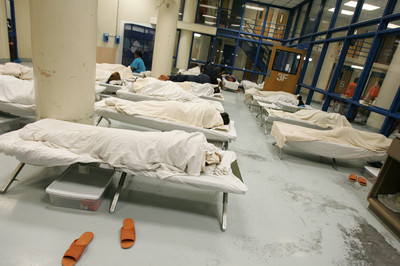
For years, the Clark County Detention Center has been in a state of perpetual overcrowding. The jail in downtown Las Vegas regularly holds 100 to 400 more inmates than its 2,957-bed capacity, forcing the extra inmates to sleep on cots in common areas.
"We've got some room to breathe, but we expect that bubble to burst," Deputy Chief Leroy Kirkegard said.
A county-run, low-level offender jail will not open until late 2009 or early 2010, and Gillespie sees the Jean prison as a short-term solution to bridge that gap. It could provide a long-term solution, as well, at least until the state needs the space back, he said.
Prison officials expect that date to come in 2014, Department of Corrections Director Howard Skolnik said.
Kirkegard and other Metropolitan Police Department officials have toured the Jean site twice and were discussing details such as transportation requirements. They have until July to work out an agreement.
That is when the Department of Corrections expects the roughly 600 prisoners, a mix of teens, men and women, to be moved to other prisons, Skolnik said.
The state could fetch more money if it rented the space to California, but officials decided it was best to help someone in their own backyard, he said.
"We're taking care of someone in our own state," Skolnik said. "It's good for the state. It's good for the county. It's good for the taxpayers. Everybody wins."
Contact reporter Brian Haynes at bhaynes@reviewjournal.com or (702) 383-0281.


