States slash mental health services





DENVER -- At the Ohio Department of Mental Health, Christy Murphy's days are filled with calls from people seeking help she can't seem to give.
They plead with her, but budget cuts have trimmed services so much -- more than $1 billion in the state budget -- that she is not sure where to send them.
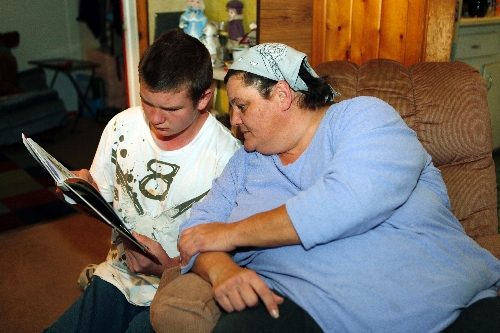
The desperation on the other end of the line hits close to home for Murphy. Her 19-year-old son, Christopher, suffers from a range of mental problems, including one that is linked to a short-tempered, hostile attitude. Although he has coverage through Medicaid, he can't get the services he needs. His mother says he has no psychiatrist, no case manager and no medication.
"I think it's 100 percent about money," said Murphy, who lives in Columbus with her son.
An onslaught of budget cuts has hit mental health services in states struggling to weather economic woes. Even in better times, help could be hard to find. Now, just as demand is soaring, billions of dollars in cuts have shuttered facilities, prolonged waiting times to get services and purged countless patients from the rolls.
In Nevada, Gov. Brian Sandoval has proposed a 12.4 percent reduction in state spending for the Mental Health and Development Services Division, which would receive $617 million over the next two years.
Sandoval plans to cut the number of people receiving outpatient mental health services from 4,075 to 2,765, and to end an autism program that serves 176 children. He wants counties to pick up the $1.5 million costs of mental health courts, which provide counseling and medication to people with mental health concerns who face legal problems. With successful completion of programs, they often are not sent to jail.
State mental health funding was on a steady upward trajectory for three decades until the Great Recession hit in 2007. Over the past two fiscal years, states have cut a combined $1.8 billion from the public mental health system, according to a recent report by the National Alliance for Mental Illness, a group that tracks mental health spending in all 50 states.
Meanwhile, experts see the dueling economic stresses of job losses and home foreclosures escalating depression, anxiety and suicide. Nine state mental health agencies have reported increased emergency room visits for psychiatric care since the recession began, and five more reported higher suicide rates .
The cuts have hit every aspect of state behavioral health systems, which served 6.4 million people nationwide in 2009, according to the most current federal government statistics.
As states face the end of federal stimulus spending, mental health advocates expect the situation to get much worse this year and next.
"I'm begging for help. Begging. And there's no one who can help me," said Sandra Roskilly of Denver, whose 15-year-old son, Gregory, left the Colorado Mental Health Institute at Fort Logan when its children's ward was shuttered last year because of budget cuts.
Roskilly's son has returned home, where his grandmother has moved in to help care for him. But the mother worries the boy is getting worse without residential treatment, sometimes breaking furniture and shoving his grandmother. Sandra Roskilly wonders if he might pose a threat to others without the proper care.
"What's going to happen when he kills somebody?" she recalls asking a doctor.
Mental health advocates often say every dollar cut from their budgets ends up being spent elsewhere, particularly in prisons. Violent crimes involving the mentally ill have raised new questions about the risks of funding cuts.
An Idaho man released from a state mental health program faces felony charges after a shooting last year that wounded a man walking out of a coffee shop. Emergency room nurses from Ohio to Vermont have reported being attacked by patients seeking psychiatric services in recent years.
In Arizona, 22-year-old Jared Loughner caught the attention of staff and administrators at his community college and was told he could not return until he had been evaluated by a mental health professional. There is no indication the man who is charged in the attempted assassination of Rep. Gabrielle Giffords and shot six others to death sought such services.
Arizona Gov. Jan Brewer, whose adult son is mentally ill, took office in January 2009 as an advocate for mental health and persuaded lawmakers to restore
$18 million in proposed midyear budget cuts to social programs, including behavioral health.
But two years later, tough times have led Brewer to call for dropping 280,000 people from Medicaid coverage, including an estimated 5,000 adults with serious mental illnesses. Over the past two years, Arizona cut counseling, case management and nearly all other services except medication for an estimated 14,000 mentally ill patients.
Nationwide, states closed 2,158 beds for mentally ill patients over the past three years, and another 1,772 beds might be closed next year to meet budget cuts, the National Association of State Mental Health Program Directors said.
In Colorado, staffing at state mental health hospitals is so short that the state no longer complies with federal Medicaid and Medicare funding rules, putting some $14 million at risk for next fiscal year.
Colorado lawmakers responded by adding enough money to hire five nurses at two mental-health hospitals. Budget writers said they would have liked to add twice as many nurses, but the money was not available.
"They are so severely understaffed it has become a serious safety issue for patients and caregivers," Colorado state Sen. Mary Hodge said.
Texas ranks near the bottom in per-capita mental health spending, one of nine states that spend $66 or less per person, and officials have proposed cutting an additional $134 million in mental health services in the 2012 and 2013 fiscal years.
Those cuts could mean immediately halting behavioral health services for thousands, though Texas sheriffs have complained the cuts would mean more mentally unstable people ending up in county jails.
Review-Journal Capital Bureau Chief Ed Vogel contributed to this report.