Tonopah’s founding had silver lining
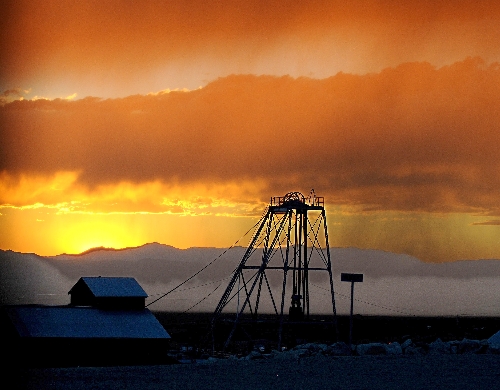


TONOPAH -- A new century was dawning when Jim Butler, rancher and part-time prospector, stumbled on what would become the state's second silver bonanza. The first, of course, was Virginia City.
It was May 19, 1900, when he noticed outcroppings that seemed to contain ore. One assay was disappointing but a later one proved the rocks contained high-grade silver.
In August that year, Butler and his wife returned, staked five claims and named the valley Tonopah.
Tonopah is an Indian word that translates as "greasewood" water or spring. The Northern Paiute name for greasewood is "to-nav" and water is "pa." The Shoshone word for greasewood is "to-nuv." So, the whites combined the two and came up with Tonopah.
In November, Butler returned to his claims with his pals Tasker Oddie, who would one day be governor and a U.S. senator, and Will Brougher. Blasting two tons of rock earned them $500. Soon, he had miners doing the hard work while he reaped the benefits. But within a year, he sold his claims for an astounding $336,000.
The rush to Tonopah was on and soon a town began to grow. Some called it New Belmont, but officially, it was named Butler City after its founder. It was reported there were 650 people. And they were crowded into the 185 tents that covered the hillside.
The tents of Tonopah soon gave way to more sturdy structures and Tonopah was on its way to becoming a modern town.
But that didn't mean the center of the new bonanza was without problems.
Claim jumpers were a constant threat and in 1903, Oddie was able to convince Wyatt Earp, famous for the gunfight at the O.K. Corral in Tombstone, Ariz., to come to Tonopah and work for the Tonopah Mining Company. Earp's reputation preceded him, and it wasn't long before those problems ceased.
Earp would remain in Tonopah for another two years, working occasionally for Oddie, but his main interest was the Northern Saloon, which he owned and ran.
It was during this time that Tonopah faced a race war between the whites and Chinese. Shortly after dark on Sept. 15, 1903, some 50 white men descended on the Chinese section on the west side of town. They stormed into house after house waking the occupants and ordering them to leave town by noon.
Not satisfied by that threat, they returned at midnight, this time beating and kicking the helpless Chinese residents and threatening them with murder. One group marched a group of Chinese outside town where they were savagely beaten. But instead of leaving, the Chinese returned to their homes.
It was the same at the Wing Sing Wash House. Four men stormed the building and killed Ping Lung. Other residents of Tonopah were outraged and called for action.
A total of 18 men, all members of the Tonopah Labor Union, were arrested. Three of them were charged with Lung's murder. But they wouldn't be in jail long.
Even the sheriff, James Cushing, found no good with Chinese and fired two of his deputies who tried to investigate the matter.
A preliminary hearing for the alleged assailants began on Sept. 21. Finally, 600 pages of testimony later on Oct. 9, the hearing was over. The following day charges were dropped against 12 of the men, the judge saying there was insufficient evidence, the identity of the men by their victims notwithstanding. The remaining five, charged with murder and assault, were taken to Belmont but released by a grand jury on Dec. 11.
Thus ended Butler City's race war.
Two years later, in 1905, the town's name was changed to Tonopah.
In 1911, came the Belmont Mine fire that left 17 men dead.
It was a cold winter morning when men arriving to work the day shift noticed a column of smoke pouring from the mine. Assured there was no danger, the men went to work.
But there was a problem. Some men already had sent a distress signal and were taken to the surface. Others fled to safety from connecting tunnels.
But for the 17 left, there was little help. Incredibly, Tonopah had no fire or rescue equipment, so any rescue attempt was futile.
Following a mass funeral for the men, wagons carried the coffins with the dead to a small graveyard at the north end of town.
Volunteers worked through a blizzard to see that all were interred.
Another fire in that mine in 1939 caused it to be closed permanently.
In those early years, the Campbell & Kelly Foundry & Machine Shop opened. It still is in operation today and is run by John Campbell.
The Mizpah Hotel also got its beginnings in the early years of the 20th century. Now after years of being closed, it has just reopened.
Tonopah, on the main route between Reno and Las Vegas, continues to thrive and is home to many stately structures that tell the history of the town.
Sources: "Nevada Ghost Towns and Mining Camps," "Nevada State Journal," and "Nevada Place Names."