



Umpire determined to remain in the game
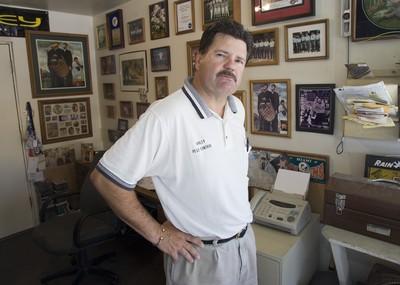


Like many kids who picked up a baseball glove, Joe Burleson had no intention of ever becoming an umpire.
But after realizing how much he loved the game despite not having the talent to play beyond high school, he decided being on the baseball diamond beat being inside a smoke-filled casino the rest of his life.
Burleson left his job as a floorman at the Gold Coast and learned how to call balls and strikes.
That was in 1983. Fast-forward to 2006 and the College World Series in Omaha, Neb.
Burleson worked home plate in the championship game, when Oregon State beat North Carolina, 3-2. No, it wasn't Yankee Stadium or even Tropicana Field in Tampa. But for Burleson, whose came closest to the major leagues when he worked spring training games for the American League in the early 1990s, a sold-out and rabid Rosenblatt Stadium wasn't a bad assignment.
A graduate of Rancho High School, Burleson, who has worked as an umpire for 27 years, spent nearly 10 years trying to make it to the majors.
He attended the umpiring school of former major league official Joe Brinkman, and he befriended big league umpire John McSherry. Both Brinkman and McSherry liked Burleson's demeanor and his ability to call a game. But Burleson got caught in a numbers game and ultimately was on the outside of the profession looking in.
"There were no openings at the time I thought I was ready," Burleson, now 50, says of his attempt to reach the big leagues. "There were five or six guys ahead of me and I'd spent a lot of time trying to get there. In 1993, they told me I wasn't going to make it and I took 1994 off. But it didn't take long for me to miss it, so that's when I decided to go work college ball.
"I gave it my best shot. It was hard to realize I wasn't good enough. But I didn't want to leave the game altogether."
For most guys, working college ball after being so close to making the major leagues would have been tough on the ego. But Burleson has found satisfaction at the college level.
"The major difference is at the pro level you're out there every day and you're with the same guys," Burleson explains. "In college, you're with different guys and there aren't as many games. The coaches and players get excited over the smallest thing because the schedule is so compact and every game means so much."
He also deals with the ping of aluminum bats rather than the sweet sound the ball makes when it connects with wood at the professional level.
"I've become allergic to aluminum," Burleson says with a laugh. "But the ball definitely comes at you quicker (in the field), and I've had some close calls getting out of the way of balls off aluminum."
Dave Yeast, the NCAA's coordinator for baseball officiating, says Burleson made a seamless transition from pro to college.
"Joe stands out for a couple of reasons," Yeast said. "First, it's a passion for him. He's not out there to make an extra $27.50. Second, nobody knows the game better than Joe. He respects the game and he's confident, not arrogant, which is what I want."
Yeast and Burleson worked together on the field during the 1999 NCAA Regionals at Florida State. The two quickly became friends and Burleson has gone on to work three College World Series, including last year's.
"For guys who come from the professional ranks to our level, it's a culture shock," Yeast says. "We call it 'making the transition.' Joe was smart. He didn't come in with a know-it-all attitude. He listened. He picked people's brains. That's why he has such high respect from everyone in college baseball."
Burleson says good judgment and common sense are more important than knowing every line of the rule book. For him, being in position to make the right call, being consistent and being able to defuse volatile situations are the keys to being a good umpire.
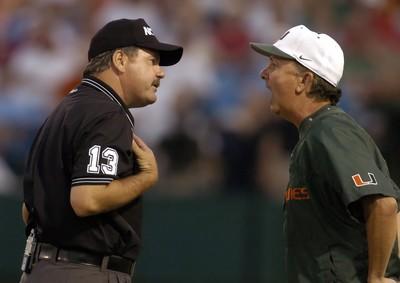
"When a coach comes out, I try to listen," he says. "I keep my mouth shut and let them vent. I try to resolve things quickly and get the game moving."
A lot of times, calling balls and strikes can develop into nasty confrontations. A pitch that was called a strike in the first inning may not be called one in the sixth. And on a hot day, getting extra heat from the dugout is not what any umpire wants.
"It's really simple," Burleson says, ticking off the keys to having a consistent strike zone. "Having good mechanics is essential. You want to be in the slot -- that area right behind the catcher -- and have a good view of the pitch. The other thing is tracking the ball all the way into the catcher's glove."
But Burleson admits he doesn't get all of them right. He will, on occasion, "Kick the call," as umpires refer to a mistake.
"You always want to be right," he says. "Sure, if I kick one, it'll bother me. But I can't let it affect me to the point where I miss the next one. Because then you really have problems."
He recalled a time early in his college umpiring career when UNLV was playing San Diego State and one of the Rebels hit a ball that was slicing down the right-field line. The San Diego State right fielder slid toward the line in an attempt to make the catch and Burleson saw white chalk dust fly.
He put his palms down to indicate safe, meaning the ball was in play and UNLV got a double out of it. Aztecs coach Jim Dietz came charging out of the dugout and argued that the ball was clearly foul. To prove it, he showed Burleson the elbow of his right fielder. It was covered in chalk as he, not the ball, created the cloud. The ball had landed foul by a couple of feet.
"I still remember that one," Burleson says, shaking his head.
In 1996, Burleson started a pest-control business because umpiring college baseball wasn't paying all the bills. But before he squashes bugs full time, Burleson would like to stay in college baseball for another 10 years. If he comes up short, he'll be around to help tutor the next generation of umpires.
"It gets into your blood," he says of being involved in baseball. "I couldn't even stay away for one year without wanting to come back. To me, it's the greatest game there is."


