Bill Raggio: Cutting a wide path
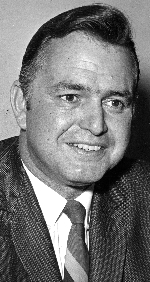





As Bill Raggio prepared to retire Saturday after 38 years as the state Senate's master manipulator and compromiser, the state's pundits waxed nostalgic about his infamous wink-and-a-nod back-room deals as the lion of the Legislature. A few even mentioned that in an earlier incarnation, he spent 18 years in the Washoe County district attorney's office.
So, in keeping with a practice that has become common of late in newspaper obituaries, rather than depicting the wrinkled, wizened visage of a man of 84, we'll show the handsome face from decades long past.
A couple of years ago I ran across a confluence of characters in the form of a fuzzy, fading clip from an April 1965 edition of the Review-Journal. Before Raggio was the colorful, glad-handing senator, he was the colorful, glad-handing DA. That's according to a certain columnist who, as an editorial writer for The Wall Street Journal, himself went on to become the internationally recognized chronicler of supply-side economics who introduced the world to the Laffer Curve, which documented how tax rate cuts could generate windfalls of revenue for governments. It's probably not something on which he and Raggio would agree.
But in 1965, Jude Wanniski was comparing DA Raggio to Hollywood's Sam Spade, recounting his bawdy humor and brash heroics.
"He knows everyone's name," Wanniski writes of a Raggio visit to the Sands Hotel, "and razzes them all, asks the bellhops if they're 'men enough to carry that blonde out of my room,' rushes up to the showroom Maitre d' Nick Kelly at five minutes to show time and asks if he can seat a party of 20, introduces an owner as 'too cheap to buy a drink,' asks pit bosses 'Which one is the honest dealer?' -- but all so obliviously and light-heartedly tongue in cheek that he leaves behind him nothing but wide grins."
Wanniski noted that Raggio had a portrait of Frank Sinatra in his office, though his friend couldn't swing a gaming license.
Back in Reno, the writer explains the difficulty of sitting and talking with Raggio for any length of time: "In restaurants the cook comes out of the kitchen to say hello to him, on the street truck drivers honk at him, cabbies slow down, yell and wave to him.
"A hotel porter is sifting cigarette butts out of a wall sandbox, Raggio, walking by, hails him: 'Freddie, you find any gold yet?' and the porter turns and grins."
Wanniski describes his subject as wearing a white, belted trench coat with traces of blood earned in the line of duty when Raggio raced to the scene of a shooting outside a girls' dormitory at "the University": "At the scene a young Negro lay in a pool of blood on the street, a rifle by his side, about 30 Negroes standing on the sidewalk screaming and swearing, some of them hysterical with anger."
But, as Wanniski tells it, Raggio marches into the middle of the crowd asking questions, grabbing a rifle away from one youth, shoving the taller and heavier youth to the ground when he tries to reclaim the gun, and single-handedly defuses what could have turned into a riot.
Raggio's wife is later quoted as saying, "Oh, Bill, look you got some more blood on your coat."
Wanniski, who died in 2005 at the age of 69, did not see a lengthy, much-lauded legislative legacy in his subject's future. Rather, he concluded the breezy little column by predicting, "He may not be gubernatorial timber, but Hollywood may want to take a look at him."
Thomas Mitchell is senior opinion editor of the Review-Journal. He may be reached at (702) 383-0261 or via e-mail at tmitchell@reviewjournal.com. Read his blog at lvrj.com/blogs/mitchell.